Health Care Professional Information
Common Name
Prickly fan-flower, Currant bush
Clinical Summary
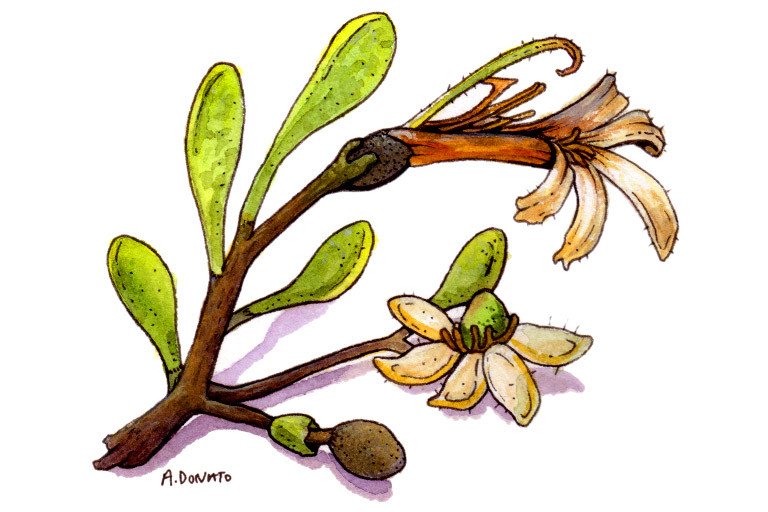
A bushy shrub used in traditional medicine for cold, stomach ailments, and as a diuretic by the Aboriginese people in Australia. Maroon bush extracts demonstrated antibacterial and antiviral properties in vitro (1) (2), without any toxic effects (2). The infusion of the leaves and branches has purported use for cancer leading to heightened interest in using this plant as an alternative cancer treatment.
There are no published scientific studies showing anti-cancer effects of maroon bush in humans.
Purported Uses
- Boils
- Sores
- Ulcers
- Stomach ache
- Diuretic
- Colds
- Cancer
Constituents
- Flavonoids
- Tannins
- Alkaloids
- Anthraquinones
- Polysteroids
- Saponins
- Cardiac glycosides
- Phenolic compounds
- Pentacyclic triterpenoids: 14-taraxerene-3,28-diol (1; myricadiol)
(2) (3)
Consumer Information
How It Works
Bottom Line: Maroon bush has not been studied in humans.
An Australian shrub used in traditional Aboriginal medicine for cold and stomach ailments. Lab studies have shown that maroon bush has antibacterial and antiviral activities, but it is not known if it has anticancer effects in humans.
Purported Uses
- Boils
There is no scientific evidence to support this use.
- Sores
This use is not backed by published data.
- Ulcers
There are no data to confirm this use.
- Stomach ache
This use is not supported by clinical data.
- Colds
Although used in traditional medicine, there are no clinical data to confirm this.
- Cancer
Even though purported to have anticancer effects, there are no scientific data to support this use.
- Diuretic
Maroon bush is used in traditional medicine as a diuretic but there is no evidence to establish this use.
Last updated: May 8, 2013
antibacterial (AN-tee-bak-TEER-ee-ul)
A substance that kills bacteria or stops them from growing and causing disease.
Source: The National Cancer Institute's Dictionary of Cancer Terms
(http://www.cancer.gov/dictionary)
antiviral (AN-tee-VY-rul)
A drug used to treat infections caused by viruses.
Source: The National Cancer Institute's Dictionary of Cancer Terms
(http://www.cancer.gov/dictionary)
cancer (KAN-ser)
A term for diseases in which abnormal cells divide without control and can invade nearby tissues. Cancer cells can also spread to other parts of the body through the blood and lymph systems. There are several main types of cancer. Carcinoma is a cancer that begins in the skin or in tissues that line or cover internal organs. Sarcoma is a cancer that begins in bone, cartilage, fat, muscle, blood vessels, or other connective or supportive tissue. Leukemia is a cancer that starts in blood-forming tissue such as the bone marrow, and causes large numbers of abnormal blood cells to be produced and enter the blood. Lymphoma and multiple myeloma are cancers that begin in the cells of the immune system. Central nervous system cancers are cancers that begin in the tissues of the brain and spinal cord. Also called malignancy.
Source: The National Cancer Institute's Dictionary of Cancer Terms
(http://www.cancer.gov/dictionary)
cardiac (KAR-dee-ak)
Having to do with the heart.
Source: The National Cancer Institute's Dictionary of Cancer Terms
(http://www.cancer.gov/dictionary)
clinical (KLIH-nih-kul)
Having to do with the examination and treatment of patients.
Source: The National Cancer Institute's Dictionary of Cancer Terms
(http://www.cancer.gov/dictionary)
diuretic (DY-yoo-REH-tik)
A drug that increases the production of urine.
Source: The National Cancer Institute's Dictionary of Cancer Terms
(http://www.cancer.gov/dictionary)
infusion (in-FYOO-zhun)
A method of putting fluids, including drugs, into the bloodstream. Also called intravenous infusion.
Source: The National Cancer Institute's Dictionary of Cancer Terms
(http://www.cancer.gov/dictionary)
medicine (MEH-dih-sin)
Refers to the practices and procedures used for the prevention, treatment, or relief of symptoms of a diseases or abnormal conditions. This term may also refer to a legal drug used for the same purpose.
Source: The National Cancer Institute's Dictionary of Cancer Terms
(http://www.cancer.gov/dictionary)
stomach (STUH-muk)
An organ that is part of the digestive system. The stomach helps digest food by mixing it with digestive juices and churning it into a thin liquid.
Source: The National Cancer Institute's Dictionary of Cancer Terms
(http://www.cancer.gov/dictionary)