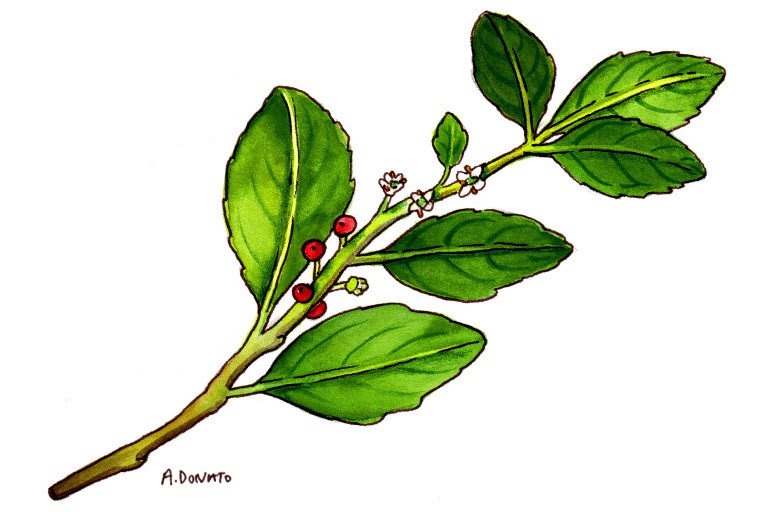
Common Names
- Yerba mate
- St. Bartholomew’s tea
- Jesuit’s tea
- Ilex
- Hervea
- Guyaki Paraguay tea
- Chimarrão
- Cimmaron
For Patients & Caregivers
Tell your healthcare providers about any dietary supplements you’re taking, such as herbs, vitamins, minerals, and natural or home remedies. This will help them manage your care and keep you safe.
Regularly drinking large amounts of mate tea can increase the risk for several types of cancers.
Mate contains compounds that are thought to have stimulant effects. Mate products have been used both for weight loss and cancer prevention.
Some lab studies suggest that mate can stop cancer cell growth, but it has not been shown to prevent or treat cancer in humans.
Drinking large amounts of mate regularly is linked to increased risks of developing prostate, lung, bladder, esophageal, or head and neck cancers.
- To lose weight
Small studies suggest mate may aid weight loss and curb appetite. However, heavy mate drinkers had higher bodyweight in a large population study. - As a stimulant
Because of its caffeine content, mate is a known stimulant. - To treat depression
No scientific evidence supports this use. - To treat headaches
Caffeine may increase the effect of some drugs for headache. - To relieve fatigue
Because of its caffeine content, mate is a known stimulant. However, the increased risk of certain cancers with long-term use likely outweighs any benefits. - To improve bone health
Small studies are mixed on whether mate may have any benefit on bone health. - To promote urination
Mate contains caffeine, which can increase urination. - To prevent cancer
Mate has not been shown to prevent or treat cancer in humans, and drinking large amounts regularly actually increases risks for several types of cancer.
Sleep disruption, palpitations, increased heart rate, stomach upset, restlessness, anxiety
Case reports
- Acute hepatitis: In a 21-year old American man, attributed to regular intake of mate tea once or twice daily for 4 months while visiting Argentina.
- Liver failure: In an adult woman, linked to chronic long-term use of mate.
- Withdrawal syndrome: In a newborn, caused by a mother’s heavy intake of mate.
Patient Warnings:
- High doses and prolonged use of mate tea are linked to increased risk of prostate, bladder, oral, esophageal, lung, and head and neck cancers.
- Heavy alcohol use and/or smoking combined with long-term mate use additionally increases the risk of cancer.
- Due to the caffeine content in mate, the following lab tests may be altered: Blood pressure, catecholamine levels, and bleeding time as measured by PT, PTT, or INR.
Do Not Take if:
- You are pregnant or breastfeeding.
- You are taking chemotherapy drugs: Mate may interfere with the actions of some drugs.
- You are taking heart or blood pressure medications: Mate may increase the effects of these drugs or cause unwanted side-effects.
- You are taking stimulant drugs (eg, Ritalin): Mate may increase the side-effects of these drugs.
- You are taking drugs for depression: Mate may increase the side-effects of these drugs.
For Healthcare Professionals
Mate is a plant native to South America. It is widely consumed as a hot beverage known as chimarrão, and is also used in traditional medicine. Mate is valued for its stimulatory effects and promoted as a dietary supplement for weight loss, cardiovascular diseases, and cancer prevention.
In vitro studies indicate that mate has antioxidant (1) and cardioprotective properties (2). Animal models also suggest antiadipogenic and antilipidemic effects (3) (4).
Studies in humans are limited. One product containing mate delayed gastric emptying in overweight patients (5), and other data in generally healthy women suggest consumption may have short-term effects on caloric intake and appetite regulation (6). However, higher bodyweight has been observed in a large population of heavy mate drinkers (34). Studies on mate for bone health are also mixed (7) (35).
In various cancer models, mate compounds exhibited proteasome (8) and topoisomerase (9) inhibitory properties, as well as anti-inflammatory and apoptotic effects (10) (11). However, no large-scale clinical studies have evaluated safety and efficacy of mate in humans.
Further, epidemiologic data show that chronic mate drinkers are at an increased risk of prostate (12), bladder (13) (14) (15), esophageal (16) (17), lung (18), and head and neck cancers (19). This risk appears to be additive when combined with chronic alcohol or tobacco use (20). Evidence also suggests that drinking very hot mate contributes to its carcinogenic effects (33), although consuming large amounts can increase risk regardless of temperature (36).
- Appetite suppression
- Bone health
- Cancer
- Depression
- Fatigue
- Headaches
- Promote urination
- Stimulant
- Weight loss
In vitro studies suggest antioxidant and antimicrobial activity of mate may be due to its polyphenolic content (1) (22) (26), while cardioprotective effects occur through the regulation of nitric oxide (2). Caffeine, theophylline, and theobromine are the xanthines in mate largely responsible for its stimulatory effects (21) (22) (23) (24) (25).
In animal models, mate regulates adipogenesis through the Wnt pathway (3), reduces lipid peroxidation, improves endothelial function and LPL and HL activities, and modulates lipogenic gene expression (4). Thermogenic properties are related to enhanced expression of uncoupling proteins, while increased fatty acid oxidation is linked to AMPK phosphorylation in visceral adipose tissue (27).
Anticancer activities of mate extract may occur through proteasome (8) and topoisomerase (9) inhibition. It also reduced DNA damage from oxidative stress (1). In human colon cancer cells, saponins and phenolics in mate demonstrated anti-inflammatory activity and induced apoptosis through caspase activation (10) (11). However, other carcinogenic constituents in mate and high temperatures used for brewing could facilitate their solubility and absorption (19) (25) and thus explain associated increased cancer risks.
Sleep disruption, arrhythmias, increased heart rate, stomach upset, and anxiety in vulnerable subjects (28) (29) (30).
Case reports
Acute hepatitis: In a 21-year old American man, attributed to regular ingestion of mate tea once or twice daily for 4 months while visiting Argentina (37).
Hepatic veno-occlusive disease/liver failure: In an adult woman, linked to the chronic long-term use of mate that contained small amounts of pyrrolizidine alkaloids (32).
Neonatal withdrawal syndrome: In a premature newborn whose mother drank mate during pregnancy. Intermittent irritability remained 24 days later at discharge (31).
Chemotherapy: Due to its antioxidant activity, mate may interfere with some chemotherapy drugs (1).
Stimulant, cardiac, hypertension, or antidepressant drugs: Due to its caffeine content, mate may interact with these drugs, although specific interactions have not been studied.
Due to the caffeine content in mate, the following lab tests may be altered:
- Blood pressure
- Catecholamine levels
- Bleeding time as measured by PT, aPTT, or INR