Health Care Professional Information
Common Name
Yerba mate, St. Bartholomew’s tea, Jesuit’s tea, ilex, hervea, guyaki Paraguay tea
Clinical Summary
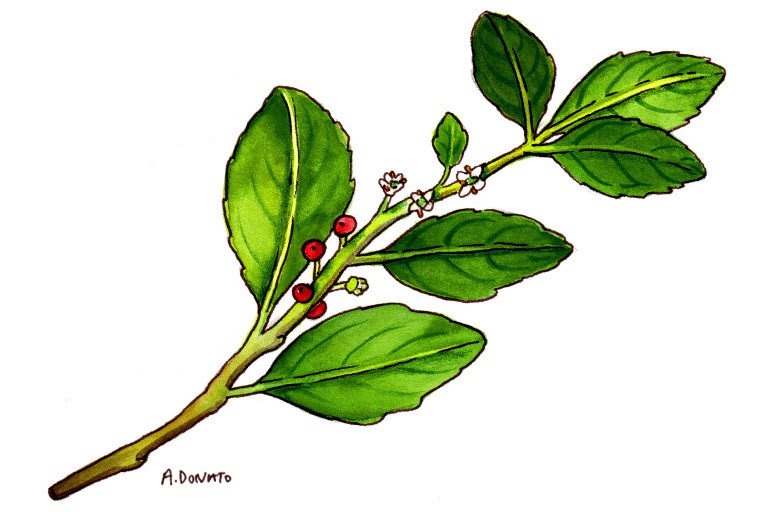
Mate is a plant native to South America. It is consumed in the form of a beverage in a social setting and is also used in traditional medicine. Mate is valued for its stimulatory effects and is promoted as a dietary supplement for weight loss, for cardiovascular diseases, and for cancer prevention.
Mate demonstrated antioxidant activity (11) and cardioprotective effects via regulation of nitric oxide (12) in vitro. In addition, constituents of mate exhibited proteasome (13) and topoisomerase (16) inhibitory properties. But no large scale clinical studies have evaluated its efficacy in humans. Epidemiologic data indicate that chronic mate drinkers are at an increased risk of bladder (1) (2) (3), esophageal (4) (18), lung (5), and head and neck cancers (9).
Frequently reported adverse effects include insomnia, restlessness, agitation, nausea, vomiting, and headache (6). Yerba mate may interact with prescription medications. Due to its antioxidant activity, mate may interfere with some chemotherapy drugs.
Constituents
- Xanthene alkaloids: 1-2% caffeine, 0.45-0.9% theobromine, 0.05% theophylline
- Tannins: 4-16% caffeic and chlorogenic acids
- Amines: Choline and trigonelline
- Amino acids
- Flavonoids: Kaemferol, quercetin, and rutin · Volatile Oils
- Other constituents: Ursolic acid (antitumor agent), vitamins B2, B6, C, niacin, pantothenic acid
(8)
Mechanism of Action
Mate's stimulant effects are due to its caffeine, theophylline, and theobromine components. A product containing Mate was found to delay gastric emptying (10). However, it is unclear if that contributes to mate's weight loss effects. In vitro studies showed that mate has antioxidant activity, (11) which is thought to be due to its polyphenolic content, (17) and exhibits cardioprotective effects via regulation of nitric oxide (12).
Research on anticancer activities demonstrated that mate extract inhibits proteasome (13) and topoisomerase (16). It also reduced DNA damage from oxidative stress (11). However, other studies show mate drinks have high concentration of carcinogenic compounds, such as polycyclic aromatic hydrocarbons (15). In addition, the high temperature of water used to steep mate is thought to facilitate solubility and absorption of these substances (9), which may explain its association with incidence of cancer.
Warnings
High doses and prolonged consumption of mate tea are associated with an increased risk of certain cancers.
Adverse Reactions
Reported: Insomnia, anxiety, tremors, restlessness, agitation, nausea and vomiting, palpitations, and headache.
(6) (14)
Herb-Drug Interactions
Chemotherapy: Due to its antioxidant activity, mate may interfere with some chemo drugs (11).
Herb Lab Interactions
Due to the caffeine content in mate, the following lab tests may be altered:
Dosage (Inside MSKCC Only)
This field is only visible to only Inside MSKCC users.
References
- De Stefani E, Correa P, Fierro L, et al. Black tobacco, mate, and bladder cancer. A case-control study from Uruguay. Cancer. Jan 15 1991;67(2):536-540.
- De Stefani E, Boffetta P, Deneo-Pellegrini H, et al. Non-alcoholic beverages and risk of bladder cancer in Uruguay. BMC Cancer. 2007;7:57.
- Bates MN, Hopenhayn C, Rey OA, et al. Bladder cancer and mate consumption in Argentina: a case-control study. Cancer Lett. Feb 8 2007;246(1-2):268-273.
- Pintos J, Franco EL, Oliveira BV, et al. Mate, coffee, and tea consumption and risk of cancers of the upper aerodigestive tract in southern Brazil. Epidemiology. Nov 1994;5(6):583-590.
- De Stefani E, Fierro L, Correa P, et al. Mate drinking and risk of lung cancer in males: a case-control study from Uruguay. Cancer Epidemiol Biomarkers Prev. Jul 1996;5(7):515-519.
- Schulz V, Rudolf H, Tyler V. Rational Phytotherapy: A Physician's Guide to the Use of Herbs and Related Remedies. 3rd ed. Berlin (Germany): Springer; 1998.
- Brinker F. Herb Contraindications and Drug Interactions. 3rd ed. Sandy (OR): Eclectic Medical Publications; 2001.
- Bisset N. Herbal Drugs and Phytopharmaceuticals. Stuttgart (Germany): CRC Press; 1994.
- Goldenberg D, Lee J, Koch WM, et al. Habitual risk factors for head and neck cancer. Otolaryngol Head Neck Surg. 2004;131(6):989-93.
- Andersen T, Fogh J. Weight loss and delayed gastric emptying following a South American herbal preparation in overweight patients. J Hum Nutr Diet 2001 Jun;14(3):243-50.
- Miranda DD, Arcari DP, Pedrazzoli J Jr, et al. Protective effects of mate tea (Ilex paraguariensis) on H2O2-induced DNA damage and DNA repair in mice. Mutagenesis 2008 Jul;23(4):261-5. Epub 2008 Feb 27.
- Schinella G, Fantinelli JC, Mosca SM. Cardioprotective effects of Ilex paraguariensis extract: evidence for a nitric oxide-dependent mechanism. Clin Nutr 2005 Jun;24(3):360-6.
- Arbiser JL, Li XC, Hossain CF, et al. Naturally occurring proteasome inhibitors from mate tea (Ilex paraguayensis) serve as models for topical proteasome inhibitors. J Invest Dermatol. 2005 Aug;125(2):207-12.
- Martin I, Lopez-Vilchez MA, Mur A, et al. Neonatal withdrawal syndrome after chronic maternal drinking of mate. Ther Drug Monit 2007 Feb;29(1):127-9.
- Kamangar F, Schantz MM, Abnet CC, et al. High levels of carcinogenic polycyclic aromatic hydrocarbons in mate drinks. Cancer Epidemiol Biomarkers Prev. 2008 May;17(5):1262-8.
- Gonzalez de Mejia E, Song YS, Ramirez-Mares MV, Kobayashi H. Effect of yerba mate (Ilex paraguariensis) tea on topoisomerase inhibition and oral carcinoma cell proliferation. J Agric Food Chem. 2005 Mar 23;53(6):1966-73.
- Chandra S, De Mejia Gonzalez E. Polyphenolic compounds, antioxidant capacity, and quinone reductase activity of an aqueous extract of Ardisia compressa in comparison to mate (Ilex paraguariensis) and green (Camellia sinensis) teas. J Agric Food Chem. 2004 Jun 2;52(11):3583-9.
- Szymañska K, Matos E, Hung RJ, et al. Drinking of maté and the risk of cancers of the upper aerodigestive tract in Latin America: a case-control study. Cancer Causes Control. 2010 Nov;21(11):1799-806.
Consumer Information
How It Works
Bottom Line: Regular consumption of mate is associated with increased risk of developing lung, bladder, esophageal, and head and neck cancers.
Mate contains compounds that are thought to have stimulant effects. Mate products have been used for weight loss and for cancer prevention. Laboratory studies suggest that mate has antioxidant effects and inhibitory effects on certain cancer cells. But it has not been shown effective for cancer prevention or as a cancer treatment in humans. Drinking high doses of mate tea can increase the risk of developing certain cancers.
Purported Uses
- To lose weight
There is one small clinical study showing a formula containing mate can help to lose weight and delay stomach emptying. However, it is unclear if mate alone has the same effect.
- As a stimulant
Because of its caffeine content, mate is a known stimulant.
- To treat depression
No scientific evidence supports this use.
- To treat headaches
Caffeine may increase the effect of some medications for headache.
- To relieve fatigue
Because of its caffeine content, mate is a known stimulant. However, the increased risk of certain cancers likely outweighs any benefits.
- To promote urination
Mate contains caffeine, which is a diuretic.
- To treat cancer
Constituents in mate can inhibit certain cancer cells in the lab. But this has not been studied in humans.
Patient Warnings
- High doses and prolonged consumption of mate tea are associated with increased risk of certain cancers (bladder, oral, esophageal, and lung).
- Due to the caffeine content in mate, the following lab tests may be altered: Blood pressure, catecholamine levels, and bleeding time as measured by PT, PTT, or INR.
Do Not Take If
- You are taking chemotherapy drugs (Mate may interfere with the actions of some drugs).
Side Effects
- Headaches
- Insomnia
- Anxiety
- Tremors
- Restlessness and agitation
- Nausea and vomiting
- Palpitations
- One case of liver failure was reported in a heavy mate drinker.
Last updated: September 26, 2012
absorption (ub-SORP-shun)
The process of taking nutrients from the digestive system into the blood so they can be used in the body.
Source: The National Cancer Institute's Dictionary of Cancer Terms
(http://www.cancer.gov/dictionary)
agitation (A-jih-TAY-shun)
A condition in which a person is unable to relax and be still. The person may be very tense and irritable, and become easily annoyed by small things. He or she may be eager to have an argument, and be unwilling to work with caregivers to make the situation better.
Source: The National Cancer Institute's Dictionary of Cancer Terms
(http://www.cancer.gov/dictionary)
antioxidant (AN-tee-OK-sih-dent)
A substance that protects cells from the damage caused by free radicals (unstable molecules made by the process of oxidation during normal metabolism). Free radicals may play a part in cancer, heart disease, stroke, and other diseases of aging. Antioxidants include beta-carotene, lycopene, vitamins A, C, and E, and other natural and manufactured substances.
Source: The National Cancer Institute's Dictionary of Cancer Terms
(http://www.cancer.gov/dictionary)
anxiety (ang-ZY-eh-tee)
Feelings of fear, dread, and uneasiness that may occur as a reaction to stress. A person with anxiety may sweat, feel restless and tense, and have a rapid heart beat. Extreme anxiety that happens often over time may be a sign of an anxiety disorder.
Source: The National Cancer Institute's Dictionary of Cancer Terms
(http://www.cancer.gov/dictionary)
appetite (A-peh-tite)
A desire to satisfy a physical or mental need, such as for food, sex, or adventure.
Source: The National Cancer Institute's Dictionary of Cancer Terms
(http://www.cancer.gov/dictionary)
aromatic (AYR-oh-MA-tik)
Having an odor, which often is pleasant or spicy.
Source: The National Cancer Institute's Dictionary of Cancer Terms
(http://www.cancer.gov/dictionary)
bladder (BLA-der)
The organ that stores urine.
Source: The National Cancer Institute's Dictionary of Cancer Terms
(http://www.cancer.gov/dictionary)
blood (blud)
A tissue with red blood cells, white blood cells, platelets, and other substances suspended in fluid called plasma. Blood takes oxygen and nutrients to the tissues, and carries away wastes.
Source: The National Cancer Institute's Dictionary of Cancer Terms
(http://www.cancer.gov/dictionary)
blood pressure (blud PREH-sher)
The force of circulating blood on the walls of the arteries. Blood pressure is taken using two measurements: systolic (measured when the heart beats, when blood pressure is at its highest) and diastolic (measured between heart beats, when blood pressure is at its lowest). Blood pressure is written with the systolic blood pressure first, followed by the diastolic blood pressure (for example 120/80).
Source: The National Cancer Institute's Dictionary of Cancer Terms
(http://www.cancer.gov/dictionary)
breast (brest)
Glandular organ located on the chest. The breast is made up of connective tissue, fat, and breast tissue that contains the glands that can make milk. Also called mammary gland.
Source: The National Cancer Institute's Dictionary of Cancer Terms
(http://www.cancer.gov/dictionary)
caffeine (ka-FEEN)
A substance found in the leaves and beans of the coffee tree, in tea, yerba mate, guarana berries, and in small amounts in cocoa. It can also be made in the laboratory, and is added to some soft drinks, foods, and medicines. Caffeine increases brain activity, alertness, attention, and energy. It may also increase blood pressure, heart rate, breathing rate, and the loss of water from the body in urine.
Source: The National Cancer Institute's Dictionary of Cancer Terms
(http://www.cancer.gov/dictionary)
cancer (KAN-ser)
A term for diseases in which abnormal cells divide without control and can invade nearby tissues. Cancer cells can also spread to other parts of the body through the blood and lymph systems. There are several main types of cancer. Carcinoma is a cancer that begins in the skin or in tissues that line or cover internal organs. Sarcoma is a cancer that begins in bone, cartilage, fat, muscle, blood vessels, or other connective or supportive tissue. Leukemia is a cancer that starts in blood-forming tissue such as the bone marrow, and causes large numbers of abnormal blood cells to be produced and enter the blood. Lymphoma and multiple myeloma are cancers that begin in the cells of the immune system. Central nervous system cancers are cancers that begin in the tissues of the brain and spinal cord. Also called malignancy.
Source: The National Cancer Institute's Dictionary of Cancer Terms
(http://www.cancer.gov/dictionary)
cardiac (KAR-dee-ak)
Having to do with the heart.
Source: The National Cancer Institute's Dictionary of Cancer Terms
(http://www.cancer.gov/dictionary)
catecholamine (ka-teh-KOH-luh-meen)
A type of neurohormone (a chemical that is made by nerve cells and used to send signals to other cells). Catecholamines are important in stress responses. High levels cause high blood pressure which can lead to headaches, sweating, pounding of the heart, pain in the chest, and anxiety. Examples of catecholamines include dopamine, epinephrine (adrenaline), and norepinephrine (noradrenaline).
Source: The National Cancer Institute's Dictionary of Cancer Terms
(http://www.cancer.gov/dictionary)
central nervous system (SEN-trul NER-vus SIS-tem)
The brain and spinal cord. Also called CNS.
Source: The National Cancer Institute's Dictionary of Cancer Terms
(http://www.cancer.gov/dictionary)
chemotherapy (KEE-moh-THAYR-uh-pee)
Treatment with drugs that kill cancer cells.
Source: The National Cancer Institute's Dictionary of Cancer Terms
(http://www.cancer.gov/dictionary)
chronic (KRAH-nik)
A disease or condition that persists or progresses over a long period of time.
Source: The National Cancer Institute's Dictionary of Cancer Terms
(http://www.cancer.gov/dictionary)
clinical (KLIH-nih-kul)
Having to do with the examination and treatment of patients.
Source: The National Cancer Institute's Dictionary of Cancer Terms
(http://www.cancer.gov/dictionary)
clinical study (KLIH-nih-kul STUH-dee)
A type of research study that tests how well new medical approaches work in people. These studies test new methods of screening, prevention, diagnosis, or treatment of a disease. Also called clinical trial.
Source: The National Cancer Institute's Dictionary of Cancer Terms
(http://www.cancer.gov/dictionary)
concentration (KON-sen-TRAY-shun)
In science, the amount of a substance, such as a salt, that is in a certain amount of tissue or liquid, such as blood. A substance becomes more concentrated when less water is present. For example, the salt in urine may become more concentrated when a person doesn’t drink enough water.
Source: The National Cancer Institute's Dictionary of Cancer Terms
(http://www.cancer.gov/dictionary)
diuretic (DY-yoo-REH-tik)
A drug that increases the production of urine.
Source: The National Cancer Institute's Dictionary of Cancer Terms
(http://www.cancer.gov/dictionary)
DNA
The molecules inside cells that carry genetic information and pass it from one generation to the next. Also called deoxyribonucleic acid.
Source: The National Cancer Institute's Dictionary of Cancer Terms
(http://www.cancer.gov/dictionary)
efficacy (EH-fih-kuh-see)
Effectiveness. In medicine, the ability of an intervention (for example, a drug or surgery) to produce the desired beneficial effect.
Source: The National Cancer Institute's Dictionary of Cancer Terms
(http://www.cancer.gov/dictionary)
esophageal (ee-SAH-fuh-JEE-ul)
Having to do with the esophagus, the muscular tube through which food passes from the throat to the stomach.
Source: The National Cancer Institute's Dictionary of Cancer Terms
(http://www.cancer.gov/dictionary)
extract (EK-strakt)
In medicine, a preparation of a substance obtained from plants, animals, or bacteria and used as a drug or in drugs.
Source: The National Cancer Institute's Dictionary of Cancer Terms
(http://www.cancer.gov/dictionary)
fatigue (fuh-TEEG)
A condition marked by extreme tiredness and inability to function due lack of energy. Fatigue may be acute or chronic.
Source: The National Cancer Institute's Dictionary of Cancer Terms
(http://www.cancer.gov/dictionary)
hypertension (HY-per-TEN-shun)
A blood pressure of 140/90 or higher. Hypertension usually has no symptoms. It can harm the arteries and cause an increase in the risk of stroke, heart attack, kidney failure, and blindness. Also called high blood pressure.
Source: The National Cancer Institute's Dictionary of Cancer Terms
(http://www.cancer.gov/dictionary)
in vitro (in VEE-troh)
In the laboratory (outside the body). The opposite of in vivo (in the body).
Source: The National Cancer Institute's Dictionary of Cancer Terms
(http://www.cancer.gov/dictionary)
incidence (IN-sih-dents)
The number of new cases of a disease diagnosed each year.
Source: The National Cancer Institute's Dictionary of Cancer Terms
(http://www.cancer.gov/dictionary)
insomnia (in-SOM-nee-uh)
Difficulty in going to sleep or getting enough sleep.
Source: The National Cancer Institute's Dictionary of Cancer Terms
(http://www.cancer.gov/dictionary)
L
A measure of volume for a liquid, using the metric system. One L is equal to 1,000 cubic centimeters (cc), 1,000 milliliters (mm), or 1.0567 quarts (qt). Also called liter.
Source: The National Cancer Institute's Dictionary of Cancer Terms
(http://www.cancer.gov/dictionary)
liver (LIH-ver)
A large organ located in the upper abdomen. The liver cleanses the blood and aids in digestion by secreting bile.
Source: The National Cancer Institute's Dictionary of Cancer Terms
(http://www.cancer.gov/dictionary)
lung (lung)
One of a pair of organs in the chest that supplies the body with oxygen, and removes carbon dioxide from the body.
Source: The National Cancer Institute's Dictionary of Cancer Terms
(http://www.cancer.gov/dictionary)
nausea (NAW-zee-uh)
A feeling of sickness or discomfort in the stomach that may come with an urge to vomit. Nausea is a side effect of some types of cancer therapy.
Source: The National Cancer Institute's Dictionary of Cancer Terms
(http://www.cancer.gov/dictionary)
oral (OR-ul)
By or having to do with the mouth.
Source: The National Cancer Institute's Dictionary of Cancer Terms
(http://www.cancer.gov/dictionary)
oxidative stress (OK-sih-DAY-tiv ...)
A condition in which antioxidant levels are lower than normal. Antioxidant levels are usually measured in blood plasma.
Source: The National Cancer Institute's Dictionary of Cancer Terms
(http://www.cancer.gov/dictionary)
oxide (OK-side)
A type of chemical substance that is a combination of oxygen and another substance. Oxides are found in essential oils.
Source: The National Cancer Institute's Dictionary of Cancer Terms
(http://www.cancer.gov/dictionary)
prescription (prih-SKRIP-shun)
A doctor's order for medicine or another intervention.
Source: The National Cancer Institute's Dictionary of Cancer Terms
(http://www.cancer.gov/dictionary)
prevention (pree-VEN-shun)
In medicine, action taken to decrease the chance of getting a disease or condition. For example, cancer prevention includes avoiding risk factors (such as smoking, obesity, lack of exercise, and radiation exposure) and increasing protective factors (such as getting regular physical activity, staying at a healthy weight, and having a healthy diet).
Source: The National Cancer Institute's Dictionary of Cancer Terms
(http://www.cancer.gov/dictionary)
stimulant (STIM-yoo-lunt)
In medicine, a family of drugs used to treat depression, attention-deficit disorder (a common disorder in which children are inattentive, impulsive, and/or over-active), and narcolepsy (a sleep disorder that causes uncontrollable sleepiness). Stimulants increase brain activity, alertness, attention, and energy. They also raise blood pressure and increase heart rate and breathing rate.
Source: The National Cancer Institute's Dictionary of Cancer Terms
(http://www.cancer.gov/dictionary)
stomach (STUH-muk)
An organ that is part of the digestive system. The stomach helps digest food by mixing it with digestive juices and churning it into a thin liquid.
Source: The National Cancer Institute's Dictionary of Cancer Terms
(http://www.cancer.gov/dictionary)