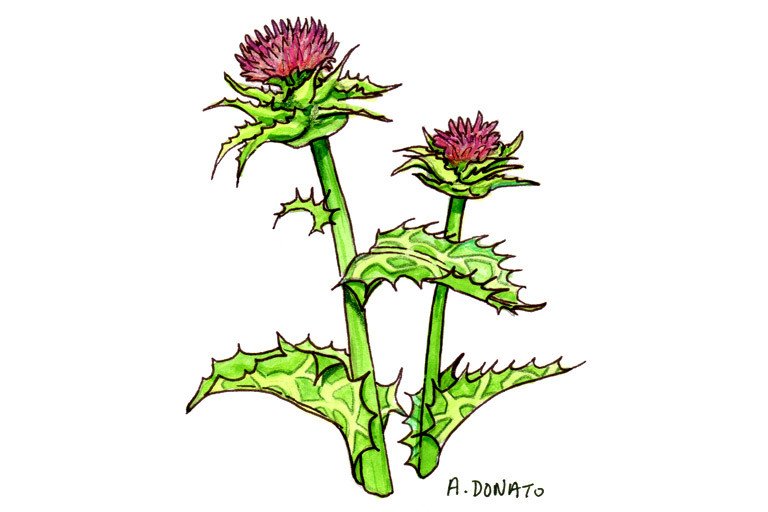
Common Names
- Holy thistle
- Lady's thistle
- Mary thistle
- Marian thistle
For Patients & Caregivers
Tell your healthcare providers about any dietary supplements you’re taking, such as herbs, vitamins, minerals, and natural or home remedies. This will help them manage your care and keep you safe.
Milk thistle is an herb related to the daisy and ragweed family. It is used in traditional medicine to treat liver issues. It comes in supplements as capsules, softgels, tablets, and liquid extracts.
Milk thistle is used to:
- Treat liver damage caused by drinking a lot of alcohol.
- Treat hepatitis (swelling of the liver).
- Treat liver damage caused by some medications.
Milk thistle has other uses, but doctors have not studied them to see if they work.
Talk with your healthcare providers before taking milk thistle supplements. Herbal supplements are stronger than the herbs you would use in cooking.
They can also interact with some medications and affect how they work. For more information, read the “What else do I need to know?” section below.
Side effects of using high doses of milk thistle may include:
- Increase in levels of bilirubin (a substance released when your older red blood cells are replaced by newer ones. Normally your liver helps clear this substance). Most people will not have any symptoms.
- Increase in levels of liver enzymes. Most people will not have any symptoms.
- Talk with your healthcare provider if you’re taking sirolimus (Rapamune®). Milk thistle may increase the side effects of this medication.
- Talk with your doctor if you had or plan to have a kidney transplant. Taking milk thistle with sirolimus (Rapamune ®) and nivolumab (Opdivo®) may lead to your body rejecting the donor kidney.
- Talk with your healthcare provider if you’re on Haloperidol (Haldol Decanoate®) or Risperidone (Risperdal M-TAB®, Risperdal Consta®, Risperdal®). Milk thistle may cause pancreatitis (swelling of pancreas) if you take it with these medications.
- Do not take milk thistle if you’re allergic to plants in the daisy or ragweed family.
For Healthcare Professionals
Derived from the seed, pod, or fruit of milk thistle, the flavolignan silymarin is used primarily to manage various liver diseases. Preclinical studies suggest flavonoids in milk thistle have antioxidant and anticancer effects (7) (8) (12) (16) (17), and may protect against Alzheimer’s disease (23) (24).
Supplementation with milk thistle or silymarin improved lipid profiles and glycemic indices in type 2 diabetic patients (18) (40) and biomarkers related to obesity and its comorbidities (53). It may also be useful against alcoholic liver disease (9), cirrhosis (11) (19), for improving fibrosis associated with nonalcoholic steatohepatitis (39), and for reducing risk of anti tuberculosis drug-induced liver injury (50). However, in both a large survey and a subsequent multi-center trial of patients with chronic hepatitis C, silymarin did not significantly reduce serum ALT levels (41) (42), and despite its association with reduced progression from fibrosis to cirrhosis, had no impact on clinical outcomes (43). Milk thistle was also reported ineffective against trichotillomania (46) but topical use may accelerate wound healing following episiotomy (54) and improve severity of acne (55). Other data suggest it may protect against antibiotic-associated nephrotoxicity (59).
Small studies suggest benefits of milk thistle in reducing chemo-induced hepatotoxicity in children with acute lymphoblastic leukemia (20) and in non-metastatic breast cancer patients (56) (60); chemo-induced peripheral neuropathy (61); and radiation therapy-induced mucositis in those with head and neck cancer (3). Additionally, both oral (62) and topical silymarin (6) may help reduce chemo-induced neuropathy and hand-foot syndrome. Topical use was also reported useful for radiodermatitis in patients with breast cancer (47).
Both silymarin (27) and silibinin (48) have estrogenic effects with greater affinity for estrogen receptor (ER-beta), and activation of ER-beta results in suppression of cell growth.
Silibinin can also exacerbate the negative effects of chronic alcohol consumption on liver cancer (10).
- Cirrhosis
- Hepatitis
- Drug-induced liver damage
Animal models suggest that silymarin confers hepatoprotection via downregulation of extracellular matrix proteins such as collagen (2). It may also be useful against liver carcinogenesis by inhibiting mast cells, a source of matrix metalloproteins that are involved in invasion and angiogenesis (29). In addition, silymarin reduced cisplatin-induced kidney damage in rats without diminishing the drug’s antitumor activity (7), and suppressed formation of amyloid beta-proteins and neurotoxicity in mice (30).
Silibinin, one of the flavonoids, demonstrated antioxidant and anti-inflammatory effects by inhibiting release of hydrogen peroxide and production of tumor necrosis factor alpha (31). Another study showed improvement in endothelial dysfunction via reduction in circulating and vascular asymmetric dimethylarginine (ADMA) levels. ADMA is an endogenous inhibitor of nitric oxide synthase (NOS) and is believed to play a role in endothelial dysfunction, associated with cardiovascular disease (32). Silibinin also inhibits the early phase of hepatitis C viral infection by affecting endosomal trafficking of virions (34).
Other studies indicate milk thistle flavonoids exert anticancer effects by arresting G1 and S phases of the cell cycle (8). Silybin inhibited hepatocellular carcinoma cell growth via the Notch signaling pathway (36). Silibinin suppressed the epidermal growth factor receptor (EGFR)-induced expression of CD44, the transmembrane receptor for hyaluronan implicated in tumor cell invasion and metastasis by inhibiting EGFR activity in breast cancer cells (33). Suggested mechanisms for reduced efficacy of silibinin in liver tumor-bearing animals that were co-administered ethanol include impaired hepatic processing of silibinin (10).
Silybin and isosilybin were shown to strongly inhibit PXR-mediated CYP3A4 induction (35).
High doses of silibinin can elevate bilirubin and liver enzymes (25). Cutaneous reactions including pruritus, rash and urticaria have also been associated with use of milk thistle (63).
Case reports
Intermittent GI symptoms: A patient experienced intermittent episodes of sweating, nausea, vomiting, diarrhea, abdominal pain, weakness, and collapse that resolved after discontinuation of milk thistle supplementation (5).
Severe epistaxis: In a 25-year-old man, possibly due to self-medication with aspirin, garlic, and milk thistle. His symptoms improved following treatment (22).
Allergy involving episodes of itching and burning in the mouth, tongue swelling, difficulty swallowing, feeling of anxiety, and rapid pulse: In a 29-year old, likely due to occupational exposure. His symptoms resolved following appropriate treatment (51).
Bullous pemphigoid characterized by generalized itchy tense blisters and erosions: In a 49-year-old woman with an anxiety disorder with milk thistle use for GI discomfort. Clinical remission was achieved with prednisone and methotrexate (58).
Deep vein thrombosis: In a 41-year-old male with milk thistle use. His symptoms resolved following appropriate treatment and discontinuing milk thistle (64).
- Cytochrome P450 3A4 substrates: Milk thistle inhibits cytochrome P450 3A4 (4) and can affect the intracellular concentration of drugs metabolized by this enzyme. However, conflicting data indicate no such effects (13) (14) (38). In another study, consumption of milk thistle did not reduce levels of indinavir, an AIDS drug (15).
- UGT (Uridine 5’-diphospho-glucuronosyltransferase) substrates: Milk thistle modulates UGT enzymes in vitro and can increase the side effects of drugs metabolized by them (26) (57).
- Sirolimus: Milk thistle may decrease clearance. Monitor therapy especially when combined with nivolumab, which may interfere with the potential to help prevent rejection of donor kidney in transplant patients (44) (45).
- Haloperidol or Risperidone: 7 cases of pancreatitis were reported following concomitant use of milk thistle (49)
- Aripiprazole: A case of hepatotoxicity was reported with combined use of milk thistle (49).
- Warfarin: Concurrent use of a liver cleanse supplement which contained milk thistle led to an increase in INR from 2.64 to 4.12 in a man on warfarin therapy for mitral valve replacement. His INR normalized after stopping the supplement (52).