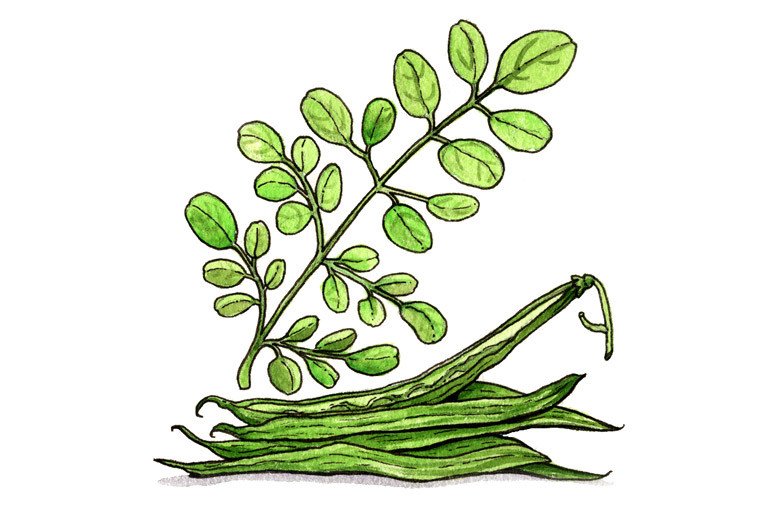
Common Names
- Horseradish tree
- Drumstick tree
- Benzolive tree
- Ben oil tree
For Patients & Caregivers
Tell your healthcare providers about any dietary supplements you’re taking, such as herbs, vitamins, minerals, and natural or home remedies. This will help them manage your care and keep you safe.
Moringa is a small, fast-growing tree. Its leaves, flowers, seeds, and roots are used in traditional medicine to treat different issues.
Moringa leaves and seeds are ground to make a powder. The powder is made into capsules and tablets. You can also mix moringa powder with liquids and drink it.
Moringa is used:
- To treat infections.
- To treat diabetes.
- To lower high cholesterol levels.
Moringa has other uses, but doctors haven’t studied them to see if they work.
It’s generally safe to eat moringa leaves, seeds, and to drink moringa powder mixed with liquids. Talk with your healthcare provider before taking moringa supplements. Herbal supplements are stronger than the herbs you would use in cooking.
Supplements can also interact with some medications and affect how they work. For more information, read the “What else do I need to know?” section below.
Side effects have not been reported.
- Talk with your healthcare provider if you’re pregnant or breastfeeding. Moringa may not be safe for you.
For Healthcare Professionals
Moringa oleifera (MO) is an edible plant native to Asia and Africa that is also cultivated around the world. The leaves and seed pods are nutritious and widely consumed as food while the bark and root are used in folk remedies for their perceived medicinal properties. Products derived from this botanical are used to treat a variety of conditions including asthma, diabetes, ulcers, infections, and cancer. In addition, the plant extracts are used in primitive water filtration systems to remove pollutants and algae (1).
Preclinical studies suggest various properties with MO leaf, seed, and root extracts, including anticancer (3) (4), hepatoprotective (10), hypoglycemic (12) (41), anti-inflammatory (13) (14), antibacterial (18) (19) (42), antifungal (20), antiviral (21), and antisickling (37) effects. Models suggest potential to protect against Alzheimer’s disease (29) and digestive ulcers (24) (43), promote wound healing (30), and lower cholesterol levels (25).
Studies in humans are quite limited. Preliminary findings suggest MO exerts a small positive effect on lipid profiles (38). An MO leaf powder increased insulin secretion in healthy subjects (44), and improved nutritional status and intake of AIDS patients undergoing antiretroviral therapy (45) (51). Systematic reviews determined potential benefits of MO in cardiovascular or metabolic disorders (52) and also cite the need for well-designed studies in diabetic or prediabetic patients (48).
Moringa leaves are eaten in many parts of the tropics where the trees are found.
- Infections
- Diabetes
- High cholesterol
Moringa is a nutritionally rich botanical with a high polyphenol content, including phenolic acids, flavonoids, and glucosinolates (48). In preclinical studies, fiber content of MO leaves mediated quercetin-3-glucoside to improve glucose tolerance (7) (12). Phenolic glycosides from the fruit show anti-inflammatory effects by inhibiting nitric oxide (13). Dipeptide and urea derivatives from MO roots also have anti-inflammatory and antinociceptive effects (14). The ethanolic seed extract produced immunosuppressive and anti-inflammatory effects by inhibiting leukocytes and splenocytes (15) as well as histamine release from mast cells (16).
In an animal model, MO root extract demonstrated protective effects on the liver and kidney in a dose-dependent manner (22). Hepatoprotective effects from acetaminophen toxicity may occur by maintaining glutathione levels (11). MO extract may protect against stomach ulcers by modulating 5-HT3 receptors (24) and lower cholesterol by inhibiting HMG-CoA reductase (25).
Lab experiments suggest an array of other properties in this botanical. A leaf extract exhibited protective effects against Alzheimer’s disease by modulating brain monoamines (29). It also may help promote wound healing by increasing collagen deposits (30). Anticancer effects may occur via apoptosis (3) (4) and NF-kappaB inhibition (5) (46). In an animal model, an MO extract helped prevent chemically-induced tumor formation by increasing glutathione activity (6).
A moringa water extract showed hormone-modulating properties, stimulation of uterine and cervical epithelium metaplasia (26) (27), and antifertility effects (28). In a murine model, MO was genotoxic at supra-supplementation levels of 3,000 mg/kg body weight (39). In a case report of Stevens-Johnson Syndrome linked to ingestion of moringa, pathogenesis may be related to an immunomodulatory effect such as a delayed Th1-mediated hypersensitivity reaction (49).
- Pregnant and breastfeeding women should avoid the use of moringa (50).
Case report
Stevens-Johnson Syndrome: In a 53-year-old man with diabetes and hypertension who was admitted with fever, rash, painful blisters and swallowing difficulties. Onset was approximately 14 hours after consuming food containing moringa leaves. A similar episode occurred 3 months prior after consuming curry containing moringa leaves (49).
Cutaneous toxicity: In a 57-year-old woman with a history of hypertension, dyslipidemia and fibromyalgia after consuming moringa powder for weight loss (53).
Anaphylaxis: In a 50-year-old woman after consuming moringa leaves resulting in widespread angioedema, a respiratory distress, and an elevation of serum tryptase (54).
- Cytochrome P450 substrates, including CYP3A4: In preclinical models, moringa increased the bioavailability of rifampin (34) and inhibited CYP3A4 (35). Clinical relevance has yet to be determined.
- Sitagliptin: In an animal model, chronic co-administration with moringa decreased antihyperglycemic effects of sitagliptin (47). Clinical relevance has yet to be determined.