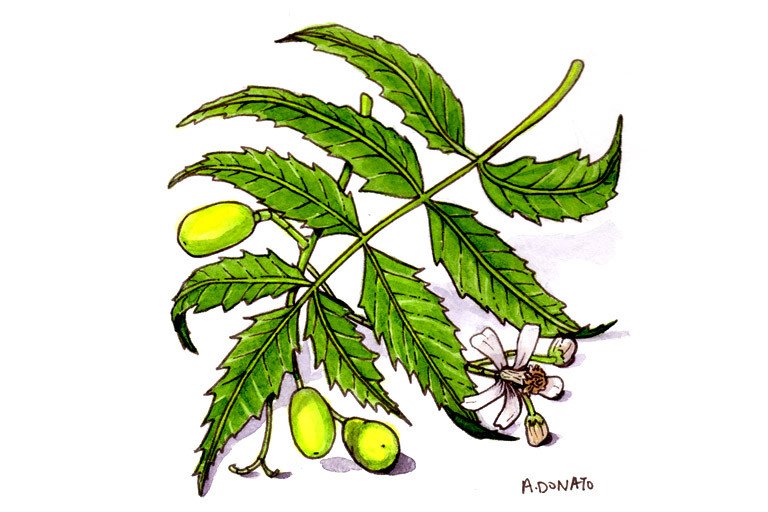
Common Names
- Margosa oil
- Neem oil
For Patients & Caregivers
Tell your healthcare providers about any dietary supplements you’re taking, such as herbs, vitamins, minerals, and natural or home remedies. This will help them manage your care and keep you safe.
Neem has been used in traditional and Ayurvedic medicine, but studies on safety and effectiveness are lacking.
Neem is an herb that is used as food, in traditional medicine for skin conditions, and for stomach ailments. It is also used as a disinfectant against pests and parasites. Some lab studies show that neem extracts have anticancer activities by inhibiting cancer cell growth. However, there are no human studies showing it to be an effective cancer treatment.
Although rare, serious adverse reactions caused by swallowing neem oil have been reported in both children and adults.
- Ulcers
A small study found neem bark extract effective in reducing stomach acid secretion without any adverse effects. More studies are needed in humans. - Cancer
In vitro studies suggest that neem can inhibit cancer cell growth. It has not been studied as a treatment for cancer. - Antiviral
Neem extract increased CD4+ cell count and bodyweight in a small number of HIV+ volunteers. More studies are needed. - Oral hygiene
Neem can reduce oral plaque and bacterial count. It is used as mouth rinse in traditional medicine.
Oral (Rare case reports): Vomiting, drowsiness, diarrhea, vision loss, toxicity to the nervous system, poisoning, seizures, and brain damage from swallowing neem oil.
Topical: Rash; itchy, dry or reddened skin
Patient Warnings:
Swallowing neem oil has caused severe poisoning in both children and adults.
For Healthcare Professionals
Azadirachta indica or neem is a tree prevalent in South Asia. The bark, leaves, flowers, and seeds have been utilized as food and medicine for centuries. In Ayurvedic medicine, neem is used externally for skin conditions, internally for gastrointestinal ailments, and for oral hygiene. Several forms of neem extracts are marketed as dietary supplements.
Neem has antimicrobial activity and is used against a wide range of pests and parasites (1). It is effective against lice (2) and has antiretroviral activity (5). Neem also reduces plaque and decreases oral bacterial counts (3), but data are conflicting (4) (21). Its extracts were found to have anti-secretory and anti-ulcer properties (6), and to improve glycemic control in patients with metabolic syndrome (22). Neem may also be effective in the treatment of cholera and diarrhea (7).
A few studies have examined the anticancer potential of neem. An ethanolic extract of neem leaves reduced the incidence of chemical-induced gastric tumors in mice (9), and neem-treated monocytes induced apoptosis in cervical (10) and prostate cancer cells (11). Neem also showed chemopreventive effects in animal models (12). However, human data are lacking.
Although rare, case reports of poisoning and other severe adverse effects have been associated with the ingestion of neem oil.
- Ulcers
- Cancer
- Infection
- Oral hygiene
The ulcer-healing properties of nimbidin from neem seeds are attributed to the stearic and palmitic acid components (14). Anti-ulcer effects are believed to be via inhibition of the proton pump, H+- K+- ATPase, to control secretion of hydrochloric acid and gastric mucus depletion, and prevent oxidative mucosal damage (6).
Azadirachta in neem has pestical activity due to its growth-regulating properties, reducing levels of the insect hormone ecdysone (14).
Neem induces cell death in prostate cancer cells by decreasing the levels of Bcl-2, an anti-apoptotic protein. Neem-treated monocytes induce apoptosis in cervical cancer cells by increasing levels of caspases 3, 8 and 9, interferon (IFN-gamma), and by decreasing tumor necrosis factor (TNF-alpha) (10). Neem also acts as an antiretroviral agent via inhibition of viral invasion of host cells (5).
Oral
- Vomiting, drowsiness, diarrhea, vision loss, tachypnea with acidotic respiration, polymorphonuclear leukocytosis, encephalopathy, and seizures associated with coma (8) (18) (19) (20).
- Poisoning and neurotoxicity requiring intensive medical care with mechanical ventilation (17).
Topical
- Allergic contact dermatitis (15) (23).
- Acute contact dermatitis: On the scalp and face of a patient following use of neem oil for alopecia (16).
- Drug-Aggravated Bullous Pemphigoid: In a 47-year-old woman following use of neem oil for managing blisters on lower limbs, necessitating conventional treatment (24).
Cytochrome P450 substrates: A neem extract was shown to inhibit CYP 3A4/5, 2C8 and 2C9 enzymes in vitro. Clinical relevance is not known (25).