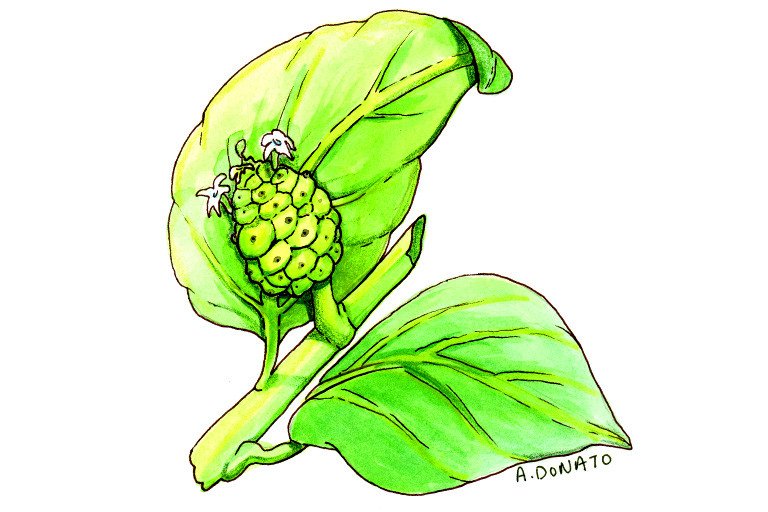
Common Names
- Lada
- Indian mulberry
- Nono
- Hog apple
For Patients & Caregivers
Tell your healthcare providers about any dietary supplements you’re taking, such as herbs, vitamins, minerals, and natural or home remedies. This will help them manage your care and keep you safe.
Noni showed anticancer effects in laboratory studies, but results from human studies are lacking.
The juice of the noni fruit has been traditionally used in Polynesian cultures as an anticancer agent. Scientists have isolated a fraction from noni juice that is rich in complex sugars. This fraction, alone and in conjunction with chemotherapy drugs, is able to increase the survival of laboratory mice that have been implanted with lung cancer. Scientists are unsure exactly how noni exerts this effect, but observe that it enhances certain aspects of the immune system. Furthermore, noni juice acts as an antioxidant and slows the transformation of normal cells to cancer cells in animal studies.
- To treat cancer
Laboratory studies in human cell lines and animals show that noni extracts have anticancer effects both when used alone and with chemotherapy drugs. However, there is no proof from clinical trials that the same effect occurs in humans, although a preliminary study is underway. - To treat diabetes
Although some compounds in noni have antidiabetic properties in the lab, there is no clinical evidence to support this use. In addition, noni fruit is rich in complex sugars and therefore may worsen medical conditions associated with high blood sugar levels. - To lower high blood pressure
No scientific evidence supports this use. - As an immune stimulant
Laboratory studies show that noni juice enhances certain aspects of the immune system, but these results are not always transferable to the human body. There is no proof from clinical trials that these effects occur in humans. - As an analgesic
One study in laboratory mice supports this use, but there is no proof from clinical trials that the same effect occurs in humans.
Case reports
- Kidney failure and dangerously high potassium levels in the blood resulting from noni juice use.
- Liver failure requiring transplants: In a 29-year-old man with prior liver inflammation following ingestion of 1.5 liters of noni juice over 3 weeks and a 56-year-old who regularly consumed noni juice and other products.
- Acute hepatitis: In a 62-year-old woman after consuming 2 liters of noni juice over 3 months. She recovered after stopping noni juice intake.
- Coumadin resistance: In a 41-year-old woman following concurrent intake of noni juice. Symptoms improved after treatment and discontinuation of noni juice.
- Reduced effectiveness of phenytoin: In a 49-year-old man with epilepsy who also ingested noni fruit juice daily. The effectiveness of phenytoin therapy was restored when he stopped his noni juice regimen.
However, a company-sponsored study showed that dose-related adverse effects are minimal in a noni product.
Do Not Take if:
- You have renal insufficiency: Caution is needed because noni juice has high potassium content.
- You have diabetes: Noni juice has high sugar content.
- You are taking potassium-sparing diuretics, angiotensin converting enzyme (ACE) inhibitors, or angiotensin receptor blockers. Noni can have additive effects.
- You are undergoing chemotherapy or radiation therapy: Noni has antioxidant effects and can interfere with treatment. Clinical relevance is not known.
- You are taking blood-thinning medications such as coumadin: Noni juice can reduce their effectiveness.
- You are taking antiepileptic drugs such as phenytoin: Noni juice may reduce its effectiveness.
- You are taking drugs to increase the motility of the stomach and intestine. Noni has similar activity and may affect the absorption of other drugs or increase their adverse effects. Clinical relevance is not known.
- You are taking UGT (Uridine 5’-diphospho-glucuronosyltransferase) substrate drugs: Noni may increase the risk of side effects of these drugs. Clinical relevance is not known.
For Healthcare Professionals
Noni is an evergreen plant found throughout Polynesia. It bears fleshy yellow-white fruit and is used in traditional medicine for wound healing, infections, diarrhea, skin conditions, and as a tonic. It is also cultivated in Hawaii and other Polynesian islands and is marketed worldwide. Fresh or fermented juices are available as drinks while capsules, pills, and powders are sold as dietary supplements.
In preclinical studies noni extracts and its constituents demonstrated antibacterial (32), antifungal (14) (33), anti-inflammatory (34), antidiabetic (35), hepatoprotective (36) (37), prokinetic (38), antitumor (39), and immunomodulatory (3) (7) (8) (17) (18) properties. Noni also inhibited low-density-lipoprotein oxidation and may be useful in preventing arteriosclerosis (15); improved memory in animal models (40); and activated cell-mediated immunity (41). Glycosides, iridoids, and other constituents isolated from noni fruits and leaves exhibited antioxidant properties (12) (13) (42) (43). In addition, noni juice exerted antiangiogenic effects in an ex vivo assay (16); along with altering oxidative stress markers and expression of DNA repair genes in cervical cancer cells (44) (45).
Small clinical studies suggest that noni may help reduce incidence of early postoperative nausea (29), alleviate cigarette smoke-induced dyslipidemia (30), and improve hangover symptoms (51). An extract containing noni, D-mannose, and N-acetylcysteine (NAC) may be useful in the prophylaxis of urinary tract infections associated with urological diagnostic procedures (50). Further research is needed to confirm these effects.
Morinda citrifolia should not be confused with Morinda officinalis, also known as Ba Ji Tian, commonly used in Chinese medicine.
- Cancer treatment
- Diabetes
- Hypertension
- Immunostimulation
- Pain
Glycosides isolated from noni juice inhibit AP-1 transactivation and cell transformation in mouse epidermal JB6 cell lines (2). Antidiabetic characteristics of some noni compounds are attributed to inhibition of the protein tyrosine phosphatase 1B enzyme (35). Anti-inflammatory activity in noni extract was attributed to quercetin (34). In addition, noni juice exhibited antioxidant effects by reducing aromatic DNA adducts (5) (19).
In animal models, an aqueous extract of noni root produced a central analgesic effect that was antagonized by naloxone (6). Hepatoprotective effects occur through regulation of lipid homeostasis, antioxidant status, and anti-inflammatory responses (36) (37). The primary iridoid deacetylasperulosidic acid may exert antioxidant effects by increasing superoxide dismutase activity (42). Scopoletin and rutin in noni may be responsible for antidopaminergic and antiadrenergic effects (46). Scopoletin also stimulates gastrointestinal motility by acting as a 5-HT4 receptor agonist (38). Treatment with noni extract prevented memory impairment through increased brain energy metabolism, cholinergic neurotransmission, brain-derived neurotrophic factor, and antioxidative activity (40).
When combined with suboptimal doses of certain chemotherapy agents, polysaccharides from noni improved survival time and curative effects (4). Apoptotic effects occur via upregulation of p53 and proapoptotic Bax proteins, as well as downregulation of the antiapoptotic Bcl-2, Bcl-XL proteins and survivin. Increase in caspase 9 and 3 was also reported, which suggests involvement of the intrinsic mitochondrial pathway (31). In cervical cancer cell lines, malondialdehyde levels were significantly reduced when treated with noni, alone or in combination with cisplatin alone (44). The antitumor effects of damnacanthal from noni are attributed to its inhibitory effects on the HGF/c-Met axis in human hepatocellular carcinoma cells, with decreases in Akt phosphorylation and matrix metalloproteinase-2 secretion (39). Noni extract induced apoptosis, G1/S phase cell-cycle arrest, and decreased intracellular ROS generation and mitochondrial membrane potential in breast cancer cells (47).
- Patients with renal insufficiency should consume noni juice with caution due to high potassium content (7).
- Patients with diabetes should consume noni juice with caution due to its high sugar content.
Case reports
- Hepatotoxicity, some acute, following consumption of noni juice products (9) (10) (22) (23) (24) (26).
- Acute liver failure requiring a transplant: In a 56-year-old woman without previous liver disease who regularly consumed noni juice and other products, the combination of products was suggested as the probable cause (48).
- Hyperkalemia (7) due to high potassium content.
- Resistance to coumadin: In a 41-year-old woman following concurrent intake of noni juice. Symptoms improved after treatment and discontinuing noni juice (25).
- Reduced effectiveness of phenytoin: In a 49-year-old man with epilepsy treated with phenytoin who also took noni fruit juice daily. Despite medication adherence, sub-therapeutic phenytoin levels persisted resulting in poor seizure control that could be traced to the concurrent ingestion of noni (49).
However, a company-sponsored study suggests that dose-related adverse effects are minimal in a noni product (20).
Chemotherapy or radiation therapy: The antioxidant effects of noni products may decrease the activity of some chemotherapeutic agents (21) or radiation therapy. Clinical relevance is not known.
Coumadin: Noni juice was reported to antagonize the effects of coumadin (25).
Antiepileptic drugs (phenytoin): Noni may reduce effectiveness of these drugs (49).
Potassium-sparing diuretics, angiotensin converting enzyme (ACE) inhibitors, or angiotensin receptor blockers: A case of hyperkalemia was reported in a patient after self-medicating with noni juice (7). Therefore, it can have additive effects with these drugs.
Prokinetic drugs: Noni may have additive effects and may affect the absorption rate of other drugs (38). Clinical relevance is not known.
UGT (Uridine 5’-diphospho-glucuronosyltransferase) substrate drugs: Noni modulates UGT enzymes in vitro and may increase the side effects of drugs metabolized by them (28). Clinical relevance is not known.