Health Care Professional Information
Common Name
Lada, Indian mulberry, nono, och plant, cheese fruit, hog apple, mora de la India, wild pine. Morinda citrifolia should not be confused with Morinda officinalis, also known as Ba Ji Tian, commonly used in Chinese medicine.
Clinical Summary
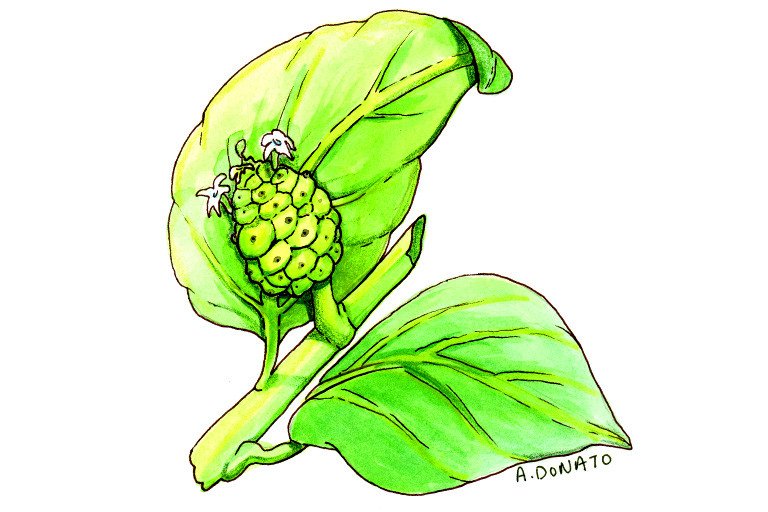
Noni is an evergreen plant found throughout Polynesia. The plant bears fleshy yellowish-white fruit and is used in traditional medicine for wound healing, infections, diarrhea, skin conditions, and as tonic. It is cultivated in Hawaii and other Polynesian islands and is marketed worldwide as Noni. Fresh or fermented juices are available as drinks while capsules, pills and powders are sold as dietary supplements. Over the last two decades, products containing Noni have been heavily promoted for immunostimulation, chronic fatigue syndrome, hypertension, and cancer treatment via network marketing schemes. The FDA issued a warning letter to an Internet distributor of noni juice for presenting misleading claims of health benefits (1).
In vitro and animal studies suggest that the plant extracts have antifungal (14), antitumor and immunomodulatory (3) (7) (8) (17) (18) properties. Noni also inhibits low-density-lipoprotein oxidation and may be useful in preventing arteriosclerosis (15). Glycosides and other constituents isolated from the fruits and leaves have demonstrated antioxidant effects (12) (13). In addition, high concentration (>5%) of noni juice was shown to have anti-angiogenic properties in an ex vivo assay (16).
In human studies, a noni extract was shown to be effective in reducing the incidence of early postoperative nausea (29). Consumption of noni juice alleviated cigarette smoke-induced dyslipidemia (30). A Phase I study of noni in cancer patients has also been completed at the University of Hawaii's Cancer Research Center. The findings are yet to be published (11).
Purported Uses
- Cancer treatment
- Chronic fatigue syndrome
- Diabetes
- Health maintenance
- Hypertension
- Immunostimulation
- Menstrual cramps
- Pain
Constituents
- Acids: Caproic, caprylic
- Anthraquinone: Damnacanthal
- Polysaccharides: Noni-ppt, galactose, arabinose, rhamnose, glucuronic acid
- Glycosides: Rutin, 6-O-(beta-D-glucopyranosyl)-1-O-octanoyl-beta-D-glucopyranose, asperulosidic acid (2)
- Terpenes
- Alkaloids
Mechanism of Action
The aqueous extract of noni roots produced a central analgesic effect that was antagonized by naloxone in Swiss mice (6). When combined with sub-optimal doses of certain chemo agents, polysaccharides from noni improved survival time and curative effects in animal model (4). Glycosides isolated from noni juice inhibited AP-1 transactivation and cell transformation in the mouse epidermal JB6 cell line (2).
In addition, noni juice exhibited antioxidant effects by reducing aromatic DNA adducts (5)(19).
The apoptotic effects of noni are thought to be medicated via up-regulation of p53 and pro-apoptotic Bax proteins, as well as down- regulation of the anti-apoptotic Bcl-2, Bcl-XL proteins and survivin. Increase in caspase 9 and 3 was also reported, which suggests involvement of the intrinsic mitochondrial pathway (31).
Contraindications
- Patients with renal insufficiency should consume noni juice with caution.
- Patients with diabetes should be careful when consuming noni products.
Adverse Reactions
- Several cases of hepatotoxicity, some acute, have been reported following consumption of noni juice products (9) (10) (22) (23) (24) (26).
- Many noni juice products are high in potassium content. Consuming large amounts of these juices may cause hyperkalemia (7) and potentially harmful in patients with compromised renal function.
- A 41-year-old woman developed resistance to Coumadin following concurrent intake of noni juice. Her symptoms improved after treatment and discontinuing noni juice (25).
- Some noni juice products have high sugar content therefore diabetics should use them with caution.
- In addition, the antioxidant effects of noni products may interfere with the actions of chemo drugs and radiation therapy.
- However, a company-sponsored study showed that dose-related adverse effects are minimal in a noni product (20).
Herb-Drug Interactions
- Chemotherapy: Noni juice may decrease the activity of some chemotherapeutic agents (21).
- Coumadin: Noni juice was reported to antagonize the effects of Coumadin (25).
- Cytochrome P450 3A4 substrates: Noni inhibits CYP 3A4 enzyme and can affect the intracellular concentration of drugs metabolized by this enzyme (27).
- UGT (Uridine 5'-diphospho-glucuronosyltransferase) substrates: Noni modulates UGT enzymes in vitro and can increase the side effects of drugs metabolized by them (28).
Dosage (Inside MSKCC Only)
This field is only visible to only Inside MSKCC users.
References
- FDA warning letter. http://www.fda.gov/NewsEvents/Testimony/ucm114985.htm. Accessed June 6,2013.
- Liu G, et al. Two novel glycosides from the fruits of Morinda citrifolia (noni) inhibit AP-1 transactivation and cell transformation in the mouse epidermal JB6 cell line. Cancer Res 2001;61:5749-56.
- Hirazumi A, et al. Immunomodulation contributes to the anticancer activity of Morinda citrifolia (noni) fruit juice. Proc West Pharmacol Soc 1996;39:7-9.
- Hirazumi A, Furusawa E. An immunomodulatory polysaccharide-rich substance from the fruit juice of Morinda citrifolia (noni) with antitumour activity. Phytother Res 1999;13:380-7.
- Wang MY, Su C. Cancer preventative effect of Morinda citrifolia (noni). Ann N Y Acad Sci 2001;952:161-8.
- Younos C, et al. Analgesic and behavioural effects of Morinda citrifolia. Planta Med 1990;56:430-4.
- Mueller BA, et al. Noni juice (Morinda citrifolia): hidden potential for hyperkalemia? Am J Kidney Dis 2000;35:310-2.
- Hirazumi A, et al. Anticancer activity of morinda citrifolia (noni) on intraperitoneally implanted Lewis lung carcinoma in syngeneic mice. Proc West Pharmacol Soc 1994;37:145-6.
- Stadlbauer V, et al. Hepatotoxicity of NONI juice: Report of two cases. World J Gastroenterol. 2005;11(30):4758-60.
- Millionig G, Stadlmann S, Vogel W. Herbal hepatotoxicity: acute hepatitis caused by a Noni preparation (Morinda citrifolia). Eur J Gastroenterol Hepatol. 2005; 17(4):445-7.
- Study of Noni in Cancer Patients. http://www.clinicaltrials.gov/ct2/show/NCT00033878?term=noni&rank=1. Accessed June 6, 2013.
- Su BN, et al. Chemical constituents of the fruits of Morinda citrifolia (Noni) and their antioxidant activity. J Nat Prod 2005 68(4):592-5.
- Sang S, et al. Flavonol glycosides and novel iridoid glycoside from the leaves of Morinda citrifolia. J Agric Food Chem 2001 49(9):4478-81.
- Banerjee S, et al. An Extract of Morinda citrifolia Interferes with the Serum-Induced Formation of Filamentous Structures in Candida albicans and Inhibits Germination of Aspergillus nidulans. Am J Chin Med 2006; 34(3):503-9.
- Kamiya K, et al. Chemical constituents of Morinda citrifolia fruits inhibit copper-induced low-density lipoprotein oxidation. J Agric Food Chem 2004; 52(19): 5843-8.
- Hornick CA, et al. Inhibition of angiogenic initiation and disruption of newly established human vascular networks by juice from Morinda citrifolia (noni). Angiogenesis 2003; 6(2):143-9.
- Arpornsuwan T, Punjanon T. Tumor cell-selective antiproliferative effect of the extract from Morinda citrifolia fruits. Phytother Res 2006; 20(6):515-7.
- Furusawa E, et al. Antitumour potential of a polysaccharide-rich substance from the fruit juice of Morinda citrifolia (Noni) on sarcoma 180 ascites tumour in mice. Phytother Res 2003; 17(10):1158-64.
- Wang MY, Peng L, Lutfiyya MN, et al. Morinda citrifolia (noni) reduces cancer risk in current smokers by decreasing aromatic DNA adducts. Nutr Cancer. 2009;61(5):634-9.
- West BJ, White LD, Jensen CJ, Palu AK. A double-blind clinical safety study of noni fruit juice. Pac Health Dialog. 2009 Nov;15(2):21-32.
- Santiago K, Gaikwad A, Coffer L, et al. Evaluation of the safety and activity of Noni Juice (Morinda citrifolia L.) in combination with chemotherapy in the oncology setting. Abstract presented at the 5th Annual Society of Integrative Oncology Conference, 2008.
- Millonig G, Stadlmann S, Vogel W. Herbal hepatotoxicity: acute hepatitis caused by a Noni preparation (Morinda citrifolia). Eur J Gastroenterol Hepatol. 2005 Apr;17(4):445-7.
- Yuce B, Gulberg V, Diebold J, Gerbes AL. Hepatitis induced by Noni juice from Morinda citrifolia: a rare cause of hepatotoxicity or the tip of the iceberg? Digestion. 2006;73(2-3):167-70.
- Stadlbauer V, Weiss S, Payer F, Stauber RE. Herbal does not at all mean innocuous: the sixth case of hepatotoxicity associated with morinda citrifolia (noni). Am J Gastroenterol. 2008 Sep;103(9):2406-7.
- Carr ME, Klotz J, Bergeron M. Coumadin resistance and the vitamin supplement “Noni”. Am J Hematol. 2004 Sep;77(1):103.
- Yu EL, Sivagnanam M, Ellis L, Huang JS. Acute hepatotoxicity after ingestion of Morinda citrifolia (Noni Berry) juice in a 14-year-old boy. J Pediatr Gastroenterol Nutr. 2011 Feb;52(2):222-4.
- Engdal S, Nilsen OG. In vitro inhibition of CYP3A4 by herbal remedies frequently used by cancer patients. Phytother Res. 2009 Jul;23(7):906-12.
- Mohamed ME, Frye RF. Effects of herbal supplements on drug glucuronidation. Review of clinical, animal, and in vitro studies. Planta Med. 2011 Mar;77(4):311-21.
- Prapaitrakool S, Itharat A. Morinda citrifolia Linn. for prevention of postoperative nausea and vomiting. J Med Assoc Thai. 2010 Dec;93 Suppl 7:S204-9.
- Wang MY, Peng L, Weidenbacher-Hoper V, et al. Noni juice improves serum lipid profiles and other risk markers in cigarette smokers. ScientificWorldJournal. 2012;2012:594657.
- Gupta RK, Banerjee A, Pathak S, Sharma C, Singh N. Induction of mitochondrial-mediated apoptosis by Morinda citrifolia (Noni) in human cervical cancer cells. Asian Pac J Cancer Prev. 2013;14(1):237-42.
Consumer Information
How It Works
Bottom Line: Noni showed anticancer effects in laboratory studies. It is being studied in cancer patients.
The juice of the noni fruit has been traditionally used in Polynesian cultures as an anti-cancer agent. Scientists have isolated a fraction from noni juice that is rich in complex sugars. This fraction, alone and in conjunction with chemotherapy drugs, is able to increase the survival of laboratory mice that have been implanted with lung cancer. Scientists are unsure exactly how noni exerts this effect, but guess that it has an immune-stimulating effect, since it has enhanced certain aspects of the immune system in laboratory studies. Furthermore, noni juice acts as an antioxidant and slows the transformation of normal cells to cancer cells in certain animal laboratory studies.
Purported Uses
- To treat cancer
Laboratory studies in animals show that noni extracts can increase the survival of mice implanted with lung cancer, both when used alone and in conjunction with chemotherapy drugs. There is no proof from clinical trials that the same effect occurs in humans, but a preliminary study is underway.
- To treat chronic fatigue syndrome
No scientific evidence supports this use.
- To treat diabetes
No scientific evidence supports this use. Noni is a fruit that is rich in complex sugars and therefore may worsen high blood sugar levels.
- To lower high blood pressure
No scientific evidence supports this use.
- As an immune stimulant
Laboratory studies show that noni juice enhances certain aspects of the immune system, but these results are not always transferable to the human body. There is no proof from clinical trials that these effects occur in humans.
- To manage menstrual cramps
No scientific evidence supports this use.
- As an analgesic
One study in laboratory mice supports this use, but there is no proof from clinical trials that the same effect occurs in humans.
Research Evidence
A noni extract was shown to be useful in reducing the incidence of nausea following surgery.
A phase I study of noni in cancer patients has been completed at the University of Hawaii. The results are yet to be published.
Do Not Take If
- You have renal insufficiency (noni is high in potassium content).
- You have diabetes (noni juice has high sugar content).
- You are on potassium-sparing diuretics, angiotensin converting enzyme (ACE) inhibitors, and angiotensin receptor blockers.
- You are taking chemo or radiation therapy (Noni has antioxidant effects and can interfere with the treatments).
- You are taking blood thinning medications such as Coumadin (Noni juice can reduce their effectiveness).
- You are taking drugs that are substrates of Cytochrome P450 3A4 (noni may increase the risk of side effects of these drugs).
- You are taking drugs that are substrates of UGT (Uridine 5'-diphospho-glucuronosyltransferase) enzymes (noni may increase the risk of side effects of these drugs).
Side Effects
- Constipation
- In a patient with kidney failure, hyperkalemia (dangerously high potassium levels in the blood) resulted from noni juice use.
- Reported (Oral): According to a recent case study, a 29-year-old male with previous toxic hepatitis developed sub-acute hepatic failure following ingestion of 1.5 L Noni juice over a period of three weeks. He recovered completely after liver transplantation.
- Reported (Oral): A 62-year-old woman developed acute hepatitis after consuming 2 L Noni juice for over three months. She recovered following cessation of Noni juice intake.
- Reported (Oral): A 41-year-old woman developed resistance to Coumadin following concurrent intake of noni juice. Her symptoms improved after treatment and discontinuing noni juice.
However, a company-sponsored study showed that dose-related adverse effects are minimal in a noni product.
Last updated: June 6, 2013
acute (uh-KYOOT)
Symptoms or signs that begin and worsen quickly; not chronic.
Source: The National Cancer Institute's Dictionary of Cancer Terms
(http://www.cancer.gov/dictionary)
animal model (A-nih-mul MAH-dul)
An animal with a disease either the same as or like a disease in humans. Animal models are used to study the development and progression of diseases and to test new treatments before they are given to humans. Animals with transplanted human cancers or other tissues are called xenograft models.
Source: The National Cancer Institute's Dictionary of Cancer Terms
(http://www.cancer.gov/dictionary)
antifungal (AN-tee-FUN-gul)
A drug that treats infections caused by fungi.
Source: The National Cancer Institute's Dictionary of Cancer Terms
(http://www.cancer.gov/dictionary)
antioxidant (AN-tee-OK-sih-dent)
A substance that protects cells from the damage caused by free radicals (unstable molecules made by the process of oxidation during normal metabolism). Free radicals may play a part in cancer, heart disease, stroke, and other diseases of aging. Antioxidants include beta-carotene, lycopene, vitamins A, C, and E, and other natural and manufactured substances.
Source: The National Cancer Institute's Dictionary of Cancer Terms
(http://www.cancer.gov/dictionary)
antitumor (AN-tee-TOO-mer)
Having to do with stopping abnormal cell growth.
Source: The National Cancer Institute's Dictionary of Cancer Terms
(http://www.cancer.gov/dictionary)
aromatic (AYR-oh-MA-tik)
Having an odor, which often is pleasant or spicy.
Source: The National Cancer Institute's Dictionary of Cancer Terms
(http://www.cancer.gov/dictionary)
assay (A-say)
A laboratory test to find and measure the amount of a specific substance.
Source: The National Cancer Institute's Dictionary of Cancer Terms
(http://www.cancer.gov/dictionary)
blood (blud)
A tissue with red blood cells, white blood cells, platelets, and other substances suspended in fluid called plasma. Blood takes oxygen and nutrients to the tissues, and carries away wastes.
Source: The National Cancer Institute's Dictionary of Cancer Terms
(http://www.cancer.gov/dictionary)
cancer (KAN-ser)
A term for diseases in which abnormal cells divide without control and can invade nearby tissues. Cancer cells can also spread to other parts of the body through the blood and lymph systems. There are several main types of cancer. Carcinoma is a cancer that begins in the skin or in tissues that line or cover internal organs. Sarcoma is a cancer that begins in bone, cartilage, fat, muscle, blood vessels, or other connective or supportive tissue. Leukemia is a cancer that starts in blood-forming tissue such as the bone marrow, and causes large numbers of abnormal blood cells to be produced and enter the blood. Lymphoma and multiple myeloma are cancers that begin in the cells of the immune system. Central nervous system cancers are cancers that begin in the tissues of the brain and spinal cord. Also called malignancy.
Source: The National Cancer Institute's Dictionary of Cancer Terms
(http://www.cancer.gov/dictionary)
cell (sel)
The individual unit that makes up the tissues of the body. All living things are made up of one or more cells.
Source: The National Cancer Institute's Dictionary of Cancer Terms
(http://www.cancer.gov/dictionary)
chemotherapy (KEE-moh-THAYR-uh-pee)
Treatment with drugs that kill cancer cells.
Source: The National Cancer Institute's Dictionary of Cancer Terms
(http://www.cancer.gov/dictionary)
chronic (KRAH-nik)
A disease or condition that persists or progresses over a long period of time.
Source: The National Cancer Institute's Dictionary of Cancer Terms
(http://www.cancer.gov/dictionary)
clinical (KLIH-nih-kul)
Having to do with the examination and treatment of patients.
Source: The National Cancer Institute's Dictionary of Cancer Terms
(http://www.cancer.gov/dictionary)
concentration (KON-sen-TRAY-shun)
In science, the amount of a substance, such as a salt, that is in a certain amount of tissue or liquid, such as blood. A substance becomes more concentrated when less water is present. For example, the salt in urine may become more concentrated when a person doesn’t drink enough water.
Source: The National Cancer Institute's Dictionary of Cancer Terms
(http://www.cancer.gov/dictionary)
diabetes (dy-uh-BEE-teez)
Any of several diseases in which the kidneys make a large amount of urine. Diabetes usually refers to diabetes mellitus in which there is also a high level of glucose (a type of sugar) in the blood because the body does not make enough insulin or use it the way it should.
Source: The National Cancer Institute's Dictionary of Cancer Terms
(http://www.cancer.gov/dictionary)
DNA
The molecules inside cells that carry genetic information and pass it from one generation to the next. Also called deoxyribonucleic acid.
Source: The National Cancer Institute's Dictionary of Cancer Terms
(http://www.cancer.gov/dictionary)
enzyme (EN-zime)
A protein that speeds up chemical reactions in the body.
Source: The National Cancer Institute's Dictionary of Cancer Terms
(http://www.cancer.gov/dictionary)
ex vivo (ex VEE-voh)
Outside of the living body. Refers to a medical procedure in which an organ, cells, or tissue are taken from a living body for a treatment or procedure, and then returned to the living body.
Source: The National Cancer Institute's Dictionary of Cancer Terms
(http://www.cancer.gov/dictionary)
extract (EK-strakt)
In medicine, a preparation of a substance obtained from plants, animals, or bacteria and used as a drug or in drugs.
Source: The National Cancer Institute's Dictionary of Cancer Terms
(http://www.cancer.gov/dictionary)
fatigue (fuh-TEEG)
A condition marked by extreme tiredness and inability to function due lack of energy. Fatigue may be acute or chronic.
Source: The National Cancer Institute's Dictionary of Cancer Terms
(http://www.cancer.gov/dictionary)
FDA
An agency in the U.S. federal government whose mission is to protect public health by making sure that food, cosmetics, and nutritional supplements are safe to use and truthfully labeled. The FDA also makes sure that drugs, medical devices, and equipment are safe and effective, and that blood for transfusions and transplant tissue are safe. Also called Food and Drug Administration.
Source: The National Cancer Institute's Dictionary of Cancer Terms
(http://www.cancer.gov/dictionary)
hepatic (heh-PA-tik)
Refers to the liver.
Source: The National Cancer Institute's Dictionary of Cancer Terms
(http://www.cancer.gov/dictionary)
hepatitis (HEH-puh-TY-tis)
Disease of the liver causing inflammation. Symptoms include an enlarged liver, fever, nausea, vomiting, abdominal pain, and dark urine.
Source: The National Cancer Institute's Dictionary of Cancer Terms
(http://www.cancer.gov/dictionary)
immune system (ih-MYOON SIS-tem)
The complex group of organs and cells that defends the body against infections and other diseases.
Source: The National Cancer Institute's Dictionary of Cancer Terms
(http://www.cancer.gov/dictionary)
in vitro (in VEE-troh)
In the laboratory (outside the body). The opposite of in vivo (in the body).
Source: The National Cancer Institute's Dictionary of Cancer Terms
(http://www.cancer.gov/dictionary)
incidence (IN-sih-dents)
The number of new cases of a disease diagnosed each year.
Source: The National Cancer Institute's Dictionary of Cancer Terms
(http://www.cancer.gov/dictionary)
ingestion (in-JES-chun)
Taking into the body by mouth.
Source: The National Cancer Institute's Dictionary of Cancer Terms
(http://www.cancer.gov/dictionary)
intracellular (IN-truh-SEL-yoo-ler)
Inside a cell.
Source: The National Cancer Institute's Dictionary of Cancer Terms
(http://www.cancer.gov/dictionary)
kidney (KID-nee)
One of a pair of organs in the abdomen. Kidneys remove waste from the blood (as urine), produce erythropoietin (a substance that stimulates red blood cell production), and play a role in blood pressure regulation.
Source: The National Cancer Institute's Dictionary of Cancer Terms
(http://www.cancer.gov/dictionary)
L
A measure of volume for a liquid, using the metric system. One L is equal to 1,000 cubic centimeters (cc), 1,000 milliliters (mm), or 1.0567 quarts (qt). Also called liter.
Source: The National Cancer Institute's Dictionary of Cancer Terms
(http://www.cancer.gov/dictionary)
liver (LIH-ver)
A large organ located in the upper abdomen. The liver cleanses the blood and aids in digestion by secreting bile.
Source: The National Cancer Institute's Dictionary of Cancer Terms
(http://www.cancer.gov/dictionary)
lung (lung)
One of a pair of organs in the chest that supplies the body with oxygen, and removes carbon dioxide from the body.
Source: The National Cancer Institute's Dictionary of Cancer Terms
(http://www.cancer.gov/dictionary)
lung cancer (lung KAN-ser)
Cancer that forms in tissues of the lung, usually in the cells lining air passages. The two main types are small cell lung cancer and non-small cell lung cancer. These types are diagnosed based on how the cells look under a microscope.
Source: The National Cancer Institute's Dictionary of Cancer Terms
(http://www.cancer.gov/dictionary)
nausea (NAW-zee-uh)
A feeling of sickness or discomfort in the stomach that may come with an urge to vomit. Nausea is a side effect of some types of cancer therapy.
Source: The National Cancer Institute's Dictionary of Cancer Terms
(http://www.cancer.gov/dictionary)
noni (NOH-nee)
Morinda citrifolia. A tropical shrub. An extract from the fruit is being studied as a treatment for cancer, and extracts from the fruit, leaves, or roots have been used in some cultures to treat other diseases. Also called Morinda citrifolia.
Source: The National Cancer Institute's Dictionary of Cancer Terms
(http://www.cancer.gov/dictionary)
oxidation (OK-sih-DAY-shun)
A chemical reaction that takes place when a substance comes into contact with oxygen or another oxidizing substance. Examples of oxidation are rust and the brown color on a cut apple.
Source: The National Cancer Institute's Dictionary of Cancer Terms
(http://www.cancer.gov/dictionary)
postoperative (post-AH-pruh-tiv)
After surgery.
Source: The National Cancer Institute's Dictionary of Cancer Terms
(http://www.cancer.gov/dictionary)
potassium (puh-TA-see-um)
A metallic element that is important in body functions such as regulation of blood pressure and of water content in cells, transmission of nerve impulses, digestion, muscle contraction, and heartbeat.
Source: The National Cancer Institute's Dictionary of Cancer Terms
(http://www.cancer.gov/dictionary)
radiation (RAY-dee-AY-shun)
Energy released in the form of particle or electromagnetic waves. Common sources of radiation include radon gas, cosmic rays from outer space, medical x-rays, and energy given off by a radioisotope (unstable form of a chemical element that releases radiation as it breaks down and becomes more stable).
Source: The National Cancer Institute's Dictionary of Cancer Terms
(http://www.cancer.gov/dictionary)
radiation therapy (RAY-dee-AY-shun THAYR-uh-pee)
The use of high-energy radiation from x-rays, gamma rays, neutrons, protons, and other sources to kill cancer cells and shrink tumors. Radiation may come from a machine outside the body (external-beam radiation therapy), or it may come from radioactive material placed in the body near cancer cells (internal radiation therapy). Systemic radiation therapy uses a radioactive substance, such as a radiolabeled monoclonal antibody, that travels in the blood to tissues throughout the body. Also called irradiation and radiotherapy.
Source: The National Cancer Institute's Dictionary of Cancer Terms
(http://www.cancer.gov/dictionary)
receptor (reh-SEP-ter)
A molecule inside or on the surface of a cell that binds to a specific substance and causes a specific physiologic effect in the cell.
Source: The National Cancer Institute's Dictionary of Cancer Terms
(http://www.cancer.gov/dictionary)
resistance
Failure of a cancer to shrink after treatment.
Source: The National Cancer Institute's Dictionary of Cancer Terms
(http://www.cancer.gov/dictionary)
surgery (SER-juh-ree)
A procedure to remove or repair a part of the body or to find out whether disease is present. An operation.
Source: The National Cancer Institute's Dictionary of Cancer Terms
(http://www.cancer.gov/dictionary)
therapy (THAYR-uh-pee)
Treatment.
Source: The National Cancer Institute's Dictionary of Cancer Terms
(http://www.cancer.gov/dictionary)
toxic (TOK-sik)
Having to do with poison or something harmful to the body. Toxic substances usually cause unwanted side effects.
Source: The National Cancer Institute's Dictionary of Cancer Terms
(http://www.cancer.gov/dictionary)
transformation (TRANZ-for-MAY-shun)
In medicine, the change that a normal cell undergoes as it becomes malignant.
Source: The National Cancer Institute's Dictionary of Cancer Terms
(http://www.cancer.gov/dictionary)
transplantation (tranz-plan-TAY-shun)
A surgical procedure in which tissue or an organ is transferred from one area of a person’s body to another area, or from one person (the donor) to another person (the recipient).
Source: The National Cancer Institute's Dictionary of Cancer Terms
(http://www.cancer.gov/dictionary)