Health Care Professional Information
Clinical Summary
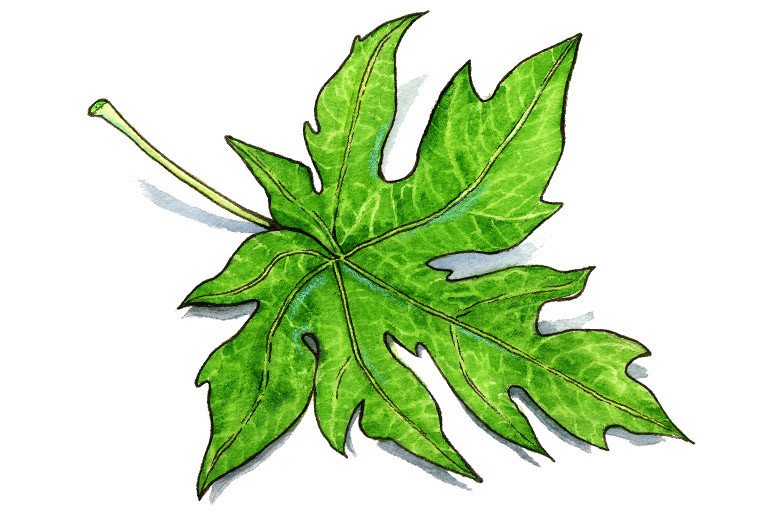
Papaya tree is commonly found in tropical areas around the world. The fruits are consumed as food and as medicine; dried and powdered stem and leaves are used to prepare medicinal teas against infections and to improve digestion. Papaya leaves and their extracts are also marketed as dietary supplements to enhance the immune system, to improve platelet function, and to prevent chemotherapy-related adverse effects.
An in vitro study showed that papaya leaves exhibit anti-tumor and immunomodulatory effects (1). Papaya leaf extracts also contain antibacterial compounds that inhibit the growth of a wide variety of Gram-positive and Gram-negative bacteria (4).
In mice, a powdered suspension of papaya leaves increased thrombocyte count (2) and a water extract reduced alcohol-induced stomach damage (5).
According to a case report, a water extract of papaya leaves was shown to increase the platelet count of a patient with Dengue fever (3).
Papaya leaf extract showed low toxicity (6) in an animal model, but it has not been studied in humans. An international patent has been filed for its use in increasing low platelet counts (7).
Papaya leaf extracts should not be used as a treatment for cancer or for low platelet count until more is known about its efficacy and adverse effects in humans.
Purported Uses
- Antimicrobial
- Improve platelet count
Constituents
Carpaine, malic acid, quinic acid, manghaslin and clitorin, minor quantities of various malic acid derivatives, nicotiflorin, and rutin.(6)
Phenolic compounds: Dimethoxycoumarin, protocatechuic acid, p-coumaric acid, caffeic acid, chlorogenic acid, kaempferol and quercetin. (8)
Mechanism of Action
Papaya leaf extract modulates the immune system by enhancing the production of Th1 type cytokines, such as interleukin (IL-12), interferon (IFN-gamma) and tumor necrosis factor (TNF-alpha). Fractions with molecular weight less of than 1000 are most active in inhibiting tumor cell growth (1). Papaya leaf extract also has antioxidant effects (5) and contains antibacterial compounds, but the mechanism of action remains unclear.
Adverse Reactions
- Papaya leaf extract has not been tested in humans. Animal studies suggest low toxicity (6).
Herb Lab Interactions
- According to a case report, a water extract of papaya leaf increased platelet count (3).
Dosage (Inside MSKCC Only)
This field is only visible to only Inside MSKCC users.
References
- Otsuki N, Dang NH, Kumagai E, et al. Aqueous extract of Carica papaya leaves exhibits anti-tumor activity and immunomodulatory effects. J Ethnopharmacol. Feb 17 2010;127(3):760-767.
- Sathasivam K, Ramanathan S, Mansor SM, et al. Thrombocyte counts in mice after the administration of papaya leaf suspension. Wiener klinische Wochenschrift. Oct 2009;121 Suppl 3:19-22.
- Ahmad N, Fazal H, Ayaz M, et al. Dengue fever treatment with Carica papaya leaves extracts. Asian Pacific Journal of Tropical Biomedicine. 2011:330-333.
- Rahman S, Imran M, Muhammad N, et al. Antibacetial screening of leaves and stem of Carica papaya. Journal of Medicinal Plants Research. 2011; 5(20):5167-5171.
- Indran M, Mahmood AA, Kuppusamy UR. Protective effect of Carica papaya L leaf extract against alcohol induced acute gastric damage and blood oxidative stress in rats. West Indian Med J. Sep 2008;57(4):323-326.
- Afzan A, Abdullah NR, Halim SZ, et al. Repeated Dose 28-Days Oral Toxicity Study of Carica papaya L. Leaf Extract in Sprague Dawley Rats. Molecules. 2012;17(4):4326-4342.
- Alva J. Increasing Low Platelets Instantly. International Publication Number WO 2010041263. World Intellectual Property Organization. 2010.
- Antonella DA, D’Arcangelob G, Tagliatestab P. Gas chromatography–mass spectrometry analysis of phenolic compounds from Carica papaya L. Journal of Food Composition and Analysis. 2007;20:584-590.
Consumer Information
How It Works
Bottom Line: Papaya leaf extract has not been shown to treat or prevent cancer.
Papaya tree is common to many tropical regions of the world. Papaya leaves and their extracts are sold as dietary supplements to improve immune system, platelet counts, and to prevent side effects of chemotherapy. Laboratory and animal studies show that papaya leaf extracts can stop growth of a variety of bacteria, improve platelet count, and reduce stomach damage caused by alcohol. Human studies have not been conducted.
Purported Uses
- Antimicrobial
Lab studies show that papaya leaf extracts can stop the growth of a variety of bacteria.
- Improve platelet count
A papaya leaf extract increased platelet count in a patient with Dengue fever. More studies are needed.
Side Effects
- Papaya leaf extract has not been tested in humans. It showed low toxicity in animal studies.
Special Point
- Papaya leaf extracts should not be used as a treatment for cancer or for low platelet count until more is known about its efficacy and adverse effects in humans.
Last updated: May 8, 2012
acid (A-sid)
A chemical that gives off hydrogen ions in water and forms salts by combining with certain metals. Acids have a sour taste and turn certain dyes red. Some acids made by the body, such as gastric acid, can help organs work the way they should. An example of an acid is hydrochloric acid. Acidity is measured on a scale called the pH scale. On this scale, a value of 7 is neutral, and a pH value of less than 7 to 0 shows increasing acidity.
Source: The National Cancer Institute's Dictionary of Cancer Terms
(http://www.cancer.gov/dictionary)
alcohol (AL-kuh-hol)
A chemical substance found in beer, wine, and liquor, and some medicines, mouthwashes, household products, and essential oils (scented liquid taken from plants). Alcohol contains a carbon atom attached to a hydroxyl group (a molecule made of an oxygen atom and a hydrogen atom).
Source: The National Cancer Institute's Dictionary of Cancer Terms
(http://www.cancer.gov/dictionary)
animal model (A-nih-mul MAH-dul)
An animal with a disease either the same as or like a disease in humans. Animal models are used to study the development and progression of diseases and to test new treatments before they are given to humans. Animals with transplanted human cancers or other tissues are called xenograft models.
Source: The National Cancer Institute's Dictionary of Cancer Terms
(http://www.cancer.gov/dictionary)
antibacterial (AN-tee-bak-TEER-ee-ul)
A substance that kills bacteria or stops them from growing and causing disease.
Source: The National Cancer Institute's Dictionary of Cancer Terms
(http://www.cancer.gov/dictionary)
bacteria (bak-TEER-ee-uh)
A large group of single-cell microorganisms. Some cause infections and disease in animals and humans. The singular of bacteria is bacterium.
Source: The National Cancer Institute's Dictionary of Cancer Terms
(http://www.cancer.gov/dictionary)
cancer (KAN-ser)
A term for diseases in which abnormal cells divide without control and can invade nearby tissues. Cancer cells can also spread to other parts of the body through the blood and lymph systems. There are several main types of cancer. Carcinoma is a cancer that begins in the skin or in tissues that line or cover internal organs. Sarcoma is a cancer that begins in bone, cartilage, fat, muscle, blood vessels, or other connective or supportive tissue. Leukemia is a cancer that starts in blood-forming tissue such as the bone marrow, and causes large numbers of abnormal blood cells to be produced and enter the blood. Lymphoma and multiple myeloma are cancers that begin in the cells of the immune system. Central nervous system cancers are cancers that begin in the tissues of the brain and spinal cord. Also called malignancy.
Source: The National Cancer Institute's Dictionary of Cancer Terms
(http://www.cancer.gov/dictionary)
case report (kays reh-PORT)
A detailed report of the diagnosis, treatment, and follow-up of an individual patient. Case reports also contain some demographic information about the patient (for example, age, gender, ethnic origin).
Source: The National Cancer Institute's Dictionary of Cancer Terms
(http://www.cancer.gov/dictionary)
chemotherapy (KEE-moh-THAYR-uh-pee)
Treatment with drugs that kill cancer cells.
Source: The National Cancer Institute's Dictionary of Cancer Terms
(http://www.cancer.gov/dictionary)
efficacy (EH-fih-kuh-see)
Effectiveness. In medicine, the ability of an intervention (for example, a drug or surgery) to produce the desired beneficial effect.
Source: The National Cancer Institute's Dictionary of Cancer Terms
(http://www.cancer.gov/dictionary)
extract (EK-strakt)
In medicine, a preparation of a substance obtained from plants, animals, or bacteria and used as a drug or in drugs.
Source: The National Cancer Institute's Dictionary of Cancer Terms
(http://www.cancer.gov/dictionary)
fever (FEE-ver)
An increase in body temperature above normal (98.6 degrees F), usually caused by disease.
Source: The National Cancer Institute's Dictionary of Cancer Terms
(http://www.cancer.gov/dictionary)
immune system (ih-MYOON SIS-tem)
The complex group of organs and cells that defends the body against infections and other diseases.
Source: The National Cancer Institute's Dictionary of Cancer Terms
(http://www.cancer.gov/dictionary)
platelet (PLAYT-let)
A tiny piece of a cell found in the blood that breaks off from a large cell found in the bone marrow. Platelets help wounds heal and prevent bleeding by forming blood clots. Also called thrombocyte.
Source: The National Cancer Institute's Dictionary of Cancer Terms
(http://www.cancer.gov/dictionary)
stomach (STUH-muk)
An organ that is part of the digestive system. The stomach helps digest food by mixing it with digestive juices and churning it into a thin liquid.
Source: The National Cancer Institute's Dictionary of Cancer Terms
(http://www.cancer.gov/dictionary)
thrombocyte (THROM-boh-site)
A tiny piece of a cell found in the blood that breaks off from a large cell found in the bone marrow. Thrombocytes help wounds heal and prevent bleeding by forming blood clots. Also called platelet.
Source: The National Cancer Institute's Dictionary of Cancer Terms
(http://www.cancer.gov/dictionary)
toxicity (tok-SIH-sih-tee)
The extent to which something is poisonous or harmful.
Source: The National Cancer Institute's Dictionary of Cancer Terms
(http://www.cancer.gov/dictionary)