Health Care Professional Information
Brand Name
PC SPES® (BotanicLab); Prostate-Res™ (ARC Nutrition)
Clinical Summary
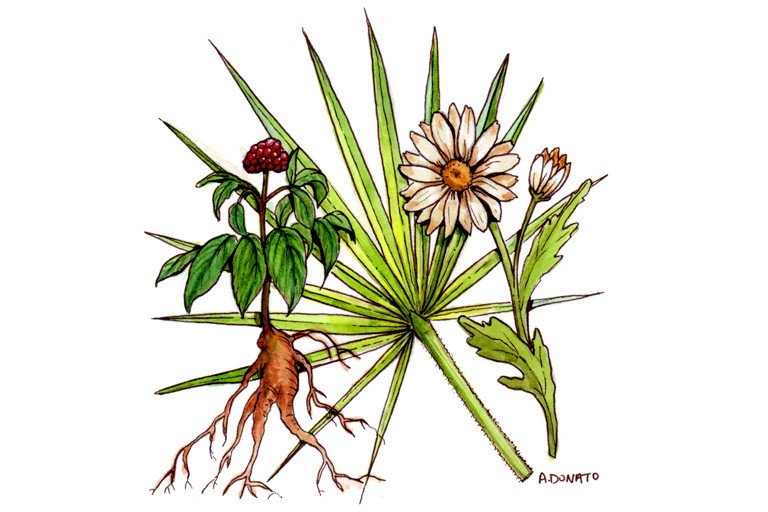
PC-SPES is a supplement consisting of eight herbs: Reishi mushroom, baikal skullcap, rabdosia, dyer's woad, chrysanthemum, saw palmetto, Panax ginseng, and licorice. Patients use it to treat prostate cancer. In vitro testing reveals suppression of human tumor cell lines, including androgen-sensitive and -insensitive prostate cancer (7) (12). It is thought that PC-SPES contains phytoestrogens (17) and other undefined components that contribute to its activity.
Published studies document efficacy of PC-SPES (10) (14) (15) (16); use of PC-SPES resulted in significant decreases in androgen and PSA levels.
Concerns about contamination with DES, warfarin, and alprazolam resulted in a voluntary recall of PC-SPES by Botanic Labs, the manufacturer of PC-SPES in 2002.
Constituents
- Chrysanthemum mori folium, flower (mum, ju hua)
- Ganoderma lucidum, stem (reishi mushroom, ling zhi)
- Glycyrrhiza uralensis, root (licorice, gan cao)
- Isatis indigotica, leaf (dyers woad, da qing ye)
- Panax notoginseng, root (san qi)
- Rabdosia rubescens, leaf (rubescens, dong ling cao)
- Scutellaria baicalensis, root (baikal skullcap, huang qin)
- Serenoa repens, berry (saw palmetto)
(1)
Mechanism of Action
The active components of PC-SPES are unknown. Laboratory analysis of PC-SPES by HPLC, gas chromatography, and mass spectrometry indicate the presence of estrogenic organic compounds different from diethylstilbestrol (DES), estrone, and estradiol. In vitro testing of this extract shows suppressed cell proliferation and reduced clonogenicity in human tumor cell lines, including prostrate, breast, and colon. The predominant cell cycle effect induced by PC-SPES is prolongation of G1 phase; however, apoptosis was observed after exposure of tumor cells to PC-SPES for 48 hours or longer. PC-SPES also inhibits proliferation of LNCaP prostate cell lines, associated with a 60-70% down regulation of the proliferating cell nuclear antigen. Preliminary studies evaluating the viability of prostate cancer cell lines LNCaP, LNCaP apoptosis-resistant derivative, LNCaP-bcl-2, PC3, and DU145 at three concentrations of PC-SPES show inhibited growth at concentrations of 4 mcg/ml or less. Another recent in vitro study indicates its cytotoxicity may be due to alteration of expression of specific genes involved in regulating the cell cycle, cell structure and androgen response. No single botanical or chemical extract appears responsible for the overall effects of this product. PC-SPES has been found to contain small amount of diethylstibestrol and ethinyl estradiol. It is unclear whether these agents account for its anticancer effects.
(2) (3) (4) (5) (6) (7) (12) (13) (14) (16)
Warnings
- Concerns about product contamination with prescription drugs, such as DES, warfarin, and alprazolam resulted in a voluntary recall of PC-SPES by Botanic Labs, the manufacturer of PC-SPES in 2002.
- PC-SPES should not be confused with SPES, an immunostimulant that contains 15 botanicals, sold by BotanicLab. SPES was also recalled in 2002 because of contaminated products.
Adverse Reactions
Common: Mastalgia, gynecomastia, sexual dysfunction, decreased libido, transient GI symptoms, diarrhea, and dyspepsia (8).
Infrequent: Pulmonary embolism, deep vein thrombosis, phlebitis, edema, and allergic reactions (10).
Case report: Retroperitoneal hemorrhage (9)
Literature Summary and Critique
Dosage (Inside MSKCC Only)
This field is only visible to only Inside MSKCC users.
References
- Anon. PC SPES® For Prostate Health: Product information. Brea (CA): BotanicLab; 2000.
- De la Taille A, et al. Effects of a phytotherapeutic agent, PC-SPES, on prostate cancer: a preliminary investigation on human cell lines and patients. BJU Int 1999;84:845-50.
- Tiwari RK, et al. Anti-tumor effects of PC-SPES, an herbal formulation in prostate cancer. Int J Oncol 1999;14:713-9.
- Chenn S. In vitro mechanism of PC SPES. Urology 2001;58:28-35.
- Kubota T, et al. PC-SPES: a unique inhibitor of proliferation of prostate cancer cells in vitro and in vivo. Prostate 2000;42:163-71.
- Hsieh TC, Wu JM. Mechanism of action of herbal supplement PC-SPES: elucidation of effects of individual herbs of PC-SPES on cell proliferation and prostate specific gene expression in androgen-dependent LNCaP cells. Int J Oncol 2002;20:583-8.
- DiPaola R, et al. Clinical and biologic activity of an estrogenic herbal combination (PC-SPES) in prostate cancer. N Engl J Med 1998;339:785-91.
- Pfeifer BL, et al. PC-SPES, a dietary supplement for the treatment of hormone-refractory prostate cancer. BJU Int 2000;85:481-5.
- Weinrobe MC, Montgomery B. Acquired bleeding diathesis in a patient taking PC-SPES. N Engl J Med 2001;345:1213-4.
- Small EJ, et al. Prospective trial of the herbal supplement PC-SPES in patients with progressive prostate cancer. J Clin Oncol 2000;18:3595-603.
- Brinker F. Herb Contraindications and Drug Interactions, 3rd ed. Sandy (OR): Eclectic Medical Publications; 2001.
- Bonham M, et al. Molecular effects of the herbal compound PC-SPES: identification of activity pathways in prostate carcinoma. Cancer Res 2002;62:3920-4.
- Hsu MJ, Lee SS, Lin WW. Polysaccharide purified from Ganoderma lucidum inhibits spontaneous and Fas-mediated apoptosis in human neutrophils through activation of the phosphatidylinositol 3 kinase/Akt signaling pathway. J Leukoc Biol 2002;72:207-16.
- De la Taille A, et al. Herbal therapy PC-SPES: in vitro effects and evaluation of its efficacy in 69 patients with prostate cancer. J Urol 2000;164:1229-34.
- Porterfield H. Survey of UsToo members and other prostate cancer patients to evaluate the efficacy and safety of PC-SPES. Mol Urol 1999;3:333-6.
- Oh WK, et al. Prospective, Multicenter, Randomized Phase II Trial of the Herbal Supplement, PC-SPES, and Diethylstilbestrol in Patients With Androgen-Independent Prostate Cancer. J Clin Oncol 2004;22(18):3657-9.
- Bonham M, et al. Characterization of chemical constituents in Scutellaria baicalensis with antiandrogenic and growth-inhibitory activities toward prostate carcinoma. Clin Cancer Res 2005 11(10):3905-14.
Consumer Information
How It Works
Bottom Line: There is no evidence that PC-SPES can shrink prostate tumors or prolong survival in cancer patients.
PC-SPES is a supplement containing eight herbs (reishi mushroom, baikal skullcap, rabdosia, dyer's woad, chrysanthemum, saw palmetto, panax ginseng, and licorice.) Scientists do not know which substances in PC-SPES account for its activity. No single botanical or chemical extract appears responsible for the overall effects of this product. Laboratory tests have analyzed the makeup of PC-SPES and have identified estrogen-like compounds that suppress growth and proliferation of human tumor cell lines on contact, including breast, colon, hormone-dependent prostate and hormone-independent prostrate. PC-SPES appears to interfere with the process of tumor cell division and also causes tumor cell death (apoptosis) when cells are exposed to it long enough. The ability of PC-SPES to kill cancer cells may be due to alteration of expression of specific genes involved in regulating the cell cycle, cell structure and response to androgens (such as testosterone). This effect has not been confirmed in humans.
PC-SPES has been found to contain small amount of prescription drugs, including diethylstibestrol and ethinyl estradiol and was taken off the market. It is unclear whether these agents account for its anticancer effects.
Purported Uses
- To treat prostate cancer
Several studies showed that PC-SPES can lower PSA levels, but none found the evidence for its anticancer effects in men with prostate cancer.
Research Evidence
Cancer treatment
In a study of 69 prostate cancer patients taking PC-SPES, blood PSA levels dropped in 82% of patients at two months, in 78% of patients at six months, and in 88% of patients at 12 months. Side effects included many cases of nipple tenderness and one case of phlebitis (vein inflammation). Although a reduction in PSA levels is a good sign, it is more important to determine if the tumors shrink, which was not addressed in this study.
Patient Warnings
- PC-SPES was recalled and its production was halted in February 2002 because of product contamination with the prescription drugs warfarin, alprazolam, and diethylstilbestrol.
- PC-SPES should not be confused with SPES, an immunostimulant that contains 15 botanicals, sold by BotanicLab. SPES was also recalled for contamination in February 2002.
Side Effects
- Mastalgia (breast pain)
- Gynecomastia (enlargement of the breasts)
- Sexual dysfunction and/or decreased libido
- GI symptoms, diarrhea, and dyspepsia
- Rare: Pulmonary embolism (blood clot in the lungs), deep vein thrombosis (blood clot), phlebitis (inflammation of a vein), edema (swelling), and allergic reactions.
- Case report: Retroperitoneal hemorrhage (bleeding from the lining of the abdominal cavity).
Last updated: September 30, 2012
abdominal (ab-DAH-mih-nul)
Having to do with the abdomen, which is the part of the body between the chest and the hips that contains the pancreas, stomach, intestines, liver, gallbladder, and other organs.
Source: The National Cancer Institute's Dictionary of Cancer Terms
(http://www.cancer.gov/dictionary)
alprazolam (al-PRAY-zoh-lam)
A drug used to treat anxiety disorders and panic attacks. It is being studied in the treatment of nausea and vomiting caused by some cancer treatments. It is a type of benzodiazepine. Also called Xanax.
Source: The National Cancer Institute's Dictionary of Cancer Terms
(http://www.cancer.gov/dictionary)
alteration (all-teh-RAY-shun)
A change resulting in something that is different from the original.
Source: The National Cancer Institute's Dictionary of Cancer Terms
(http://www.cancer.gov/dictionary)
androgen (AN-droh-jen)
A type of hormone that promotes the development and maintenance of male sex characteristics.
Source: The National Cancer Institute's Dictionary of Cancer Terms
(http://www.cancer.gov/dictionary)
antigen (AN-tih-jen)
Any substance that causes the body to make a specific immune response.
Source: The National Cancer Institute's Dictionary of Cancer Terms
(http://www.cancer.gov/dictionary)
blood (blud)
A tissue with red blood cells, white blood cells, platelets, and other substances suspended in fluid called plasma. Blood takes oxygen and nutrients to the tissues, and carries away wastes.
Source: The National Cancer Institute's Dictionary of Cancer Terms
(http://www.cancer.gov/dictionary)
botanical (buh-TA-nih-kul)
Having to do with, or derived from, plants.
Source: The National Cancer Institute's Dictionary of Cancer Terms
(http://www.cancer.gov/dictionary)
breast (brest)
Glandular organ located on the chest. The breast is made up of connective tissue, fat, and breast tissue that contains the glands that can make milk. Also called mammary gland.
Source: The National Cancer Institute's Dictionary of Cancer Terms
(http://www.cancer.gov/dictionary)
cancer (KAN-ser)
A term for diseases in which abnormal cells divide without control and can invade nearby tissues. Cancer cells can also spread to other parts of the body through the blood and lymph systems. There are several main types of cancer. Carcinoma is a cancer that begins in the skin or in tissues that line or cover internal organs. Sarcoma is a cancer that begins in bone, cartilage, fat, muscle, blood vessels, or other connective or supportive tissue. Leukemia is a cancer that starts in blood-forming tissue such as the bone marrow, and causes large numbers of abnormal blood cells to be produced and enter the blood. Lymphoma and multiple myeloma are cancers that begin in the cells of the immune system. Central nervous system cancers are cancers that begin in the tissues of the brain and spinal cord. Also called malignancy.
Source: The National Cancer Institute's Dictionary of Cancer Terms
(http://www.cancer.gov/dictionary)
cell (sel)
The individual unit that makes up the tissues of the body. All living things are made up of one or more cells.
Source: The National Cancer Institute's Dictionary of Cancer Terms
(http://www.cancer.gov/dictionary)
cell cycle (sel SY-kul)
The process a cell goes through each time it divides. The cell cycle consists of a series of steps during which the chromosomes and other cell material double to make two copies. The cell then divides into two daughter cells, each receiving one copy of the doubled material. The cell cycle is complete when each daughter cell is surrounded by its own outer membrane. Also called mitotic cycle.
Source: The National Cancer Institute's Dictionary of Cancer Terms
(http://www.cancer.gov/dictionary)
chemical (KEH-mih-kul)
A substance made up of elements, such as hydrogen or sodium.
Source: The National Cancer Institute's Dictionary of Cancer Terms
(http://www.cancer.gov/dictionary)
colon (KOH-lun)
The longest part of the large intestine, which is a tube-like organ connected to the small intestine at one end and the anus at the other. The colon removes water and some nutrients and electrolytes from partially digested food. The remaining material, solid waste called stool, moves through the colon to the rectum and leaves the body through the anus.
Source: The National Cancer Institute's Dictionary of Cancer Terms
(http://www.cancer.gov/dictionary)
deep vein thrombosis (… vayn throm-BOH-sis)
The formation of a blood clot in a deep vein of the leg or lower pelvis. Symptoms may include pain, swelling, warmth, and redness in the affected area. Also called DVT.
Source: The National Cancer Institute's Dictionary of Cancer Terms
(http://www.cancer.gov/dictionary)
DES
A synthetic form of the hormone estrogen that was prescribed to pregnant women between about 1940 and 1971 because it was thought to prevent miscarriages. DES may increase the risk of uterine, ovarian, or breast cancer in women who took it. It also has been linked to an increased risk of clear cell carcinoma of the vagina or cervix in daughters exposed to DES before birth. Also called diethylstilbestrol.
Source: The National Cancer Institute's Dictionary of Cancer Terms
(http://www.cancer.gov/dictionary)
diarrhea (dy-uh-REE-uh)
Frequent and watery bowel movements.
Source: The National Cancer Institute's Dictionary of Cancer Terms
(http://www.cancer.gov/dictionary)
diethylstilbestrol (dy-EH-thul-stil-BES-trol)
A synthetic form of the hormone estrogen that was prescribed to pregnant women between about 1940 and 1971 because it was thought to prevent miscarriages. Diethylstilbestrol may increase the risk of uterine, ovarian, or breast cancer in women who took it. It also has been linked to an increased risk of clear cell carcinoma of the vagina or cervix in daughters exposed to diethylstilbestrol before birth. Also called DES.
Source: The National Cancer Institute's Dictionary of Cancer Terms
(http://www.cancer.gov/dictionary)
dysfunction (dis-FUNK-shun)
A state of not functioning normally.
Source: The National Cancer Institute's Dictionary of Cancer Terms
(http://www.cancer.gov/dictionary)
edema (eh-DEE-muh)
Swelling caused by excess fluid in body tissues.
Source: The National Cancer Institute's Dictionary of Cancer Terms
(http://www.cancer.gov/dictionary)
efficacy (EH-fih-kuh-see)
Effectiveness. In medicine, the ability of an intervention (for example, a drug or surgery) to produce the desired beneficial effect.
Source: The National Cancer Institute's Dictionary of Cancer Terms
(http://www.cancer.gov/dictionary)
embolism (EM-boh-lih-zum)
A block in an artery caused by blood clots or other substances, such as fat globules, infected tissue, or cancer cells.
Source: The National Cancer Institute's Dictionary of Cancer Terms
(http://www.cancer.gov/dictionary)
estradiol (es-truh-DY-ol)
A form of the hormone estrogen.
Source: The National Cancer Institute's Dictionary of Cancer Terms
(http://www.cancer.gov/dictionary)
extract (EK-strakt)
In medicine, a preparation of a substance obtained from plants, animals, or bacteria and used as a drug or in drugs.
Source: The National Cancer Institute's Dictionary of Cancer Terms
(http://www.cancer.gov/dictionary)
GI
Refers to the stomach and intestines. Also called gastrointestinal.
Source: The National Cancer Institute's Dictionary of Cancer Terms
(http://www.cancer.gov/dictionary)
hemorrhage (HEH-muh-rij)
In medicine, loss of blood from damaged blood vessels. A hemorrhage may be internal or external, and usually involves a lot of bleeding in a short time.
Source: The National Cancer Institute's Dictionary of Cancer Terms
(http://www.cancer.gov/dictionary)
immunostimulant (IH-myoo-noh-STIH-myoo-lunt)
A substance that increases the ability of the immune system to fight infection and disease.
Source: The National Cancer Institute's Dictionary of Cancer Terms
(http://www.cancer.gov/dictionary)
in vitro (in VEE-troh)
In the laboratory (outside the body). The opposite of in vivo (in the body).
Source: The National Cancer Institute's Dictionary of Cancer Terms
(http://www.cancer.gov/dictionary)
M
In chemistry, M is the amount of a substance that has 6.023 x 10(23) atoms or molecules of that substance. Also called mole (chemical).
Source: The National Cancer Institute's Dictionary of Cancer Terms
(http://www.cancer.gov/dictionary)
nipple (NIH-pul)
In anatomy, the small raised area in the center of the breast through which milk can flow to the outside.
Source: The National Cancer Institute's Dictionary of Cancer Terms
(http://www.cancer.gov/dictionary)
PC-SPES
A mixture of eight herbs that has been sold as a dietary supplement and promoted as a way to keep the prostate healthy and to treat prostate cancer. PC-SPES has been studied in the treatment of prostate cancer, but has been taken off the market in the U.S. because of safety concerns.
Source: The National Cancer Institute's Dictionary of Cancer Terms
(http://www.cancer.gov/dictionary)
phlebitis (fleh-BY-tis)
Inflammation (redness, swelling, pain, and heat) of a vein, usually in the legs. Phlebitis may be caused by infection, injury, or irritation.
Source: The National Cancer Institute's Dictionary of Cancer Terms
(http://www.cancer.gov/dictionary)
potassium (puh-TA-see-um)
A metallic element that is important in body functions such as regulation of blood pressure and of water content in cells, transmission of nerve impulses, digestion, muscle contraction, and heartbeat.
Source: The National Cancer Institute's Dictionary of Cancer Terms
(http://www.cancer.gov/dictionary)
prescription (prih-SKRIP-shun)
A doctor's order for medicine or another intervention.
Source: The National Cancer Institute's Dictionary of Cancer Terms
(http://www.cancer.gov/dictionary)
prostate (PROS-tayt)
A gland in the male reproductive system. The prostate surrounds the part of the urethra (the tube that empties the bladder) just below the bladder, and produces a fluid that forms part of the semen.
Source: The National Cancer Institute's Dictionary of Cancer Terms
(http://www.cancer.gov/dictionary)
prostate cancer (PROS-tayt KAN-ser)
Cancer that forms in tissues of the prostate (a gland in the male reproductive system found below the bladder and in front of the rectum). Prostate cancer usually occurs in older men.
Source: The National Cancer Institute's Dictionary of Cancer Terms
(http://www.cancer.gov/dictionary)
PSA
A protein made by the prostate gland and found in the blood. PSA blood levels may be higher than normal in men who have prostate cancer, benign prostatic hyperplasia (BPH), or infection or inflammation of the prostate gland. Also called prostate-specific antigen.
Source: The National Cancer Institute's Dictionary of Cancer Terms
(http://www.cancer.gov/dictionary)
pulmonary (PUL-muh-NAYR-ee)
Having to do with the lungs.
Source: The National Cancer Institute's Dictionary of Cancer Terms
(http://www.cancer.gov/dictionary)
randomized
Describes an experiment or clinical trial in which animal or human subjects are assigned by chance to separate groups that compare different treatments.
Source: The National Cancer Institute's Dictionary of Cancer Terms
(http://www.cancer.gov/dictionary)
response (reh-SPONTS)
In medicine, an improvement related to treatment.
Source: The National Cancer Institute's Dictionary of Cancer Terms
(http://www.cancer.gov/dictionary)
retroperitoneal (REH-troh-PAYR-ih-toh-NEE-ul)
Having to do with the area outside or behind the peritoneum (the tissue that lines the abdominal wall and covers most of the organs in the abdomen).
Source: The National Cancer Institute's Dictionary of Cancer Terms
(http://www.cancer.gov/dictionary)
serum (SEER-um)
The clear liquid part of the blood that remains after blood cells and clotting proteins have been removed.
Source: The National Cancer Institute's Dictionary of Cancer Terms
(http://www.cancer.gov/dictionary)
thrombosis (throm-BOH-sis)
The formation or presence of a thrombus (blood clot) inside a blood vessel.
Source: The National Cancer Institute's Dictionary of Cancer Terms
(http://www.cancer.gov/dictionary)
tumor (TOO-mer)
An abnormal mass of tissue that results when cells divide more than they should or do not die when they should. Tumors may be benign (not cancer), or malignant (cancer). Also called neoplasm.
Source: The National Cancer Institute's Dictionary of Cancer Terms
(http://www.cancer.gov/dictionary)
vein (vayn)
A blood vessel that carries blood to the heart from tissues and organs in the body.
Source: The National Cancer Institute's Dictionary of Cancer Terms
(http://www.cancer.gov/dictionary)
warfarin (WOR-fuh-rin)
A drug that prevents blood from clotting. It belongs to the family of drugs called anticoagulants (blood thinners).
Source: The National Cancer Institute's Dictionary of Cancer Terms
(http://www.cancer.gov/dictionary)