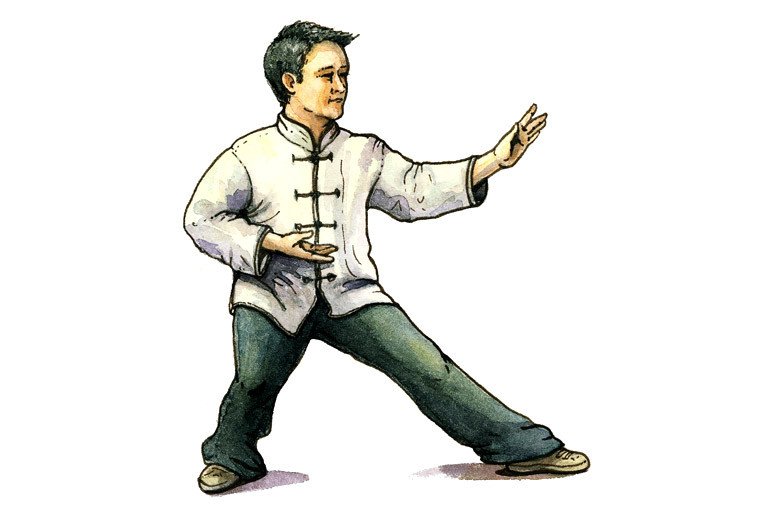
Chi Kung; may also be known by names of the commonly practiced forms, like Chan Chuang, Yì Jīn Jīng, Yan Xin, Wu Qin Xi, Liu Zi Jue, and Ba Duan Jin
Developed nearly 5000 years ago in China, qigong integrates methods of body movement, muscle relaxation, meditation, and respiratory exercise to improve physical, emotional, and psychological health. Proponents of Traditional Chinese Medicine contend that qigong works to promote a healthy, balanced flow of energy – called “qi” – within the body. Many believe that a disturbed or blocked flow of qi produces discomfort and illness within an individual; conversely, with a balanced, free flow of qi, one is believed to be in better health (1) (2).
There are many interpretations on the relationship between qigong and tai chi (or taiji), as both are mind–body–spirit integrative exercises (3). Static qigong refers to meditation in sitting, standing, and lying-down postures. These are the most fundamental, and therefore the most essential qigong training methods. Dynamic qigong refers to moving meditation, which can take on many forms (4). With many variations of “external qigong,” a professionally trained instructor directs the experience to a recipient (5). However, one might also practice “internal qigong” by oneself.
In several small studies, regular qigong practice has been shown to provide long-term benefits for patients with hypertension (6), fibromyalgia (7), chronic fatigue (8), tinnitus (9), and other chronic medical illnesses (10). It appears to have “dose-dependent” positive effects on sleep quality and climacteric symptoms in perimenopausal women (11). It may also have specific health-preserving effects, as it improved muscle endurance, waist-to-hip ratio (WHR), and body mass index (BMI) in middle-aged women (12).
Qigong also improves respiratory function and activity tolerance in patients with chronic obstructive pulmonary disease (COPD) (13), cardiorespiratory function and expiratory capacity in patients with hypertension (14), and reduced stress levels with improved sleep quality, activity levels, immune response, and balance in older adults (15) (16) (17). As a physical activity, qigong along with tai chi can be considered a low-intensity exercise, and as such may be beneficial in cardiopulmonary rehabilitation (18) (19).
More research is needed to not only confirm these findings, but to more fully elucidate the mechanisms by which qigong exerts its positive effects.
Recently, qigong has been found to be an effective complementary therapy for cancer patients. Clinical studies have found that qigong has a significant impact on psychological and emotional symptoms including anxiety, depression, mood, and quality of life (1) (20). It has also demonstrated effectiveness in ameliorating physical symptoms experienced by cancer patients such as pain, numbness, dizziness, fatigue, inflammation, and cognitive function (1) (21) (22). Attempts to evaluate the effect of qigong on cancer itself are inchoate. Earlier in vitro and animal studies in China using a form of external qigong suggest it can inhibit cancer cell growth. However, these studies are not reproducible due to variety of methods and practitioners (23). One study even found qigong to be effective in attenuating lymphoma growth in mice (24). More recent studies also indicate these effects in various cell lines (25) (26), but the inability to specifically qualify and quantify the delivery of qi in these studies poses some basic challenges when evaluating qigong in this way.
Qigong incorporates methods of muscle relaxation, breathing exercises, meditation, and body movements to foster a free, stabilized, and unobstructed internal flow of qi (2). Through this mind-body dynamic, qigong can play an integral role in hypothalamic activity, easing both parasympathetic and sympathetic nervous systems (PNS, SNS) towards a state of homeostasis (1) (27). Since blood pressure (BP) level is directly linked to the SNS, the lower BP levels exhibited following qigong exercise are compatible with the stabilization of SNS activity (6) (14). Practice of qigong also modulates urinary catecholamine levels suggesting a positive effect on BP (14). The pulmonary benefits observed are likely due to the focus of deep breathing exchange that is powered by the muscles in ; the lower abdomen, in an area called tantien (pronounced dawn-dee-in) considered the body’s main energy center). This places less pressure on lungs and increases lung capacity (13), as well as the overall improvement seen in ventilatory function (14) and breathing efficiency (19). The potential to reduce BMI and WHR may also be related to tantien contractions, which strengthens the waist and increases calorific consumption (12). The downregulation of hyperactivity in the hypothalamic–pituitary–adrenal axis is a proposed mechanism for qigong’s antidepressive effect (10). Qigong may modify inflammation by affecting immune responsiveness through neuroendocrine factors (1) (28). Its positive effect on balance is attributed to the improved use of vestibular input and wider stances (16). The effect of qigong on numbness in breast cancer patients receiving chemotherapy may be due to its stimulatory action as an upper extremity exercise, which is often recommended for post-surgery patients (21). The specific mechanisms by which qigong can confer benefits across various study populations still needs further evaluation.
Patients who are especially weak – particularly due to chemotherapy – should consult a physician before taking on more strenuous forms of qigong (27).
Oh B, et al. Effect of medical Qigong on cognitive function, quality of life, and a biomarker of inflammation in cancer patients: a randomized controlled trial. Support Care Cancer. 2012;20:1235-1242.
A total of 81 cancer patients were randomly assigned to either a 10-week medical qigong program in addition to usual care (intervention), or usual care (control). Quality of life (QoL), cognitive function, and inflammation as measured by the presence of C-reactive protein (CRP) were assessed for all patients before and after the 10-week period. Patients in the intervention group who completed the study had significantly lower CRP levels and significantly higher QoL and cognitive function scores than their control-group counterparts. Even though much of the data from this study relies on self-report, with the exception of CRP levels, it does suggest a significant role for qigong in the lives of cancer patients, where there is a high incidence of self-reported cognitive dysfunction during and after treatment.
Lynch M, et al. A randomized controlled trial of qigong for fibromyalgia. Arthritis Res Ther. 2012;14:R178.
This randomized controlled trial evaluated a standardized qigong practice used by 100 patients with fibromyalgia. Immediate or delayed practice groups took qigong training for 3 half-days, followed by weekly review and practice sessions for 8 weeks. During this time, participants were also asked to practice at home for 45 to 60 minutes daily. Outcomes recorded at baseline, Week 8, and Months 4 and 6 were pain, impact, sleep, and physical and mental functioning. Qigong demonstrated significant improvements in pain, impact, sleep, and physical and mental functioning for both immediate and delayed-practice groups when compared with the wait-listed/usual care control group at Week 8, with benefits extending beyond this time. There were also significant changes for all measures at all times except mental functioning at Month 4. Post-hoc analysis of self-reported practice indicated a greater benefit with the per-protocol group compared with minimal practice. This study provided reproducible outcomes and demonstrated that regular qigong can provide long-term benefits in several core domains in fibromyalgia and may be a useful adjuvant self-care treatment for this condition.
Tsang HW, et al. Psycho-physical and neurophysiological effects of qigong on depressed elders with chronic illness. Aging Ment Health. 2012 Oct 16. [Epub ahead of print]
In this randomized controlled trial, the psychological, physical, and neurophysiological effects of a 12-week qigong exercise program on depressed elders with chronic medical illness were examined. The intervention group (n=21) received a total of 36 sessions (3 times weekly for 45 minutes using the Eight-Section Brocades protocol for 2–3 cycles with short breaks in between. Each cycle lasted ~ 10–15 minutes and was considered easy to learn). A comparison group (n=17) was provided with a research assistant for the same duration and frequency who read news articles aloud and led subsequent discussions on the article topics presented. Considered a good comparison activity by experts and often provided in geriatric settings, this comparison activity also served to neutralize the attention given by therapists to the intervention group. At 12 weeks, the qigong group had a significant reduction in depressive symptoms and improvements in self-efficacy, self-concept of physical well-being, and right-hand grip strength, but not cortisol levels vs the comparison group. This trial offers some preliminary evidence that regular qigong practice produces an antidepressive effect.
Chan AW, et al. Tai chi Qigong improves lung functions and activity tolerance in COPD clients: a single blind, randomized controlled trial. Complement Ther Med. 2011;19:3-11.
This single-blind, randomized controlled trial evaluated a blended practice of tai chi qigong (TCQ) on enhancing respiratory functions and activity tolerance in 206 patients with chronic obstructive pulmonary disease (COPD). Patients were randomly assigned to TCQ (two 60-min sessions weekly for 3 months), regular exercise (breathing techniques combined with walking), or control (instructed to maintain their usual activities). Measurements of lung function, a 6-min walk test, and COPD exacerbation rate were performed at baseline, Week 6, and Month 3. At 3 months, there were significant changes for forced vital capacity (p=.002), forced expiratory volume in 1 second (p<.001), walking distance (p<.001), and exacerbation rate (p=.006), with no changes observed in the exercise group and a decline in lung functions for the control group. Further there was a high compliance rate and desire among participants in the TCQ group to continue practice. Future studies with extended followup could help to determine additional improvements in physiological and psychosocial status with TCQ in this population.
Oh B, et al. Impact of medical Qigong on quality of life, fatigue, mood and inflammation in cancer patients: a randomized controlled trial. Ann Oncol. 2010;21:608-614.
In this study, 162 patients with malignant cancer were randomly assigned to a 10-week program of two 90-minute qigong sessions per week in addition to usual care, or a control group that only received usual care. Participants were also encouraged to practice at home daily for at least 30 minutes. The program was modified from a traditional qigong practice to specifically target the needs of cancer patients with respect to aid in the control of emotions and stress and to improve physical function. Quality of life (QoL), fatigue, mood, and inflammation as measured by the presence of C-reactive protein were assessed before and after the 10-week period. QoL, fatigue, and inflammation were significantly improved for the intervention group compared with control patients after their qigong program. However, no follow-up measures were taken to assess whether these effects endured over time. Additional studies evaluating both the “dose-response relationship” and endurance of benefit could help to determine efficient prescriptions for practice in cancer populations.
Lee MS, et al. Effects of chan-chuang qigong on improving symptom and psychological distress in chemotherapy patients. Am J Chin Med. 2006;34:37-46.
This nonrandomized study examined the effects of Chan-Chuang qigong practice on the physical and psychological symptoms experienced by 67 breast cancer patients undergoing chemotherapy. Patients were assigned to either a qigong group practicing for at least 15 minutes daily for 3 weeks, or a control group without any qigong practice. Measures of physical and psychological distress were taken at baseline and again on days 8, 15, and 22 for all patients using a 21-item symptom distress scale and psychological distress a revised symptom checklist-90-revised (SCL-90-R). Significant differences were found on day 8 for sense of numbness and heartburn, on day 15 for sense of numbness and pain, and on day 22 for sense of numbness (p<.01), heartburn, pain, and dizziness (p<.01). However, there were no significant differences for measures of psychological distress except on day 22 for “hopelessness about the future” and “unwillingness to live”. Future study designs that include randomization would eliminate potential bias.
Bottom Line: Qigong practice is effective in alleviating stress, pain, anxiety, and fatigue, and improving lung function, mood, and sleep. It is also beneficial for overall health maintenance, particularly in older adults.
Qigong combines body movements, muscle relaxation, meditation, and breathing to improve physical, mental, and emotional health by creating a balanced flow of energy, called “qi” (pronounced chee). In Traditional Chinese Medicine, disturbed or blocked flow of qi can produce discomfort and illness within an individual. Therefore, a free flow of qi is equated with better health.
Studies show that qigong practice can have many positive effects, particularly among patients with cancer, chronic illnesses, and breathing problems, as well as older adults. Benefits include improved lung function, mood, sleep, and quality of life, as well as reduced stress, pain, anxiety, and fatigue. Some studies have shown the amount of benefit corresponds to amount of practice. A blended practice of qigong and tai chi can be considered a low-intensity exercise, and may be especially beneficial for those undergoing rehabilitation.
Pain, numbness, dizziness in breast cancer patients
In this study, 67 breast cancer patients undergoing chemotherapy were divided into either a qigong practice group for at least 15 minutes daily for 3 weeks, or no practice. Improvements were noted for dizziness, numbness, and pain, as well as some psychological measures such as hopelessness. However, this study was not a randomized trial, which would have made the study more objective.
Mental functioning and inflammation in cancer patients
A study used a tailored Qigong program to address the special needs of cancer patients to control emotions and stress and improve their physical condition. Eighty-one patients were divided into two groups. Both groups received usual care, but one group also added a supervised Qigong class once per week for 10 weeks and was encouraged to practice at home. Patients who participated in the qigong program improved their mental functioning and quality of life. Objective laboratory tests also showed that patients had decreased inflammation.
Fibromyalgia
In this study, 100 patients with fibromyalgia were divided into two groups. Both groups received usual care, but one group took a standard qigong class for 3 half-days, with weekly review and practice sessions for 8 weeks. The other group received the same training 6 months later. Both groups were also asked to practice at home. Patients experienced improvements in several fibromyalgia markers, including pain, sleep, and physical and mental functioning. In addition, benefits extended beyond the training period. The study showed that regular qigong practice could provide long-term benefits for patients suffering from fibromyalgia. Depression and chronic medical conditions in older adults An easy-to-learn qigong practice was tested among depressed older adults with chronic medical illness. One group attended an interactive reading and discussion session 3 times per week for 12 weeks, while the other received qigong instruction for the same duration. At the end of the study, the qigong group had reduced depressive symptoms and improved strength and well-being. The study offers some initial evidence that regular qigong practice may help symptoms of depression.