Common Names
- Polyphenolic flavonoid
For Patients & Caregivers
Tell your healthcare providers about any dietary supplements you’re taking, such as herbs, vitamins, minerals, and natural or home remedies. This will help them manage your care and keep you safe.
Quercetin has not been shown to treat cancer or other diseases.
Quercetin belongs to a family of compounds called bioflavonoids, which are largely responsible for the bright colors and medicinal activities of many plants. Quercetin is the most common bioflavonoid that people consume, and is the most active of the bioflavonoids in laboratory experiments. It is known to act as an antioxidant, neutralizing free radicals that can cause cellular and DNA damage. Quercetin is thought to have anti-inflammatory properties by inhibiting the release of substances that mediate the inflammatory response, such as histamine. Presently, considerable laboratory data support the concept of quercetin as an anticancer compound, but it is still unclear from clinical trials whether this effect occurs in the human body.
Because of its antioxidant effects, quercetin may interfere with the actions of certain chemotherapy drugs.
-
To treat allergies and inflammation
Laboratory studies show an anti-inflammatory effect of quercetin, including inhibition of histamine release. Clinical trials have not been conducted. -
To prevent and treat cancer
Laboratory studies indicate anticancer activity of quercetin against a wide range of cancer cell types. A systematic review showed that it does not help reduce the risk of ovarian cancer. -
To treat heart disease
One study showed that quercetin, in combination with red wine extract, lowered LDL oxidation (which may contribute to atherosclerosis) in healthy volunteers. However, it is unclear how much of this effect was due to quercetin alone, and other similar studies have not found the same effect.
Do Not Take if:
- You are taking drugs that are substrates of cytochrome P450 3A4 or 2C19 enzymes: Quercetin may increase the risk of side effects of such drugs. Clinical relevance is not known.
- Losartan (medication to treat hypertension): Following concomitant administration, quercetin increased the systemic exposure of losartan in a murine model. Clinical relevance is not known.
For Healthcare Professionals
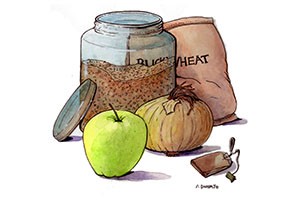
Quercetin is a dietary flavonoid found in fruits and vegetables including apples, black, green and buckwheat tea, onions, red grapes, cherries, raspberries, citrus fruits. It is also found in some popular medicinal plants including ginkgo biloba and St. John’s Wort (5) and is used widely for its antioxidant effects. Quercetin showed antioxidant, anti-inflammatory (13) (14) and chemopreventive effects (15) in vitro. However, it can also act as an anti-apoptotic agent (5). Animal models showed its ability to potentiate the antitumor effects of doxorubicin in liver cancer cells, while protecting normal liver cells (16). Quercetin also demonstrated neuroprotective and antidepressant effects (17), exerted pro-oxidant effects by decreasing serum homocysteine levels (18), and protected against osteoarthritis (29).
In clinical studies, long-term supplementation had wide-ranging metabolic effects in healthy subjects (19). But concomitant intake of quercetin did not attenuate postprandial metabolic responses such as lipemia and insulinemia (22) or increase the concentration of alpha linoleic acid, and its conversion to omega-3 fatty acids, which is associated with cardiovascular benefits (23). Supplementation also did not affect endothelial dysfunction biomarkers or depression levels in post myocardial infarction patients (30).
In other studies, quercetin attenuated the severity of muscle weakness caused by eccentric exercise (24), reduced oxidative damage following eccentric exercise (25), and enhanced neuromuscular performance during and after resistance training (26). In women with rheumatoid arthritis, supplementation improved clinical symptoms and disease activity (27). A quercetin containing formula was comparable to omeprazole for treating nonerosive gastroesophageal reflux disease (31).
Meta analyses determined quercetin to be among the active components in TCM formulas that improved overall survival in metastatic colorectal patients (32) and fatigue in those with gastric cancer (33). But findings from a systematic review showed quercetin obtained from a typical diet may not decrease the risk of ovarian cancer (21). It also exacerbated estrogen-induced breast tumors in a murine model (12). Further research is warranted.
Onions, apples, black tea, green tea, buckwheat tea, citrus fruits, red grapes, cherries, raspberries
- Allergies
- Inflammation
- Cancer prevention
- Cancer treatment
- Cardiovascular disease
Quercetin constitutes the major bioflavonoid in the human diet. Its antioxidant effects are due its phenolic group, which reacts with free radicals to form the more stable phenoxy radicals (1). Quercetin also exerts anti-inflammatory (13) and chemopreventive (15) properties. It also has been shown to have membrane-stabilizing capabilities and inhibits aldose reductase and low-density lipoprotein oxidation (8). The anti-cancer effects of quercetin are via down regulation of mutant p53 proteins; G1 phase arrest (1); tyrosine kinase inhibition (10); and down regulation of cell survival, proliferative and anti-apoptotic proteins (15). Preclinical data support the concept of quercetin as an anti-cancer compound (15). However, clinical studies that support these uses are few and the results are mixed (7) (9).
- Cytochrome P450 3A4 and 2C19 substrate drugs: Quercetin was shown to significantly inhibit the constitutive CYP3A4 and CYP2C19 activity, in vitro (11) (20). Clinical relevance is not known.
- Losartan: Following concomitant administration, quercetin increased the systemic exposure of losartan in a murine model. Clinical significance is not known (28).
- Tamoxifen: Quercetin significantly increased the bioavailability of tamoxifen in preclinical studies. Clinical relevance has yet to be determined (34).
- Warfarin: A 79-year-old man on stable warfarin therapy for atrial fibrillation presented with elevated INR following quercetin supplementation. His INR normalized after discontinuing quercetin (35).