Health Care Professional Information
Clinical Summary
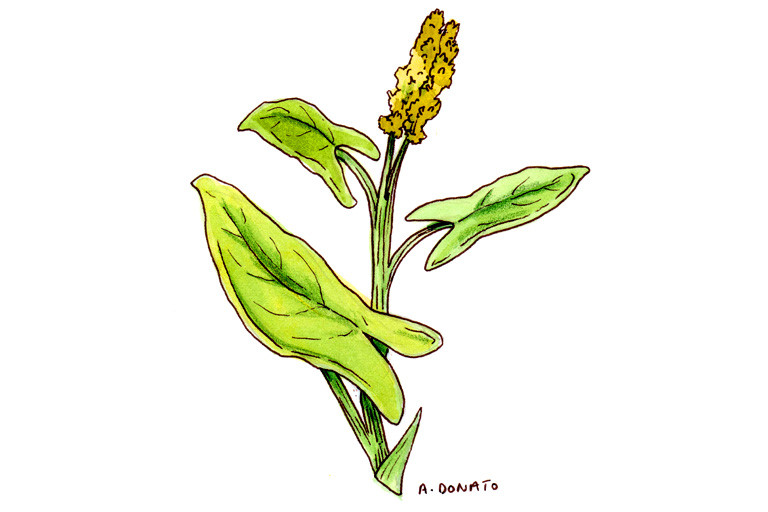
Derived from the aerial parts of the plant, Sheep sorrel historically has been used to treat inflammation, scurvy, cancer, and diarrhea. The major constituents include anthraquinones, oxalates, and various vitamins (1). Consumption of large doses may result in diarrhea from the anthraquinones and renal and liver damage from the oxalate content (2). Sheep sorrell is one of the four ingredients in Essiac (1). There are no published trials evaluating the efficacy of sheep sorrel for any proposed claims.
Purported Uses
- Cancer treatment
- Diarrhea
- Fever
- Inflammation
- Scurvy
Constituents
- Glycosides: Hyperoside, quercitin-3d-galactoside
- Anthraquinones: Emodin, aloe emodin, chrysophanol, rhein, physcion
- Vitamins: A, B complex, C, D, E, K
- Other: Oxalates, tannins
(1)
Mechanism of Action
The anthraquinones, including emodin, rhein, and physcion, stimulate peristalsis and increase the secretion of mucous and water into the intestine. They are also considered to be antioxidants and free radical scavengers.
(1)
Contraindications
Patients with history of kidney stones should not consume this herb.
Herb Lab Interactions
Anthraquinones can cause discoloration of the urine interfering with urinalysis.
(3)
Literature Summary and Critique
No clinical trials have been conducted to evaluate the efficacy of sheep sorrel for any proposed claims.
Consumer Information
How It Works
Bottom Line: There is no evidence that sheep sorrel can treat cancer, diarrhea, scurvy, or any other medical condition.
No scientific research has been performed with sheep sorrel, but scientists are familiar with how some of the natural compounds found in this plant work. The anthraquinones stimulate peristalsis in the gastrointestinal tract and increase the secretion of mucous and water into the intestine. This can cause a laxative effect. These compounds are also considered to be antioxidants and therefore may be able to neutralize free radicals, which can cause cellular and DNA damage in the body.
Purported Uses
- To treat cancer
No scientific evidence supports this use.
- To treat diarrhea
There are no data to back this claim.
- To reduce fever
No scientific evidence supports this use.
- To reduce inflammation
This use is not supported by research.
- To treat scurvy
Sheep sorrel contains vitamin C, which helps prevent scurvy. But there are no human data.
Patient Warnings
- Large doses of sheep sorrel may result in diarrhea, and cause kidney and liver damage.
Do Not Take If
- You have a history of kidney stones
- You are taking diuretics (Most diuretics cause potassium loss from the body, which can be increased by the laxative effect of sheep sorrel. This increases the risk of hypokalemia, or dangerously low blood potassium levels).
Side Effects
- Upset stomach
- Abdominal cramps
- Diarrhea, possibly leading to hypokalemia (dangerously low blood potassium levels)
- Kidney and liver damage
Special Point
- Sheep sorrel is one of the four ingredients in Essiac.
- Anthraquinones can cause discoloration of the urine interfering with urinalysis.
Last updated: September 28, 2012
abdominal (ab-DAH-mih-nul)
Having to do with the abdomen, which is the part of the body between the chest and the hips that contains the pancreas, stomach, intestines, liver, gallbladder, and other organs.
Source: The National Cancer Institute's Dictionary of Cancer Terms
(http://www.cancer.gov/dictionary)
blood (blud)
A tissue with red blood cells, white blood cells, platelets, and other substances suspended in fluid called plasma. Blood takes oxygen and nutrients to the tissues, and carries away wastes.
Source: The National Cancer Institute's Dictionary of Cancer Terms
(http://www.cancer.gov/dictionary)
cancer (KAN-ser)
A term for diseases in which abnormal cells divide without control and can invade nearby tissues. Cancer cells can also spread to other parts of the body through the blood and lymph systems. There are several main types of cancer. Carcinoma is a cancer that begins in the skin or in tissues that line or cover internal organs. Sarcoma is a cancer that begins in bone, cartilage, fat, muscle, blood vessels, or other connective or supportive tissue. Leukemia is a cancer that starts in blood-forming tissue such as the bone marrow, and causes large numbers of abnormal blood cells to be produced and enter the blood. Lymphoma and multiple myeloma are cancers that begin in the cells of the immune system. Central nervous system cancers are cancers that begin in the tissues of the brain and spinal cord. Also called malignancy.
Source: The National Cancer Institute's Dictionary of Cancer Terms
(http://www.cancer.gov/dictionary)
clinical (KLIH-nih-kul)
Having to do with the examination and treatment of patients.
Source: The National Cancer Institute's Dictionary of Cancer Terms
(http://www.cancer.gov/dictionary)
diarrhea (dy-uh-REE-uh)
Frequent and watery bowel movements.
Source: The National Cancer Institute's Dictionary of Cancer Terms
(http://www.cancer.gov/dictionary)
DNA
The molecules inside cells that carry genetic information and pass it from one generation to the next. Also called deoxyribonucleic acid.
Source: The National Cancer Institute's Dictionary of Cancer Terms
(http://www.cancer.gov/dictionary)
efficacy (EH-fih-kuh-see)
Effectiveness. In medicine, the ability of an intervention (for example, a drug or surgery) to produce the desired beneficial effect.
Source: The National Cancer Institute's Dictionary of Cancer Terms
(http://www.cancer.gov/dictionary)
emodin (EH-moh-din)
A substance found in certain plants, including rhubarb. It belongs to a family of compounds called anthraquinones, which have shown anti-inflammatory and anticancer effects.
Source: The National Cancer Institute's Dictionary of Cancer Terms
(http://www.cancer.gov/dictionary)
free radical (free RA-dih-kul)
A type of unstable molecule that is made during normal cell metabolism (chemical changes that take place in a cell). Free radicals can build up in cells and cause damage to other molecules, such as DNA, lipids, and proteins. This damage may increase the risk of cancer and other diseases.
Source: The National Cancer Institute's Dictionary of Cancer Terms
(http://www.cancer.gov/dictionary)
gastroenteritis (GAS-troh-EN-teh-RY-tis)
Inflammation of the lining of the stomach and the intestines. Symptoms may include nausea, vomiting, diarrhea, and abdominal cramps (dull or sharp pains). Gastroenteritis may be caused by infection with bacteria, parasites, or viruses. It may also be caused by food poisoning, allergic reactions, or reactions to certain medicines or foods.
Source: The National Cancer Institute's Dictionary of Cancer Terms
(http://www.cancer.gov/dictionary)
gastrointestinal (GAS-troh-in-TES-tih-nul)
Refers to the stomach and intestines. Also called GI.
Source: The National Cancer Institute's Dictionary of Cancer Terms
(http://www.cancer.gov/dictionary)
herbal (ER-bul)
Having to do with plants.
Source: The National Cancer Institute's Dictionary of Cancer Terms
(http://www.cancer.gov/dictionary)
intestine (in-TES-tin)
The long, tube-shaped organ in the abdomen that completes the process of digestion. The intestine has two parts, the small intestine and the large intestine. Also called bowel.
Source: The National Cancer Institute's Dictionary of Cancer Terms
(http://www.cancer.gov/dictionary)
kidney (KID-nee)
One of a pair of organs in the abdomen. Kidneys remove waste from the blood (as urine), produce erythropoietin (a substance that stimulates red blood cell production), and play a role in blood pressure regulation.
Source: The National Cancer Institute's Dictionary of Cancer Terms
(http://www.cancer.gov/dictionary)
laxative (LAK-suh-tiv)
A substance that promotes bowel movements.
Source: The National Cancer Institute's Dictionary of Cancer Terms
(http://www.cancer.gov/dictionary)
liver (LIH-ver)
A large organ located in the upper abdomen. The liver cleanses the blood and aids in digestion by secreting bile.
Source: The National Cancer Institute's Dictionary of Cancer Terms
(http://www.cancer.gov/dictionary)
peristalsis (payr-ih-STAL-sis)
The rippling motion of muscles in the intestine or other tubular organs characterized by the alternate contraction and relaxation of the muscles that propel the contents onward.
Source: The National Cancer Institute's Dictionary of Cancer Terms
(http://www.cancer.gov/dictionary)
potassium (puh-TA-see-um)
A metallic element that is important in body functions such as regulation of blood pressure and of water content in cells, transmission of nerve impulses, digestion, muscle contraction, and heartbeat.
Source: The National Cancer Institute's Dictionary of Cancer Terms
(http://www.cancer.gov/dictionary)
sheep sorrel (sheep SOR-ul)
A plant that has been used in some cultures to treat certain medical problems. It may have anticancer effects. The scientific name is . Also called dock and sorrel.
Source: The National Cancer Institute's Dictionary of Cancer Terms
(http://www.cancer.gov/dictionary)
sorrel (SOR-ul)
A plant that has been used in some cultures to treat certain medical problems. It may have anticancer effects. The scientific name is . Also called dock and sheep sorrel.
Source: The National Cancer Institute's Dictionary of Cancer Terms
(http://www.cancer.gov/dictionary)
stimulant (STIM-yoo-lunt)
In medicine, a family of drugs used to treat depression, attention-deficit disorder (a common disorder in which children are inattentive, impulsive, and/or over-active), and narcolepsy (a sleep disorder that causes uncontrollable sleepiness). Stimulants increase brain activity, alertness, attention, and energy. They also raise blood pressure and increase heart rate and breathing rate.
Source: The National Cancer Institute's Dictionary of Cancer Terms
(http://www.cancer.gov/dictionary)
urinalysis (YOOR-ih-NA-lih-sis)
A test that determines the content of the urine.
Source: The National Cancer Institute's Dictionary of Cancer Terms
(http://www.cancer.gov/dictionary)
urine (YOOR-in)
Fluid containing water and waste products. Urine is made by the kidneys, stored in the bladder, and leaves the body through the urethra.
Source: The National Cancer Institute's Dictionary of Cancer Terms
(http://www.cancer.gov/dictionary)
vitamin (VY-tuh-min)
A nutrient that the body needs in small amounts to function and stay healthy. Sources of vitamins are plant and animal food products and dietary supplements. Some vitamins are made in the human body from food products. Vitamins are either fat-soluble (can dissolve in fats and oils) or water-soluble (can dissolve in water). Excess fat-soluble vitamins are stored in the body’s fatty tissue, but excess water-soluble vitamins are removed in the urine. Examples are vitamin A, vitamin C, and vitamin E.
Source: The National Cancer Institute's Dictionary of Cancer Terms
(http://www.cancer.gov/dictionary)