Health Care Professional Information
Common Name
Juzen-taiho-to, SQT, TJ-48
Clinical Summary
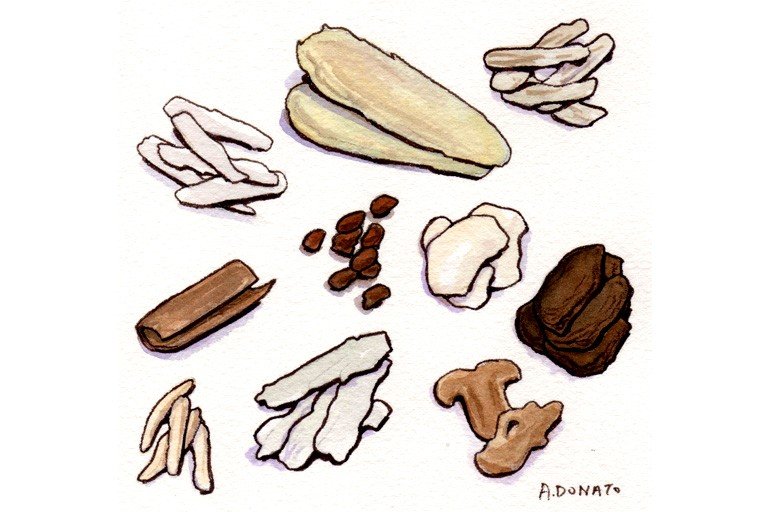
Shi quan da bu tang is a Chinese herbal formula consisting of ten different herbs. Also known as Juzen-taiho-to in Japan, it is used in traditional medicine to alleviate symptoms of fatigue, anemia, loss of appetite, dry or scaly skin, night sweating, dryness of mouth, and for cancer treatment. Supporters believe that the beneficial effects of shi quan da bu tang are due to interactions between its components. Studies done in mice suggest that it has antitumor and antimetastatic effects (2) (3) (4) (5) (6) (12), and protects against Alzheimer's disease (13).
Shi quan da bu tang exhibits radioprotective effects in mice exposed to radiation (7) and protects against myelosuppression induced by anticancer drugs (17).
Researchers in Japan administered Shi quan da bu tang to patients with advanced lung cancer for one year and observed an increase in survival time (8). It also alleviated hematotoxicity in patients with breast carcinoma receiving chemotherapy (18). Improvement in anemia has been reported in some studies (14) (15) (16).
No adverse effects have been reported with use of Shi quan da bu tang. However, some components are known to cause interactions with other drugs.
Purported Uses
- Appetite
- Cancer treatment
- Dry Skin
- Dryness of mouth
- Fatigue
- Night Sweating
Mechanism of Action
Studies performed in mice suggest that shi quan da bu tang has antitumor and antimetastatic effects (2) (3) (4) (6). These effects are mediated by stimulation of macrophages and natural killer cells. It also exhibits radioprotective effect in mice evidenced by an increase in spleen colony forming unit in mice exposed to radiation (7). In vitro studies using human bone marrow cells indicate that shi quan da bu tang can stimulate hemopoiesis (9).
Contraindications
Breast cancer patients should use this product with caution as dong quai and ginseng may stimulate the growth of breast cancer cells (11).
Dosage (Inside MSKCC Only)
This field is only visible to only Inside MSKCC users.
References
- Zee-Cheng RK. Shi-quan-da-bu-tang (ten significant tonic decoction), SQT. A potent Chinese biological response modifier in cancer immunotherapy, potentiation and detoxification of anticancer drugs. Methods Find Exp Clin Pharmacol 1992; 14(9):725-36.
- Niwa K, et al. Preventive effects of Juzen-taiho-to on N-methyl-N-nitrosourea and estradiol-17beta-induced endometrial carcinogenesis in mice. Carcinogenesis 2001; 22(4):587-91.
- Saiki I. A Kampo medicine “Juzen-taiho-to”—prevention of malignant progression and metastasis of tumor cells and the mechanism of action. Biol Pharm Bull 2000; 23(6):677-88.
- Tagami K, et al. Preventive effect of Juzen-taiho-to on endometrial carcinogenesis in mice is based on Shimotsu-to constituent. Biol Pharm Bull 2004; 27(2):156-61.
- Dai Y, et al. T-cell-immunity-based inhibitory effects of orally administered herbal medicine juzen-taiho-to on the growth of primarily developed melanocytic tumors in RET-transgenic mice. J Invest Dermatol 2001; 117(3):694-701.
- Ohnishi Y, et al. Oral administration of a Kampo (Japanese herbal) medicine Juzen-taiho-to inhibits liver metastasis of colon 26-L5 carcinoma cells. Jpn J Cancer Res 1998; 89(2):206-13.
- Ohnishi Y, et al. Effects of juzen-taiho-toh (TJ-48), a traditional Oriental medicine, on hematopoietic recovery from radiation injury in mice. Exp Hematol 1990; 18(1):18-22.
- Satoh H, et al. Japanese herbal medicine in patients with advanced lung cancer: prolongation of survival. J Altern Complement Med 2002; 8(2):107-8.
- Hisha H, et al. Treatment of Shwachman syndrome by Japanese herbal medicine (Juzen-taiho-to): stimulatory effects of its fatty acids on hemopoiesis in patients. Stem Cells 2002; 20(4):311-19.
- Honso Professional Catalog 2002. Honso USA Inc.
- Amato P, et al. Estrogenic activity of herbs commonly used as remedies for menopausal symptoms. Menopause 2002 Mar-Apr;9(2):145-50.
- Kamiyama H, Takano S, Ishikawa E, Tsuboi K, Matsumura A. Anti-angiogenic and immunomodulatory effect of the herbal medicine “Juzen-taiho-to” on malignant glioma. Biol Pharm Bull. 2005 Nov;28(11):2111-6.
- Hara H, Kataoka S, Anan M, et al. The therapeutic effects of the herbal medicine, Juzen-taiho-to, on amyloid-beta burden in a mouse model of Alzheimer's disease. J Alzheimers Dis. 2010;20(2):427-39.
- Sho Y, Fujisaki K, Sakashita H, et al. Orally administered Kampo medicine, Juzen-taiho-to, ameliorates anemia during interferon plus ribavirin therapy in patients with chronic hepatitis C. J Gastroenterol. 2004 Dec;39(12):1202-4.
- Nakamoto H, Mimura T, Honda N. Orally administrated Juzen-taiho-to/TJ-48 ameliorates erythropoietin (rHuEPO)-resistant anemia in patients on hemodialysis. Hemodial Int. 2008 Oct;12 Suppl 2:S9-S14.
- Kishida Y, Nishii T, Inoue T, et al. Juzentaihoto (TJ-48), a traditional Japanese herbal medicine, influences hemoglobin recovery during preoperative autologous blood donation and after hip surgery. Int J Clin Pharmacol Ther. 2009 Dec;47(12):716-21.
- Ogawa K, Omatsu T, Matsumoto C, et al. Protective effect of the Japanese traditional medicine juzentaihoto on myelosuppression induced by the anticancer drug TS-1 and identification of a potential biomarker of this effect. BMC Complement Altern Med. 2012 Aug 9;12:118.
- Huang SM, Chien LY, Tai CJ, Chiou JF, Chen CS, Tai CJ.Effectiveness of 3-Week Intervention of Shi Quan Da Bu Tang for Alleviating Hematotoxicity Among Patients With Breast Carcinoma Receiving Chemotherapy. Integr Cancer Ther. 2012 Jul 16. [Epub ahead of print]
Consumer Information
How It Works
Bottom Line: Current evidence is insufficient to support use of Shi quan da bu tang for cancer in humans.
Shi quan da bu tang is an herbal formula comprised of Panax ginseng (Ginseng), Angelica sinensis (Dong quai), Paeonia lactiflora (Peony), Atractylodes macrocephala (Atractylodes), Poria cocos (Hoelen), Cinnamomum cassia (Cinnamon), Astragalus membranaceus (Astragulus), Liqusticum wallichii (Cnidium), Glycyrrhiza uralensis (Licorice), and Rehmannia glutinosa (Rehmannia).
It is used in traditional medicine to treat fatigue, anemia, loss of appetite, dry or scaly skin, night sweating, dryness of mouth, and cancer. Laboratory studies suggest that shi quan da bu tang can help prevent cancer and metastases.
Purported Uses
- Cancer treatment
Studies in mice suggest that shi quan da bu tang has anticancer and antimetastatic effects.
A small study of cancer patients showed that it improves survival.
- Fatigue
This formula is traditionally used for fatigue. However, scientific evidence is lacking.
- Appetite
There are no clinical data to support this use.
- Dry skin
No studies have been conducted to investigate this use.
- Dryness of mouth
This use is not backed by clinical data.
- Night sweating
There are no scientific evidence to support this use.
Do Not Take If
- You have hypersensitivity to any of the components.
- You have breast cancer patients (Dong quai and Ginseng present in shi quan da bu tang may stimulate the growth of breast cancer cells).
Last updated: November 27, 2012
anemia (uh-NEE-mee-uh)
A condition in which the number of red blood cells is below normal.
Source: The National Cancer Institute's Dictionary of Cancer Terms
(http://www.cancer.gov/dictionary)
appetite (A-peh-tite)
A desire to satisfy a physical or mental need, such as for food, sex, or adventure.
Source: The National Cancer Institute's Dictionary of Cancer Terms
(http://www.cancer.gov/dictionary)
bone marrow (bone MAYR-oh)
The soft, sponge-like tissue in the center of most bones. It produces white blood cells, red blood cells, and platelets.
Source: The National Cancer Institute's Dictionary of Cancer Terms
(http://www.cancer.gov/dictionary)
breast (brest)
Glandular organ located on the chest. The breast is made up of connective tissue, fat, and breast tissue that contains the glands that can make milk. Also called mammary gland.
Source: The National Cancer Institute's Dictionary of Cancer Terms
(http://www.cancer.gov/dictionary)
breast cancer (brest KAN-ser)
Cancer that forms in tissues of the breast, usually the ducts (tubes that carry milk to the nipple) and lobules (glands that make milk). It occurs in both men and women, although male breast cancer is rare.
Source: The National Cancer Institute's Dictionary of Cancer Terms
(http://www.cancer.gov/dictionary)
cancer (KAN-ser)
A term for diseases in which abnormal cells divide without control and can invade nearby tissues. Cancer cells can also spread to other parts of the body through the blood and lymph systems. There are several main types of cancer. Carcinoma is a cancer that begins in the skin or in tissues that line or cover internal organs. Sarcoma is a cancer that begins in bone, cartilage, fat, muscle, blood vessels, or other connective or supportive tissue. Leukemia is a cancer that starts in blood-forming tissue such as the bone marrow, and causes large numbers of abnormal blood cells to be produced and enter the blood. Lymphoma and multiple myeloma are cancers that begin in the cells of the immune system. Central nervous system cancers are cancers that begin in the tissues of the brain and spinal cord. Also called malignancy.
Source: The National Cancer Institute's Dictionary of Cancer Terms
(http://www.cancer.gov/dictionary)
carcinoma (KAR-sih-NOH-muh)
Cancer that begins in the skin or in tissues that line or cover internal organs.
Source: The National Cancer Institute's Dictionary of Cancer Terms
(http://www.cancer.gov/dictionary)
chemotherapy (KEE-moh-THAYR-uh-pee)
Treatment with drugs that kill cancer cells.
Source: The National Cancer Institute's Dictionary of Cancer Terms
(http://www.cancer.gov/dictionary)
clinical (KLIH-nih-kul)
Having to do with the examination and treatment of patients.
Source: The National Cancer Institute's Dictionary of Cancer Terms
(http://www.cancer.gov/dictionary)
cyclosporine (SY-kloh-SPOR-een)
A drug used to help reduce the risk of rejection of organ and bone marrow transplants by the body. It is also used in clinical trials to make cancer cells more sensitive to anticancer drugs.
Source: The National Cancer Institute's Dictionary of Cancer Terms
(http://www.cancer.gov/dictionary)
dong quai (dong kwye)
An herb native to China. A substance taken from the roots has been used in traditional Chinese medicine to treat menstrual and menopausal problems. Dong quai may increase the effect of the drug warfarin (a blood-thinner). The scientific name is .
Source: The National Cancer Institute's Dictionary of Cancer Terms
(http://www.cancer.gov/dictionary)
fatigue (fuh-TEEG)
A condition marked by extreme tiredness and inability to function due lack of energy. Fatigue may be acute or chronic.
Source: The National Cancer Institute's Dictionary of Cancer Terms
(http://www.cancer.gov/dictionary)
ginseng (JIN-seng)
An herb with a root that has been used in some cultures to treat certain medical problems. It may have anticancer effects.
Source: The National Cancer Institute's Dictionary of Cancer Terms
(http://www.cancer.gov/dictionary)
hypersensitivity (HY-per-SEN-sih-tih-vih-tee)
An exaggerated response by the immune system to a drug or other substance.
Source: The National Cancer Institute's Dictionary of Cancer Terms
(http://www.cancer.gov/dictionary)
in vitro (in VEE-troh)
In the laboratory (outside the body). The opposite of in vivo (in the body).
Source: The National Cancer Institute's Dictionary of Cancer Terms
(http://www.cancer.gov/dictionary)
lung (lung)
One of a pair of organs in the chest that supplies the body with oxygen, and removes carbon dioxide from the body.
Source: The National Cancer Institute's Dictionary of Cancer Terms
(http://www.cancer.gov/dictionary)
medicine (MEH-dih-sin)
Refers to the practices and procedures used for the prevention, treatment, or relief of symptoms of a diseases or abnormal conditions. This term may also refer to a legal drug used for the same purpose.
Source: The National Cancer Institute's Dictionary of Cancer Terms
(http://www.cancer.gov/dictionary)
myelosuppression (MY-eh-loh-suh-PREH-shun)
A condition in which bone marrow activity is decreased, resulting in fewer red blood cells, white blood cells, and platelets. Myelosuppression is a side effect of some cancer treatments. When myelosuppression is severe, it is called myeloablation.
Source: The National Cancer Institute's Dictionary of Cancer Terms
(http://www.cancer.gov/dictionary)
radiation (RAY-dee-AY-shun)
Energy released in the form of particle or electromagnetic waves. Common sources of radiation include radon gas, cosmic rays from outer space, medical x-rays, and energy given off by a radioisotope (unstable form of a chemical element that releases radiation as it breaks down and becomes more stable).
Source: The National Cancer Institute's Dictionary of Cancer Terms
(http://www.cancer.gov/dictionary)
spleen (spleen)
An organ that is part of the lymphatic system. The spleen makes lymphocytes, filters the blood, stores blood cells, and destroys old blood cells. It is located on the left side of the abdomen near the stomach.
Source: The National Cancer Institute's Dictionary of Cancer Terms
(http://www.cancer.gov/dictionary)
tacrolimus (tak-ROH-lih-mus)
A drug used to help reduce the risk of rejection by the body of organ and bone marrow transplants.
Source: The National Cancer Institute's Dictionary of Cancer Terms
(http://www.cancer.gov/dictionary)
tamoxifen (tuh-MOK-sih-FEN)
A drug used to treat certain types of breast cancer in women and men. It is also used to prevent breast cancer in women who have had ductal carcinoma in situ (abnormal cells in the ducts of the breast) and in women who are at a high risk of developing breast cancer. Tamoxifen is also being studied in the treatment of other types of cancer. It blocks the effects of the hormone estrogen in the breast. Tamoxifen is a type of antiestrogen. Also called tamoxifen citrate.
Source: The National Cancer Institute's Dictionary of Cancer Terms
(http://www.cancer.gov/dictionary)