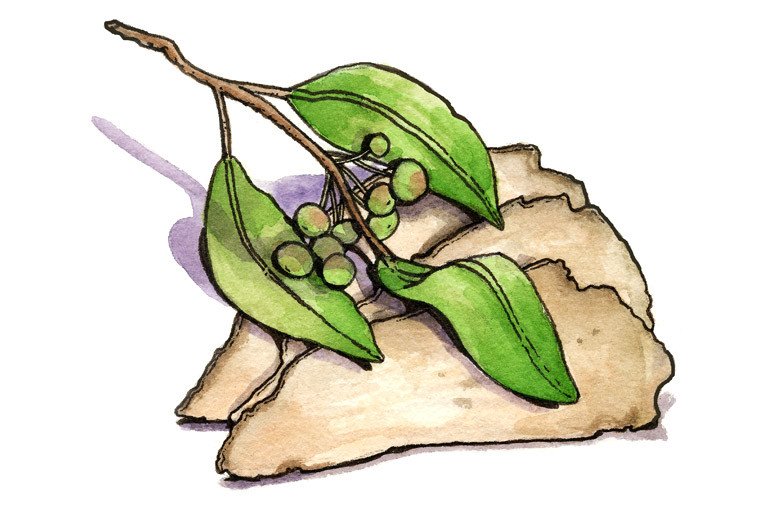
Common Names
- Glabrous greenbrier rhizome
- Tu Fu Ling
- Tufuling
- China root
For Patients & Caregivers
Tell your healthcare providers about any dietary supplements you’re taking, such as herbs, vitamins, minerals, and natural or home remedies. This will help them manage your care and keep you safe.
Smilax glabra has not been shown to treat or prevent cancer.
Smilax glabra is known as Tufuling in traditional Chinese medicine. The root has been used in combination with other herbs to treat various types of infections and inflammatory conditions.
Lab studies suggest this plant has anti-inflammatory and anticancer properties. However, clinical studies have not been conducted and it is not known if the same effects would occur in humans.
- Arthritis
Anti-inflammatory activity has been observed in rat models, but studies in humans are lacking. - Infections
Lab studies suggest S. glabra has antiviral activity. - Kidney disease
Astilbin, a compound present in S. glabra, has been studied in rats with diabetic nephropathy. However, clinical trials are lacking. - Immunostimulation
Smilaxin, a protein isolated from S. glabra, stimulated immune activity in mice, but studies have not been conducted in humans. - Cancer
Lab studies suggest antioxidant and antitumor effects, but clinical trials have not been conducted.
Do Not Take if:
You are taking CYP3A4 or 2D6 substrate drugs: Lab studies suggest compounds in S. glabra may affect the activity of drugs metabolized by these enzymes. Clinical relevance has yet to be determined.
Special Point:
Smilax glabra should not be confused with Smilax officinalis, another species commonly known as sarsaparilla.
For Healthcare Professionals
Smilax glabra is a plant prevalent in South Asia. The rhizome is used in traditional Chinese medicine to treat various types of infections and inflammatory conditions.
Preclinical studies suggest antioxidant (1) (2), antiviral (3), renoprotective (4), immunostimulatory (5), anti-inflammatory (6) (7), hepatoprotective (16), and anticancer properties (8) (9) (10) (11) (12), but human studies are lacking.
Smilax glabra should not be confused with Smilax officinalis, another species commonly known as sarsaparilla.
Smilax glabra is used in traditional Chinese foods (2).
- Arthritis
- Infections
- Nephritis
- Immunostimulant
- Cancer
Anticancer effects may be due to apoptotic induction via Bax upregulation, Bcl2 downregulation, or cell cycle arrest and decreased mRNA expression of cyclin B1 and Cdk1 in carcinoma cells (9).
Anti-inflammatory effects may be due to inhibition of T-lymphocyte adhesion, causing a decrease in T-cell ability to express CD44 and produce TNFα (6). In cardiomyoblast cells, anticardiac hypertrophy effects occurred via targeted inhibition of ryanodine receptor-mediated intracellular Ca(2+) release (18).
Inhibition of TGFβ and connective tissue growth factor, both thought to induce the fibrotic process in diabetic nephropathy, was observed in HK-2 cells after exposure to the constituent astilbin (4). Renoprotective activities animal nephropathy models occurred via significant reductions in urinary volume and albumin, serum creatinine, blood urea nitrogen, and creatinine clearance (4).