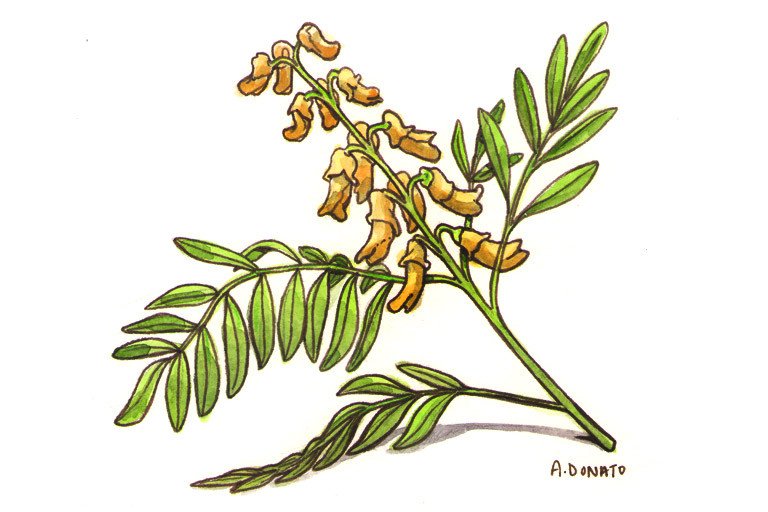
Common Names
- Ku Shen Gen
- Bitter root
- Yellow sophora root
For Patients & Caregivers
Tell your healthcare providers about any dietary supplements you’re taking, such as herbs, vitamins, minerals, and natural or home remedies. This will help them manage your care and keep you safe.
Sophora flavescens has shown anticancer effects in lab studies, but has not been studied for cancer prevention or treatment in humans.
Sophora flavescens or Ku Shen, which in Chinese means "bitter root," is an herb used in Traditional medicine to treat a wide variety of symptoms, with purported effects on the liver, intestinal tract, and skin. Lab and animal studies have shown that some compounds can kill cancer cells and help fight certain viruses. However, human data are lacking.
Sophora flavescens may act like an estrogen in the body. Patients with hormone-sensitive cancer should avoid this product.
- Cancer treatment
Lab studies show anticancer activities through different mechanisms, but this use has not been proven by clinical trials. - Antiviral
Limited evidence suggests that a compound from Sophora flavescens may be useful for hepatitis B and coxsackie B viruses, but more data are necessary to support this use. - Skin disorders
Sophora flavescens is used to treat skin disorders in Traditional Medicine, but this use has not been proven in clinical trials.
Do Not Take if:
- You are taking paclitaxel: In animal studies, Sophora flavescens flavonoids increased the effects of Taxol against certain tumors. Clinical relevance has yet to be determined.
- You are taking ampicillin/gentamicin: In the lab, one of the compounds in Sophora flavescens increased the activity of these antibiotics against oral bacteria. Clinical relevance has yet to be determined.
- You have a hormone-sensitive cancer: Sophora flavescens has estrogenic effects and may stimulate the proliferation of hormone-sensitive cancer cells.
For Healthcare Professionals
Sophora flavescens is a deciduous shrub related to peas. The root known as “Kushen” which means “bitter root” in Chinese, has been used in Traditional Medicine for two thousand years to treat a variety of conditions including diarrhea, jaundice, and skin rashes, and to kill parasites (1). Although this herb is generally not consumed as a dietary supplement in the West, recent lab studies indicate that it has antitumor properties and patients are using it as a natural cancer treatment.
Matrine, an alkaloid present in Sophora flavescens, demonstrated antitumor effects against liver (10) (18), breast (19), pancreatic (20), myeloma (21) and gastric (22) (23) cancer cell lines. Other flavonoids such as kuraninone and sophoraflavonone are also thought to be biologically active and may have vasodilatory and antiviral effects (5) (6) (7), and benefit patients with ulcerative colitis (31) (32). Adjunctive use of formulas containing Kushen may improve effectiveness of chemotherapy in patients with non-small cell lung cancer (33).
Sophora flavescens acts as a phytoestrogen (24) (25) (26) and therefore, patients with hormone-sensitive cancers should avoid this product.
- Cancer treatment
- Antiviral
- Skin disorders
In animal models, the antiviral properties of sophoridine, an alkaloid constituent, appear to be mediated via upregulation of IL-10 and IFN-gamma cytokines (11). S. flavescens flavonoids may promote vasodilation by inhibiting Ca2+ influx through a voltage-gated channel (12). The flavonoids sophoraflavonone G and kurarinone may be responsible for antioxidant effects, which are mediated through free-radical scavenging (4). Anti-inflammatory effects of Sophoraflavonone G are attributed to inhibition of prostaglandin E2 formation via COX-2 downregulation (13). (2S)-2’-Methoxykurarinone isolated from S. flavescens root inhibits osteoclast differentiation and bone resorption via receptor activator of nuclear factor-κB ligand (RANKL)-induced mitogen-activated protein kinases (MAPKs) and c-Fos-NFATc1 signaling pathways (29).
Most reported antineoplastic effects of S.flavescens are due to the proapoptotic activity of matrine, the main alkaloid constituent. In human hepatocellular carcinoma cells, matrine inhibits matrix metalloproteinase-9 (MMP-9) by downregulating the NF-kappa B pathway (18). It also demonstrates antiangiogenic effects by inhibiting VEGF and VEGFR-2 (19). Matrine triggers the mitochondrial pathway, in which cytochrome C release induces caspase-9 and -3 activation and subsequently induces apoptosis (2) (3) (10) (21).
- Paclitaxel: In mice, S. flavescens flavonoids may enhance the effects of Taxol against certain tumors (16). Clinical relevance has yet to be determined.
- Ampicillin/gentamicin: In vitro, sophoraflavanone G may increase the activity of these antibiotics against oral bacteria (17). Clinical relevance has yet to be determined.