Common Names
- Miracle fruit
For Patients & Caregivers
Tell your healthcare providers about any dietary supplements you’re taking, such as herbs, vitamins, minerals, and natural or home remedies. This will help them manage your care and keep you safe.
Preliminary data suggest Synsepalum dulcificum may change taste sensation from sour to sweet in patients undergoing chemotherapy, but it has not been shown to prevent weight loss.
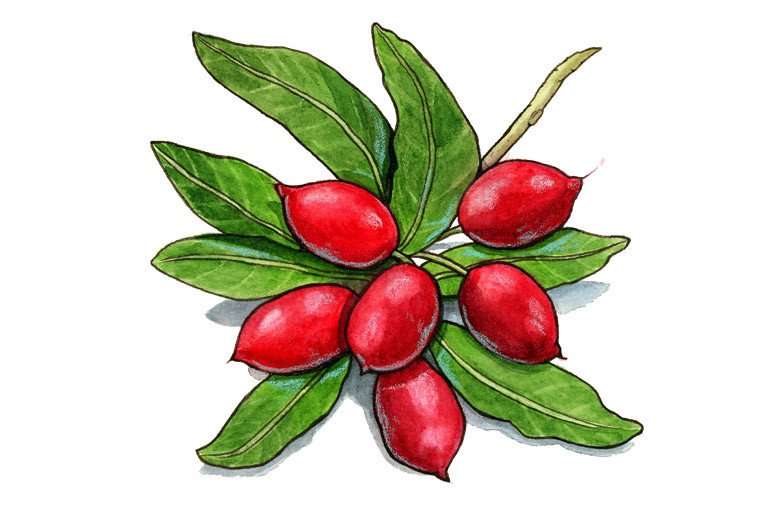
Synsepalum dulcificum is a West African plant that produces red berries commonly known as miracle fruit. A protein found in these berries can bind to the sweet taste receptors of the tongue. This causes many sour, acidic foods to taste sweet, and the effects may last for one to two hours. Miracle fruit has been proposed for use in taste changes caused by chemotherapy and for weight loss, but studies are quite limited. Data suggest that some patients undergoing chemotherapy reported improved taste, but no change in weight with miracle fruit.
- Low calorie sweetener
Although miracle fruit may make things taste sweeter, it has not been shown to help weight loss. - Taste changes caused by chemotherapy
Small studies suggest benefits. Larger studies are needed.
- Stomach ache and throat discomfort have been reported.
Do Not Take if:
- You are allergic to this fruit.
For Healthcare Professionals
Synsepalum dulcificum is a West African plant that produces a red berry commonly referred to as miracle fruit (1). The berry has been used as a food sweetener and some cancer patients also use it to improve taste changes caused by chemotherapy. The puff of the berries contains a glycoprotein known as miraculin that may alter taste perception from sour to sweet (1). Preclinical experiments found antioxidant (2) (3), antihyperglycemic (15) and cholesterol-lowering (16) effects.
In small studies, cancer patients undergoing chemotherapy reported improvements in taste after consuming miracle fruit (6) (12). Confirmatory research is needed.
- Low-calorie sweetener
- Alter taste changes caused by chemotherapy
Miraculin is a glycosylated protein (7) that acts on the human sweet taste receptor of the tongue (hT1R2, hT1R3). It binds only in acidic conditions, which allows conversion of sour stimuli to sweet (8). The effects last 1 to 2 hours, although the intensity declines with time (9). Miraculin alters taste in primates but not in rodents (8). Maximum taste-modifying activity is observed at pH 3.0, which allows two key histidine residues to facilitate cooperative binding, dimerization and miraculin-to-receptor binding in an acidic environment (10). Only the dimeric and tetrameric forms of miraculin are active (11). In a weakly acidic environment, miraculin acts as a positive allosteric modulator; at neutral pH, it acts as an antagonist that can inhibit the activity of other sweeteners including sucrose, saccharine and aspartame (8). Results from another study suggest that miraculin binds hT1R2-hT1R3 as an antagonist at neutral pH and changes into an agonist at acidic pH (13).
Compounds isolated from the stem of S. dulcificum inhibit proliferation of human melanoma cells via free-radical scavenging activity and by inhibiting tyrosinase (3).
- Allergy or sensitivity to any of the constituents.
- Stomach ache and throat discomfort have been reported (6).