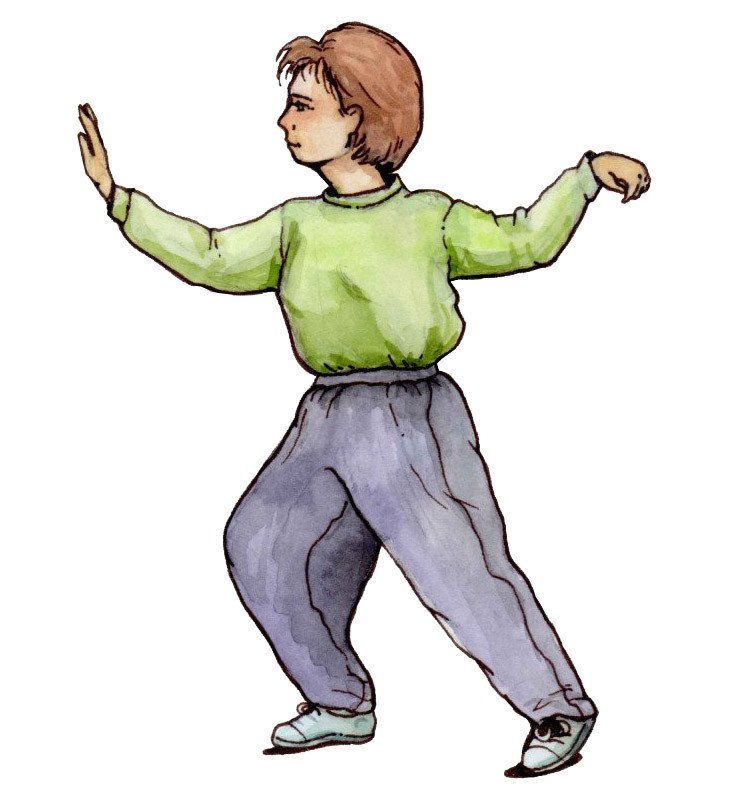
Common Names
- Tai Chi Chuan
- Taijiquan
For Patients & Caregivers
Tell your healthcare providers about any dietary supplements you’re taking, such as herbs, vitamins, minerals, and natural or home remedies. This will help them manage your care and keep you safe.
Regular tai chi practice can improve posture, movement control, and ability to walk. The gradual weight shift in lower and upper limbs and slow foot movements like forward heel-to-toe and backward toe-to-heel also improve flexibility, stamina, and muscle tone. Moves from wide to narrow stances while turning also expands the types of situations under which the body experiences support.
The coordinated breathing used in tai chi helps to improve lung function, increase awareness, and reduce stress.
Taken together, these physical and mental aspects of tai chi work to improve balance and mobility while reducing fall risk. It also reduces markers of inflammation linked to many chronic diseases.
-
Balance and fall risk
Several studies show that tai chi improves balance which may also help reduce fall risk. -
Fatigue
Clinical trials suggest that tai chi can help reduce fatigue in cancer patients. -
Pain
Tai chi can help with several types of pain including knee pain, low back pain, and fibromyalgia. -
Physical functioning
Tai chi can improve muscle strength, flexibility, stamina, and posture in a variety of populations including cancer patients. -
Sleep
Tai chi can improve sleep, including among cancer patients. One study found it had similar effects to cognitive behavioral therapy, the non-drug gold standard treatment for insomnia. -
Inflammation
Tai chi reduces markers of inflammation linked with many chronic diseases and disturbed sleep. -
Immune functioning
In a randomized trial of older adults, tai chi appeared to boost immune response to the shingles vaccine and the shingles virus.
What Is It:
Based on Chinese philosophy and traditional medicine, tai chi is a movement therapy that seeks to harmonize the Yin and Yang vital forces and promote the flow of energy in the body known as Qi to improve health. It coordinates a series of prescribed movements with meditation and breathing exercises.
Clinical trials of tai chi have been conducted in elderly, frail, and disabled patients, and those with chronic conditions such as fibromyalgia, arthritis, Parkinson’s disease, heart disease, and cancer. These studies show that tai chi can improve sleep, strength, stamina, flexibility, balance, limb function, immune function, blood pressure, mental outlook, and awareness. It can also help reduce stress, fall risk, inflammation, and bone loss.
Tai chi can be practiced by people of all age groups as the movements are gentle with little stress on the body. Like other mind-body approaches, benefits increase with regular practice.
Is It Safe:
- Tai chi is generally considered to be safe.
- Patients with muscle and bone injuries should consult their physician before starting tai chi practice.
Who Can Provide this Service:
Experienced tai chi instructors.
Where Can I Get Treatment:
Many hospitals, cancer centers, and community and senior centers offer tai chi classes. The Integrative Medicine Service at MSK offers tai chi and other exercise and mind-body modalities in our online program, Integrative Medicine at Home, to help support the recovery and well-being of cancer patients everywhere.
For Healthcare Professionals
Tai chi is an exercise program that uses a sequence of precise body movements, meditation, and synchronized breathing to improve health and well-being. Based on Chinese philosophy and traditional medicine theory, tai chi exercises are thought to harmonize Yin and Yang vital forces and promote the flow of Qi, or internal energy. Coordinated breathing with these exercises also serve a meditative function to increase awareness and reduce stress.
Tai chi can help improve
- Balance
- Mobility
- Stamina
It can also help reduce
- Pain
- Fatigue
- Fall risk
Effects on pain, mobility, balance, and fall risk
Clinical trials show that tai chi practice reduces pain (9) (26) (27) (51) (53), improves flexibility, strength, balance, and mobility (1) (2) (5) (6) (7) (8) (11) (56) (62), and reduces fall and fracture risks (3) (4) (12) (54) (55). It also improved fitness and mental health among ethnically diverse participants (10), and significantly improved function and balance even as a tailored sitting program for subacute stroke survivors (64).
Effects on fatigue, sleep, and inflammation
Tai chi reduced cancer-related fatigue (40) (52) (56) (65), improved sleep (21) (50) (65), and was noninferior to cognitive behavioral therapy (50). Other studies suggest it can also reverse markers of inflammation (20) (23) (37) (49) (59) (62) and boost immune response (60).
Studied in multiple patient populations
Tai chi may reduce risk factors for chronic diseases (18) (19) and is a useful tool in chronic illness management (58) including patients with cancer (50) (56) (59), COPD (14) (15), cardiovascular disease (16) (17) (24) (25), neurological diseases like Parkinson’s (28) (29) (31) (62) and multiple sclerosis (30), and in sedentary adults (2).
Oncology guidelines recommend tai chi
Current oncology guidelines recommend tai chi as adjunctive therapy in cancer patients to reduce fatigue, improve sleep, and as exercise therapy (66) (67) (69) and for anxiety and depression (68).
Clinical trials are continuing to evaluate tai chi for patients with cancer.
The Integrative Medicine Service at MSK offers tai chi as part our online program, Integrative Medicine at Home, as well as other classes and therapies to support the recovery and well-being of cancer patients everywhere.
- Balance
- Fatigue
- Fall risk
- Inflammation
- Mobility
- Pain
- Sleep
Specific features that characterize the tai chi protocol include weight shifting and ankle sway, which move center of gravity toward the limits of stability (28). Alternating narrow and wide stances continually change the base of support, increase support-leg standing and trailing-leg swing time, and encourage torso rotation with an upright posture. Forward heel-to-toe and backward toe-to-heel steps strengthen dorsiflexion and plantar flexion, respectively.
Regular tai chi practice also incorporates semi-squatting positions and abdominal breathing producing lower extremity muscle co-contractions that affect neuromuscular coordination, gait, and postural control, as well as bone mineral density by producing stress changes in the lumbar spine and femur (61) (63). Improved mobility is related to increased flexibility and balance (6), and are also the mechanisms by which tai chi practice helps prevent falls (41).
In patients with Parkinson’s disease, fMRI studies associated improved balance score with visual network changes, the reduced connections of which have been shown in PD patients with frozen gait (62). Tai chi particularly appears to alleviate bradykinetic movements by improving gait characteristics such as maximum excursion, while reducing deviation in movement and markedly increasing gait velocity and stride length (28). Reduced markers of inflammation and improvements in amino acid, energy, and neurotransmitter metabolism were also attributed to long-term effects on Parkinson’s severity and balance scores (62).
Other studies evaluating biomarker changes suggest the physical aspects of tai chi mediate reductions in both decreased fat mass and IL-2 levels along with increased fat-free mass and IL-6, while the meditative component may also contribute to anti-inflammatory effects (42). Declining pro-inflammatory cytokine IL-2 levels further result in increased bone formation and metabolism levels (43). Other anti-inflammatory effects include increased superoxide dismutase activity with reduced IL-1β (44).
Tai chi classes are offered in many hospitals, cancer centers, and community and senior centers, generally by experienced instructors. The Integrative Medicine Service at MSK offers tai chi and other exercise and mind-body modalities in our online program, Integrative Medicine at Home, to help support the recovery and well-being of cancer patients everywhere.