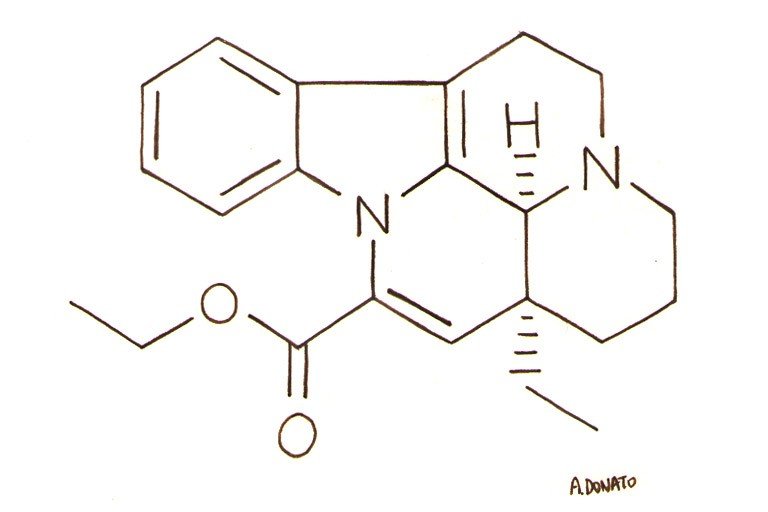
Health Care Professional Information
Scientific Name
(14-ethoxycarbonyl-(3a,16a-ethyl)-14,15eburnamine)
Common Name
Kavinton, Rgh-4405, Tcv-3B
Clinical Summary
Vinpocetine is derived from vincamine, an alkaloid found in the common periwinkle plant. Originally developed in Europe where it is marketed as a drug called Cavinton, vinpocetine is sold in the United States as a dietary supplement to improve brain function. Studies show that vinpocetine enhances short-term memory (2), cognitive performance (3), and improves chronic cerebral dysfunction in elderly patients (4). It has also been studied as a potential treatment for Alzheimer's disease (5) but a systematic review did not find evidence of its benefits (6).
Parenteral administration followed by oral administration of vinpocetine significantly maintained beneficial hemorheologic changes in stroke patients in a recent clinical trial (1).
In animal studies, vinpocetine potentiates the effects of radiation therapy in tumor cells (7). There is no evidence of vinpocetine's anticancer effects in humans.
Vinpocetine should not be confused with chemotherapy drugs such as vincristine or vinblastine, which are also alkaloids derived from the periwinkle plant.
Purported Uses
- Alzheimer's disease
- Cognitive decline
- Dementia
- Stroke
- Vasoconstriction
- Cancer treatment
Mechanism of Action
Vinpocetine has been shown to possess antioxidant and hydroxyl radical scavenging properties in vitro (8) (9). It inhibits phosphodiesterase 1 (PDE1) activity and improves cerebral blood flow by elevating cGMP and cAMP, by increasing mitochondrial function and also by improving glucose and oxygen utilization by the brain. Vinpocetine helps improve spatial memory in rats through its ability to prevent neuronal damage and to favorably modulate cholinergic function (8). In an animal study, it increased cerebral microcirculation and blood flow by inhibiting platelet aggregation. Administration of vinpocetine to chronic stroke patients increased glucose uptake and release in unaffected areas of the brain (6). Vinpocetine does not possess systemic circulatory effects or any effects on heart rate or blood pressure (10). It demonstrated antiepileptic effects by suppressing the abnormal neuronal excitability through the regulation of sodium channels and release of dopamine in the striatal nerve endings (11) (12) (13). Vinpocetine can increase the effects of radiation by increasing tumor oxygenation (7). It also shows anti-inflammatory effects by inhibiting TNF-alpha-induced NF-kappaB activities (14).
Pharmacokinetics
Vinpocetine is absorbed in the small intestine and transported to the liver via portal circulation. Absorption is 60% when taken with food and 7% on empty stomach. Plasma levels of vinpocetine peak approximately 1 to 1.5 hours after ingestion. The elimination half-life is 1 to 2 hours and it is non-detectable in plasma 2-3 hours after ingestion. From the liver vinpocetine is distributed via systemic circulation to various tissues including the brain. In the liver, it is metabolized to the inactive apovincaminic acid, which is the major metabolite excreted in the urine (10).
Adverse Reactions
Rare: Flushing, rashes, gastrointestinal problems (15), hypotension (16) (17)
Case Report: A 73 year-old man developed agranulocytosis after using vinpocetine for 50 days. His symptoms resolved after discontinuing vinpocetine (18).
Herb-Drug Interactions
- Anticoagulants/antiplatelet agents: Vinpocetine may have additive effects and can increase risk of bleeding.
- Antihypertensive agents: Vinpocetine may increase hypotensive effects.
Herb Lab Interactions
- May decrease red blood cell aggregation (9).
- May reduce plasma and whole blood viscosity (9).
Literature Summary and Critique
Feher G, Koltai K, Kesmarky G, et al. Effect of parenteral or oral vinpocetine on the hemorheological parameters of patients with chronic cerebrovascular diseases. Phytomedicine. 2009;16(2-3):111-7.
In this study 40 patients with ischemic cardiovascular disease were administered high-dose parenteral vinpocetine gradually increasing to 1mg/kg/day. Patients underwent stroke > three months prior to the beginning of the study. Hemorheological parameters including plasma fibrinogen, whole blood viscosity, red blood cell aggregation, deformability, and hematocrit were assessed at one and three months. Additionally, 20 patients received 30mg of vinpocetine orally for three months with those receiving placebo serving as controls. High-dose parenteral administration of vinpocetine for 7 days significantly reduced whole blood and plasma viscosity and red blood cell aggregation in comparison to initial values (p<0.05). In the oral treatment arm of the study, whole blood and plasma viscosities were significantly lower compared to the placebo group at 3 months (p<0.05). Most of the parameters studied, with the exception of red blood cell aggregation, worsened in the control group during follow up.
The authors suggest that long-term oral administration of vinpocetine along with parenteral administration helps maintain the beneficial hemorheological changes.
Dosage (Inside MSKCC Only)
This field is only visible to only Inside MSKCC users.
References
- Feigin VL, Doronin BM, Popova TF, Gribatcheva EV, Tchervov DV. Vinpocetine treatment in acute ischaemic stroke: a pilot single-blind randomized clinical trial. Eur J Neurol. Jan 2001;8(1):81-85.
- Bhatti JZ, Hindmarch I. Vinpocetine effects on cognitive impairments produced by flunitrazepam. Int Clin Psychopharmacol. Oct 1987;2(4):325-331.
- Hindmarch I, Fuchs HH, Erzigkeit H. Efficacy and tolerance of vinpocetine in ambulant patients suffering from mild to moderate organic psychosyndromes. Int Clin Psychopharmacol. Spring 1991;6(1):31-43.
- Balestreri R, Fontana L, Astengo F. A double-blind placebo controlled evaluation of the safety and efficacy of vinpocetine in the treatment of patients with chronic vascular senile cerebral dysfunction. J Am Geriatr Soc. May 1987;35(5):425-430.
- Akhondzadeh S, Abbasi SH. Herbal medicine in the treatment of Alzheimer's disease. Am J Alzheimers Dis Other Demen. Mar-Apr 2006;21(2):113-118.
- Szatmari SZ, Whitehouse PJ. Vinpocetine for cognitive impairment and dementia. Cochrane Database Syst Rev. 2003(1):CD003119.
- Amano M, Monzen H, Suzuki M, et al. Increase in tumor oxygenation and potentiation of radiation effects using pentoxifylline, vinpocetine and ticlopidine hydrochloride. J Radiat Res (Tokyo). Dec 2005;46(4):373-378.
- Deshmukh R, Sharma V, Mehan S, Sharma N, Bedi KL. Amelioration of intracerebroventricular streptozotocin induced cognitive dysfunction and oxidative stress by vinpocetine — a PDE1 inhibitor. Eur J Pharmacol. Oct 12 2009;620(1-3):49-56.
- Feher G, Koltai K, Kesmarky G, et al. Effect of parenteral or oral vinpocetine on the hemorheological parameters of patients with chronic cerebrovascular diseases. Phytomedicine. Mar 2009;16(2-3):111-117.
- Vlase L, Bodiu B, Leucuta SE. Pharmacokinetics and comparative bioavailability of two vinpocetine tablet formulations in healthy volunteers by using the metabolite apovincaminic acid as pharmacokinetic parameter. Arzneimittelforschung. 2005;55(11):664-668.
- Sitges M, Chiu LM, Nekrassov V. Single and combined effects of carbamazepine and vinpocetine on depolarization-induced changes in Na+, Ca2+ and glutamate release in hippocampal isolated nerve endings. Neurochem Int. Jul 2006;49(1):55-61.
- Sitges M, Aldana BI, Chiu LM, Nekrassov V. Characterization of phenytoin, carbamazepine, vinpocetine and clorgyline simultaneous effects on sodium channels and catecholamine metabolism in rat striatal nerve endings. Neurochem Res. Mar 2009;34(3):470-479.
- Trejo F, Nekrassov V, Sitges M. Characterization of vinpocetine effects on DA and DOPAC release in striatal isolated nerve endings. Brain Res. Aug 3 2001;909(1-2):59-67.
- Jeon KI, Xu X, Aizawa T, et al. Vinpocetine inhibits NF-kappaB-dependent inflammation via an IKK-dependent but PDE-independent mechanism. Proc Natl Acad Sci U S A. May 25 2010;107(21):9795-9800.
- Vinpocetine. Monograph. Altern Med Rev. Jun 2002;7(3):240-243.
- Imamoto T, Tanabe M, Shimamoto N, Kawazoe K, Hirata M. Cerebral circulatory and cardiac effects of vinpocetine and its metabolite, apovincaminic acid, in anesthetized dogs. Arzneimittelforschung. 1984;34(2):161-169.
- Manconi E, Binaghi F, Pitzus F. A double-blind clinical trial of vinpocetine in the treatment of cerebral insufficiency of vascular and degenerative origin. Curr Ther Res. 1986;40:702-709.
- Shimizu Y, Saitoh K, Nakayama M, et al. Agranulocytosis induced by vinpocetine. Medicine Online [serial online]. http://www.priory.com/med/vinpocetine.htm. Accessed March 7, 2011.
Consumer Information
How It Works
Bottom Line: Vinpocetine may be useful against some cerebrovascular disorders. It has not been shown to treat or prevent cancer.
Vinpocetine is made from a compound found in the common periwinkle plant. It was developed in Europe as a drug but sold in the United States as a dietary supplement to improve brain function. Vinpocetine was shown to increase blood flow to the brain by inhibiting clumping of blood platelets. It has also been studied as a treatment for Alzheimer's disease and for disorders of the nervous and circulatory systems. But more studies are needed before it can be recommended. Vinpocetine should not be confused with the chemo drugs vincristine and vinblastine, which are also made from compounds of periwinkle plant.
Purported Uses
- Alzheimer's disease
Small studies have shown benefit of vinpocetine, but well designed clinical trials are needed.
- Cognitive decline
Vinpocetine was useful in improving cognitive decline. More studies are needed.
- Dementia
A systematic review of studies did not find any effectiveness of Vinpocetine for dementia.
- Memory loss
A few clinical trials have shown benefit. Large scale studies are needed.
- Stroke
Some studies have shown effectiveness of vinpocetine in stroke patients.
- Cancer treatment
In animal studies, vinpocetine increased the effects of radiation on tumor cells. But there is no evidence of vinpocetine's anticancer effects in humans.
Research Evidence
Cerebrovascular Disease:
In this study 40 patients who had a stroke three months prior to the study, were given high-dose parenteral vinpocetine up to 1mg/kg/day. Additionally, 20 patients received 30mg of vinpocetine orally for three months with those receiving placebo serving as controls. Plasma fibrinogen, whole blood viscosity, red blood cell aggregation and deformability and hematocrit were assessed at one and three months. High-dose parenteral administration of vinpocetine for 7 days significantly reduced whole blood and plasma viscosity and red blood cell aggregation in comparison to initial values. In the oral treatment arm of the study, whole blood and plasma viscosities were significantly lower compared to the placebo group at 3 months (p<0.05) Most of the parameters studied, with the exception of red blood cell aggregation, showed worsening in the control group during follow up.
Do Not Take If
- You are using blood-thinning drugs (Vinpocetine may increase their effects).
- You are taking medication to lower high blood pressure (Vinpocetine may enhance their effects).
Last updated: September 27, 2012
abnormal (ab-NOR-mul)
Not normal. An abnormal lesion or growth may be cancer, premalignant (likely to become cancer), or benign (not cancer).
Source: The National Cancer Institute's Dictionary of Cancer Terms
(http://www.cancer.gov/dictionary)
absorption (ub-SORP-shun)
The process of taking nutrients from the digestive system into the blood so they can be used in the body.
Source: The National Cancer Institute's Dictionary of Cancer Terms
(http://www.cancer.gov/dictionary)
acid (A-sid)
A chemical that gives off hydrogen ions in water and forms salts by combining with certain metals. Acids have a sour taste and turn certain dyes red. Some acids made by the body, such as gastric acid, can help organs work the way they should. An example of an acid is hydrochloric acid. Acidity is measured on a scale called the pH scale. On this scale, a value of 7 is neutral, and a pH value of less than 7 to 0 shows increasing acidity.
Source: The National Cancer Institute's Dictionary of Cancer Terms
(http://www.cancer.gov/dictionary)
administration (ad-MIH-nih-STRAY-shun)
In medicine, the act of giving a treatment, such as a drug, to a patient. It can also refer to the way it is given, the dose, or how often it is given.
Source: The National Cancer Institute's Dictionary of Cancer Terms
(http://www.cancer.gov/dictionary)
alkaloid (AL-kuh-loyd)
A member of a large group of substances found in plants and in some fungi. Alkaloids contain nitrogen and can be made in the laboratory. Nicotine, caffeine, codeine, and vincristine are alkaloids. Some alkaloids, such as vincristine, are used to treat cancer.
Source: The National Cancer Institute's Dictionary of Cancer Terms
(http://www.cancer.gov/dictionary)
animal study (A-nih-mul STUH-dee)
A laboratory experiment using animals to study the development and progression of diseases. Animal studies also test how safe and effective new treatments are before they are tested in people.
Source: The National Cancer Institute's Dictionary of Cancer Terms
(http://www.cancer.gov/dictionary)
anti-inflammatory (AN-tee-in-FLA-muh-TOR-ee)
Having to do with reducing inflammation.
Source: The National Cancer Institute's Dictionary of Cancer Terms
(http://www.cancer.gov/dictionary)
antiepileptic (AN-tee-EH-pih-LEP-tik)
A drug or other substance used to prevent or stop seizures or convulsions. Also called anticonvulsant.
Source: The National Cancer Institute's Dictionary of Cancer Terms
(http://www.cancer.gov/dictionary)
blood (blud)
A tissue with red blood cells, white blood cells, platelets, and other substances suspended in fluid called plasma. Blood takes oxygen and nutrients to the tissues, and carries away wastes.
Source: The National Cancer Institute's Dictionary of Cancer Terms
(http://www.cancer.gov/dictionary)
blood pressure (blud PREH-sher)
The force of circulating blood on the walls of the arteries. Blood pressure is taken using two measurements: systolic (measured when the heart beats, when blood pressure is at its highest) and diastolic (measured between heart beats, when blood pressure is at its lowest). Blood pressure is written with the systolic blood pressure first, followed by the diastolic blood pressure (for example 120/80).
Source: The National Cancer Institute's Dictionary of Cancer Terms
(http://www.cancer.gov/dictionary)
cancer (KAN-ser)
A term for diseases in which abnormal cells divide without control and can invade nearby tissues. Cancer cells can also spread to other parts of the body through the blood and lymph systems. There are several main types of cancer. Carcinoma is a cancer that begins in the skin or in tissues that line or cover internal organs. Sarcoma is a cancer that begins in bone, cartilage, fat, muscle, blood vessels, or other connective or supportive tissue. Leukemia is a cancer that starts in blood-forming tissue such as the bone marrow, and causes large numbers of abnormal blood cells to be produced and enter the blood. Lymphoma and multiple myeloma are cancers that begin in the cells of the immune system. Central nervous system cancers are cancers that begin in the tissues of the brain and spinal cord. Also called malignancy.
Source: The National Cancer Institute's Dictionary of Cancer Terms
(http://www.cancer.gov/dictionary)
cardiovascular (KAR-dee-oh-VAS-kyoo-ler)
Having to do with the heart and blood vessels.
Source: The National Cancer Institute's Dictionary of Cancer Terms
(http://www.cancer.gov/dictionary)
cell (sel)
The individual unit that makes up the tissues of the body. All living things are made up of one or more cells.
Source: The National Cancer Institute's Dictionary of Cancer Terms
(http://www.cancer.gov/dictionary)
chemotherapy (KEE-moh-THAYR-uh-pee)
Treatment with drugs that kill cancer cells.
Source: The National Cancer Institute's Dictionary of Cancer Terms
(http://www.cancer.gov/dictionary)
chronic (KRAH-nik)
A disease or condition that persists or progresses over a long period of time.
Source: The National Cancer Institute's Dictionary of Cancer Terms
(http://www.cancer.gov/dictionary)
circulation (ser-kyoo-LAY-shun)
In the body, the flow of blood through the heart and blood vessels, and the flow of lymph through the lymph vessels.
Source: The National Cancer Institute's Dictionary of Cancer Terms
(http://www.cancer.gov/dictionary)
clinical (KLIH-nih-kul)
Having to do with the examination and treatment of patients.
Source: The National Cancer Institute's Dictionary of Cancer Terms
(http://www.cancer.gov/dictionary)
compound (KOM-pownd)
In science, a substance that is made up of more than one ingredient.
Source: The National Cancer Institute's Dictionary of Cancer Terms
(http://www.cancer.gov/dictionary)
control group (kun-TROLE groop)
In a clinical trial, the group that does not receive the new treatment being studied. This group is compared to the group that receives the new treatment, to see if the new treatment works.
Source: The National Cancer Institute's Dictionary of Cancer Terms
(http://www.cancer.gov/dictionary)
dementia (deh-MEN-shuh)
A condition in which a person loses the ability to think, remember, learn, make decisions, and solve problems. Symptoms may also include personality changes and emotional problems. There are many causes of dementia, including Alzheimer disease, brain cancer, and brain injury. Dementia usually gets worse over time.
Source: The National Cancer Institute's Dictionary of Cancer Terms
(http://www.cancer.gov/dictionary)
dietary supplement (DY-uh-TAYR-ee SUH-pleh-ment)
A product that is added to the diet. A dietary supplement is taken by mouth, and usually contains one or more dietary ingredient (such as vitamin, mineral, herb, amino acid, and enzyme). Also called nutritional supplement.
Source: The National Cancer Institute's Dictionary of Cancer Terms
(http://www.cancer.gov/dictionary)
drug (drug)
Any substance, other than food, that is used to prevent, diagnose, treat or relieve symptoms of a disease or abnormal condition. Also refers to a substance that alters mood or body function, or that can be habit-forming or addictive, especially a narcotic.
Source: The National Cancer Institute's Dictionary of Cancer Terms
(http://www.cancer.gov/dictionary)
dysfunction (dis-FUNK-shun)
A state of not functioning normally.
Source: The National Cancer Institute's Dictionary of Cancer Terms
(http://www.cancer.gov/dictionary)
ester (EH-ster)
A chemical substance made when an acid and an alcohol combine and water is removed. Esters are found in essential oils (scented oils that come from plants).
Source: The National Cancer Institute's Dictionary of Cancer Terms
(http://www.cancer.gov/dictionary)
gastrointestinal (GAS-troh-in-TES-tih-nul)
Refers to the stomach and intestines. Also called GI.
Source: The National Cancer Institute's Dictionary of Cancer Terms
(http://www.cancer.gov/dictionary)
glucose (GLOO-kose)
A type of sugar; the chief source of energy for living organisms.
Source: The National Cancer Institute's Dictionary of Cancer Terms
(http://www.cancer.gov/dictionary)
hypotension (HY-poh-TEN-shun)
Abnormally low blood pressure.
Source: The National Cancer Institute's Dictionary of Cancer Terms
(http://www.cancer.gov/dictionary)
ingestion (in-JES-chun)
Taking into the body by mouth.
Source: The National Cancer Institute's Dictionary of Cancer Terms
(http://www.cancer.gov/dictionary)
intestine (in-TES-tin)
The long, tube-shaped organ in the abdomen that completes the process of digestion. The intestine has two parts, the small intestine and the large intestine. Also called bowel.
Source: The National Cancer Institute's Dictionary of Cancer Terms
(http://www.cancer.gov/dictionary)
liver (LIH-ver)
A large organ located in the upper abdomen. The liver cleanses the blood and aids in digestion by secreting bile.
Source: The National Cancer Institute's Dictionary of Cancer Terms
(http://www.cancer.gov/dictionary)
M
In chemistry, M is the amount of a substance that has 6.023 x 10(23) atoms or molecules of that substance. Also called mole (chemical).
Source: The National Cancer Institute's Dictionary of Cancer Terms
(http://www.cancer.gov/dictionary)
medicine (MEH-dih-sin)
Refers to the practices and procedures used for the prevention, treatment, or relief of symptoms of a diseases or abnormal conditions. This term may also refer to a legal drug used for the same purpose.
Source: The National Cancer Institute's Dictionary of Cancer Terms
(http://www.cancer.gov/dictionary)
metabolite (meh-TA-boh-lite)
A substance made or used when the body breaks down food, drugs or chemicals, or its own tissue (for example, fat or muscle tissue). This process, called metabolism, makes energy and the materials needed for growth, reproduction, and maintaining health. It also helps get rid of toxic substances.
Source: The National Cancer Institute's Dictionary of Cancer Terms
(http://www.cancer.gov/dictionary)
modulate (MAH-juh-layt)
To adjust, or change.
Source: The National Cancer Institute's Dictionary of Cancer Terms
(http://www.cancer.gov/dictionary)
nerve (nerv)
A bundle of fibers that receives and sends messages between the body and the brain. The messages are sent by chemical and electrical changes in the cells that make up the nerves.
Source: The National Cancer Institute's Dictionary of Cancer Terms
(http://www.cancer.gov/dictionary)
oral (OR-ul)
By or having to do with the mouth.
Source: The National Cancer Institute's Dictionary of Cancer Terms
(http://www.cancer.gov/dictionary)
oxygen (OK-sih-jen)
A colorless, odorless gas. It is needed for animal and plant life. Oxygen that is breathed in enters the blood from the lungs and travels to the tissues.
Source: The National Cancer Institute's Dictionary of Cancer Terms
(http://www.cancer.gov/dictionary)
placebo (pluh-SEE-boh)
An inactive substance or treatment that looks the same as, and is given the same way as, an active drug or treatment being tested. The effects of the active drug or treatment are compared to the effects of the placebo.
Source: The National Cancer Institute's Dictionary of Cancer Terms
(http://www.cancer.gov/dictionary)
plasma (PLAZ-muh)
The clear, yellowish, fluid part of the blood that carries the blood cells. The proteins that form blood clots are in plasma.
Source: The National Cancer Institute's Dictionary of Cancer Terms
(http://www.cancer.gov/dictionary)
platelet (PLAYT-let)
A tiny piece of a cell found in the blood that breaks off from a large cell found in the bone marrow. Platelets help wounds heal and prevent bleeding by forming blood clots. Also called thrombocyte.
Source: The National Cancer Institute's Dictionary of Cancer Terms
(http://www.cancer.gov/dictionary)
radiation (RAY-dee-AY-shun)
Energy released in the form of particle or electromagnetic waves. Common sources of radiation include radon gas, cosmic rays from outer space, medical x-rays, and energy given off by a radioisotope (unstable form of a chemical element that releases radiation as it breaks down and becomes more stable).
Source: The National Cancer Institute's Dictionary of Cancer Terms
(http://www.cancer.gov/dictionary)
red blood cell (red blud sel)
A cell that carries oxygen to all parts of the body. Also called erythrocyte and RBC.
Source: The National Cancer Institute's Dictionary of Cancer Terms
(http://www.cancer.gov/dictionary)
sodium (SOH-dee-um)
A mineral needed by the body to keep body fluids in balance. Sodium is found in table salt and in many processed foods. Too much sodium can cause the body to retain water.
Source: The National Cancer Institute's Dictionary of Cancer Terms
(http://www.cancer.gov/dictionary)
stomach (STUH-muk)
An organ that is part of the digestive system. The stomach helps digest food by mixing it with digestive juices and churning it into a thin liquid.
Source: The National Cancer Institute's Dictionary of Cancer Terms
(http://www.cancer.gov/dictionary)
stroke (stroke)
In medicine, a loss of blood flow to part of the brain, which damages brain tissue. Strokes are caused by blood clots and broken blood vessels in the brain. Symptoms include dizziness, numbness, weakness on one side of the body, and problems with talking, writing, or understanding language. The risk of stroke is increased by high blood pressure, older age, smoking, diabetes, high cholesterol, heart disease, atherosclerosis (a build-up of fatty material and plaque inside the coronary arteries), and a family history of stroke.
Source: The National Cancer Institute's Dictionary of Cancer Terms
(http://www.cancer.gov/dictionary)
synthetic (sin-THEH-tik)
Having to do with substances that are man-made instead of taken from nature.
Source: The National Cancer Institute's Dictionary of Cancer Terms
(http://www.cancer.gov/dictionary)
systemic (sis-TEH-mik)
Affecting the entire body.
Source: The National Cancer Institute's Dictionary of Cancer Terms
(http://www.cancer.gov/dictionary)
therapy (THAYR-uh-pee)
Treatment.
Source: The National Cancer Institute's Dictionary of Cancer Terms
(http://www.cancer.gov/dictionary)
tumor (TOO-mer)
An abnormal mass of tissue that results when cells divide more than they should or do not die when they should. Tumors may be benign (not cancer), or malignant (cancer). Also called neoplasm.
Source: The National Cancer Institute's Dictionary of Cancer Terms
(http://www.cancer.gov/dictionary)
unaffected
An individual who does not manifest symptoms of a condition or disease occurring in his or her family.
Source: The National Cancer Institute's Dictionary of Cancer Terms
(http://www.cancer.gov/dictionary)
urine (YOOR-in)
Fluid containing water and waste products. Urine is made by the kidneys, stored in the bladder, and leaves the body through the urethra.
Source: The National Cancer Institute's Dictionary of Cancer Terms
(http://www.cancer.gov/dictionary)
vinblastine
An anticancer drug that belongs to the family of plant drugs called vinca alkaloids. It is a mitotic inhibitor.
Source: The National Cancer Institute's Dictionary of Cancer Terms
(http://www.cancer.gov/dictionary)
vincristine (vin-KRIS-teen)
The active ingredient in a drug used to treat acute leukemia. It is used in combination with other drugs to treat Hodgkin disease, non-Hodgkin lymphoma, rhabdomyosarcoma, neuroblastoma, and Wilms tumor. Vincristine is also being studied in the treatment of other types of cancer. It blocks cell growth by stopping cell division. It is a type of vinca alkaloid and a type of antimitotic agent.
Source: The National Cancer Institute's Dictionary of Cancer Terms
(http://www.cancer.gov/dictionary)
white blood cell (hwite blud sel)
A type of immune cell. Most white blood cells are made in the bone marrow and are found in the blood and lymph tissue. White blood cells help the body fight infections and other diseases. Granulocytes, monocytes, and lymphocytes are white blood cells. Also called leukocyte and WBC.
Source: The National Cancer Institute's Dictionary of Cancer Terms
(http://www.cancer.gov/dictionary)