Common Names
- Tocopherol
- Alpha-tocopherol
- dl-tocopherol
- Tocotrienol
- RRR-alpha-tocopherol
For Patients & Caregivers
Tell your healthcare providers about any dietary supplements you’re taking, such as herbs, vitamins, minerals, and natural or home remedies. This will help them manage your care and keep you safe.
A diet containing adequate amounts of vitamin E is important in maintaining general health, and may prevent against some forms of cancer. The ability of vitamin E to prevent or treat Alzheimer’s disease or heart disease requires further study.
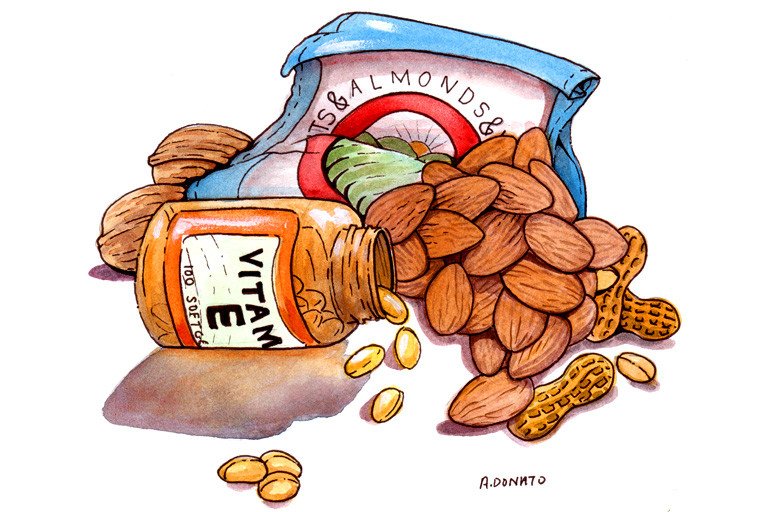
Vitamin E, also known as alpha-tocopherol, is a natural antioxidant that is found in foods such as plant oils, eggs, nuts, green leafy vegetables, and whole grains. Its major function is to neutralize free radicals, meaning that it protects cells from their damaging effects. Therefore, vitamin E is being investigated in conditions such as Alzheimer’s disease and cancer, in which free radical damage is known to play a part.
Clinical trials show that vitamin E supplementation does not help prevent cardiovascular disease, and it may increase risk for a certain kind of stroke. Data on whether it can reduce cancer risk are also mixed, and under some circumstances taking vitamin E supplements may actually increase risk. For chronic disease prevention including conditions such as heart disease and cancer, a meta-analysis concludes that nutrients like vitamin E are best obtained from the diet.
-
To prevent progression of Alzheimer’s disease
One clinical trial showed that vitamin E reduced progression of Alzheimer’s disease. A few population-based studies suggest that high dietary intake of vitamin E may lower risk of developing Alzheimer’s disease. -
To prevent cancer
Data on whether Vitamin E supplementation can reduce cancer risk are mixed. Large population-based studies suggest it may reduce risk of prostate and colorectal cancers in male smokers. However, initial data from the SELECT Trial shows vitamin E taken alone or with selenium for 5 years did not reduce prostate cancer risk, and even increased risk after 7-year follow-up. Vitamin E also had no effect on lung, urinary tract, pancreas, mouth or stomach cancer risks. Another trial in patients with head and neck cancers found that patients who received vitamin E had a higher rate of second primary cancers compared with placebo, and that vitamin E may interfere with radiation therapy. -
To manage cardiovascular disease
Data from clinical trials show that vitamin E supplementation does not help prevent heart disease, and it may increase risk for a certain kind of stroke. For chronic disease prevention, a meta-analysis concludes that nutrients like Vitamin E are best obtained from the diet.
- Symptoms of vitamin E toxicity from long-term consumption include fatigue, dizziness, weakness, rash, and vein inflammation due to a blood clot.
- Vitamin E supplementation may increase stroke risk.
Patient Warnings:
- An analysis of commercially available vitamin E supplements found the actual content to vary considerably from the labeled dosage, from 41% less to 57% more than the labeled amounts.
- This product is regulated by the FDA as a dietary supplement and is not required to be manufactured under specific standardized conditions. Therefore, it may not have been tested for safety or effectiveness, may not contain the labeled amount, or may be contaminated.
Do Not Take if:
- You are taking warfarin or other blood thinners: Doses of vitamin E greater than 400 IU per day may increase the risk of bleeding. PT and INR should be monitored if vitamin E is started or discontinued.
Special Point:
- Vitamin E supplements derived from plant oils contain d-alpha-tocopherol, which is believed to be the active form, while synthetic vitamin E supplements are a mixture of d-alpha-tocopherol and l-alpha-tocopherol (inactive forms).
- It is controversial whether antioxidants like vitamin E can lessen or negate the effects of chemotherapy and radiation therapy. Because these therapies work by creating free radicals that kill cancer cells, some physicians have suggested that high levels of antioxidants can neutralize these free radicals and thereby protect cancer cells from these therapies. So what protects healthy cells may protect cancer cells as well. This question is still not fully understood and patients who are interested in taking more than the RDA of any antioxidant should consult with their doctor.
For Healthcare Professionals
Vitamin E is a fat-soluble vitamin derived from plants. Natural food sources include plant oils, wheat germ, eggs, green leafy vegetables, and whole grains (3). Vitamin E acts as an antioxidant and is thought to help prevent and treat many diseases. Although it is available in a variety of formulations, only the d-isomer is considered active (1).
Studies suggest Vitamin E may slow the progression of Alzheimer’s disease (9) (15) (16) (18). However, long-term supplementation did not reduce incidence of dementia (23) or slow cognitive deterioration (24), and another study does not support the utility of antioxidants (vitamin E, vitamin C, lipoid acid, and Coenzyme Q) for Alzheimer’s disease (43). It was also ineffective in arresting the development or progression of macular degeneration (14) and early Parkinson’s Disease (21).
Vitamin E did not decrease the incidence of acute respiratory tract infections (12), reduce mortality, or reduce the risk of cardiovascular death or cerebrovascular accident (26) (51). When taken along with vitamin C, vitamin E may increase mortality and nonfatal myocardial infarction in patients with coronary artery disease (13). Further, findings from the recent Physicians’ Health Study II show that neither vitamin E nor C is beneficial in preventing cardiovascular events, and vitamin E may actually increase stroke risk (36). The Women’s Health Study also failed to find any benefit of vitamin E supplementation in lowering the risk of heart failure in healthy women (42). A meta-analysis showed that vitamin E increases the risk for hemorrhagic stroke but reduces the risk of ischemic stroke (38). Vitamin E may reduce symptoms of nonalcoholic steatohepatitis in adults (45), but not in children and adolescents (46).
Vitamin E may have a preventive effect on bone loss in postmenopausal osteopenic women (52) and improve male infertility (53).
Limited studies on Vitamin E to improve symptoms in cancer patients suggest it may help relieve hot flashes in breast cancer survivors (27) and prevent symptoms of CIPN (54), reduce incidence of cisplatin-induced neurotoxicity (22) (25), and prevent radiodermatitis in breast cancer patients (55).
Data on whether Vitamin E supplementation can reduce cancer risk are mixed (19) (20) (37) (44) (49) (51) (56), and some studies even suggest it may increase cancer risk (28) (33) (48). In prostate cancer, data from the SELECT trial showed that vitamin E alone or with selenium for 5 years did not reduce prostate cancer risk (35), and significantly increased risk at 7 years’ follow-up (41). Vitamin E taken with soy and selenium also did not prevent prostate cancer progression (40).
Some studies suggest an association between dietary tocopherol and reduced risks for lung (38) (48) and liver (44) cancers. In addition, a meta-analysis supports dietary intake of various nutrients including alpha-tocopherol, but not antioxidant supplement use, for chronic disease prevention (50).
Toxicity may occur with chronic supplementation of vitamin E in doses greater than 800 IU. Daily supplementation over 400 IU may increase all-cause mortality (29). Vitamin E may also enhance the activity of warfarin. In a large study of patients treated with warfarin, higher serum vitamin E levels predicted hemorrhagic events (4).
- Alzheimer’s disease
- Cancer
- Cardiovascular disease
Vitamin E is a fat-soluble vitamin that acts as an antioxidant. The natural form of vitamin E is composed of 4 different tocopherols and 4 different tocotrienol homologues (alpha, beta, delta, and gamma). All 8 forms have antioxidant activity, but recent data indicate the different homologues have different activities unrelated to antioxidant effects (34).
Gamma-tocopherol is a stronger inhibitor of cyclooxygenase and traps reactive oxygen species more effectively than alpha-tocopherol. In vitro and in vivo, gamma-tocopherol exhibits antiproliferative and proapoptotic effects whereas alpha-tocopherol does not (34). While both alpha- and gamma-tocopherols exhibit anti-inflammatory effects in vitro and in vivo, gamma-enriched mixed tocopherols may have more activity than alpha-tocopherols. This may help explain the negative outcomes of recent large-scale intervention studies that used only the alpha homologue (34).
The d-alpha-tocopherol isomer is believed to be the active principle. Natural vitamin E supplements contain d-alpha-tocopherol derived from plant oil sources, whereas synthetic supplements are composed of a racemic mixture of d- and l-alpha-tocopherols. The major function of d-alpha-tocopherol is to prevent the propagation of free radical reactions by acting as a peroxyl radical scavenger and protecting polyunsaturated fatty acids (PUFAs) in membrane phospholipids and plasma lipoproteins. Alpha-tocopherol reportedly causes inhibition of protein kinase C activity, which is involved in cell proliferation and differentiation in smooth muscle cells, human platelets, and monocytes. Vitamin E enrichment of endothelial cells downregulates expression of intercellular and vascular cell adhesion molecules to decrease adhesion of blood cell components to the endothelium. Vitamin E also upregulates expression of cytosolic phospholipase A2 and cyclooxegenase-1, which leads to release of prostacyclin, a vasodilator and inhibitor of platelet aggregation in humans (3).
In an animal study, vitamin E increased lung cancer cell proliferation due to its antioxidant activity by reducing reactive oxygen species, DNA damage, and p53 expression (47).
An analysis of commercially available vitamin E supplements found the actual content to vary considerably from the labeled dosage, from 41% less to 57% more than labeled amounts (5).
Vitamin E supplementation may increase the risk of hemorrhagic stroke (36).
Toxicity: Thrombophlebitis; long-term consumption of doses greater than or equal to 400–800 IU per day may cause fatigue, dizziness, weakness, and rash (3) (6).
Coagulopathy: In a 31-year-old male due to toxicity related to use of vitamin E for hair loss (57).
Lipogranuloma characterized by inflammation, edema, erythema, and tenderness: Following use of vitamin E injection for cosmetic facial rejuvenation (58).
Warfarin: In a large study of patients treated with warfarin, higher serum vitamin E levels predicted hemorrhagic events (4).
Although many research protocols use milligrams of vitamin E, most commercial products are sold in international units (IU). One IU natural vitamin E equals 0.67 mg d-alpha-tocopherol and one IU of synthetic vitamin E equals 0.45 mg d-alpha-tocopherol.