Common Names
- Stabilized oxygen
For Patients & Caregivers
Tell your healthcare providers about any dietary supplements you’re taking, such as herbs, vitamins, minerals, and natural or home remedies. This will help them manage your care and keep you safe.
Vitamin O does not treat or cure cancer.
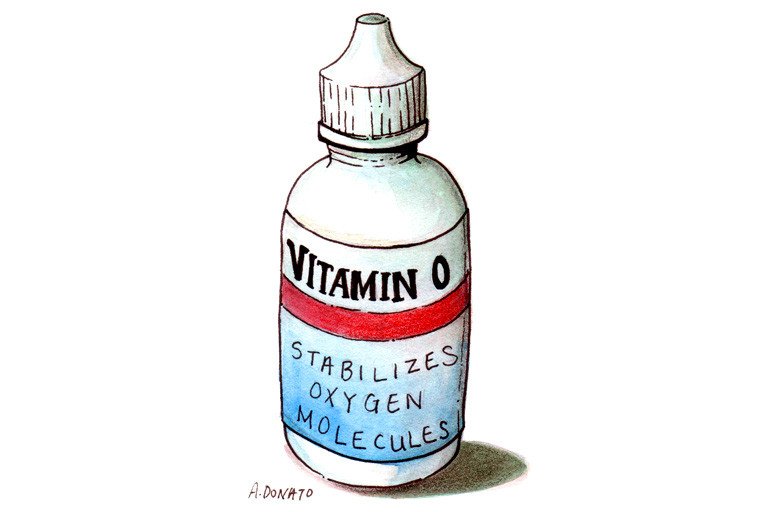
Vitamin O is a dietary supplement that is marketed on the Internet. Supporters claim that it contains a high concentration of oxygen molecules (30,000 parts per million) dissolved in distilled water. This is unlikely because the maximum solubility of oxygen in water at room temperature is only 7500 parts per million.
Vitamin O as oxygen therapy is based on the idea that cancer and many other diseases are caused by a build-up of toxins from pollution, processed foods, and other factors. Promoters believe that by supplying high levels of oxygen to the body, vitamin O can detoxify the organs and kill cancer cells.
Animal studies suggest inhaling oxygen-rich air, absorbed through the lungs, has anticancer activities. However, taking oxygen supplements by mouth is unlikely to have the same effect.
None of the following claims is supported by scientific evidence:
- To treat arthritis
- To prevent and treat cancer
- To manage heart disease
- To treat lung disease
- To sharpen the mind
- To treat infections, such as the flu and the common cold
- To treat headaches
- To treat HIV and AIDS
- To lower high blood pressure
- To promote sleep
- To improve recovery from illness
- To relieve stress
- To improve strength and stamina
Patient Warnings:
- In March 1999, the Federal Trade Commission (F.T.C.) charged Rose Creek Health Products, Inc., and Staff of Life, Inc., the producers of Vitamin O, with making false health claims. These companies had to pay $375,000 in consumer compensation and are barred from selling this product under false pretenses that it will benefit people with cancer, HIV/AIDS, heart disease, lung disease, or other chronic illnesses.
- No health claim made for Vitamin O has ever been supported.
Special Point:
- This product is not supported by any scientific evidence.
For Healthcare Professionals
As a dietary supplement advertised on the Internet and elsewhere, Vitamin O is promoted to prevent and treat cancer, HIV/AIDS, cardiovascular disease, pulmonary disease, and other chronic illnesses by detoxifying the body and improving metabolism via high doses of molecular oxygen. It is purported to contain 30,000 ppm stabilized oxygen molecules in a solution of sodium chloride and distilled water. The anticancer activity of vitamin O is based on the theory that cancer cells grow in an oxygen-poor environment and cannot proliferate in oxygen-rich conditions.
Vitamin O was advertised in national newspapers for mail-order purchase until the Federal Trade Commission (FTC) filed a complaint against its marketers, Rose Creek Health Products, Inc., and Staff of Life, Inc., in March 1999. The FTC found, contrary to the advertisement claims, that Vitamin O does not allow oxygen molecules to be absorbed through the gastrointestinal system, does not prevent or treat any physical ailment or disease, does not have a beneficial effect on human health, has not been proven effective by medical or scientific research, and was not developed by NASA for use of astronauts (1).
- Arthritis
- Cancer
- Heart disease
- Lung disorders
- Cognition
- Infections
- Recovery
Supposed efficacy is based on the idea that most degenerative diseases result from decreased levels of atmospheric oxygen caused by industry and deforestation. Stress, toxins, and modern diets of processed foods, fats, sugar, alcohol, white flour, and caffeine are said to make the body oxygen-deficient because more oxygen is required to metabolize them (1).
Vitamin O marketers misappropriate the discovery of higher atmospheric oxygen levels in past geologic eras to conclude that the human body evolved to function at higher concentrations of oxygen than is now available; the dissolved oxygen content of most people’s bodies is considerably lower than that needed to maintain sufficient metabolism; and that the lower the level of dissolved oxygen in a person’s body, the greater the susceptibility to disease.
While supplemental respiratory oxygen is thought to have anticancer activities by enhancing T cells and NK cells (3), none of the claims on oral vitamin O supplement are supported by laboratory or clinical evidence.
The Federal Trade Commission charged the marketers of Vitamin O with making false health claims in March 1999, for which marketers paid $375,000 in consumer compensation (2). None of the health claims made for Vitamin O has been substantiated.