Health Care Professional Information
Brand Name
Vitamin O (Manufactured by Rose Creek Health Products, Inc., and Staff of Life, Inc.)
Clinical Summary
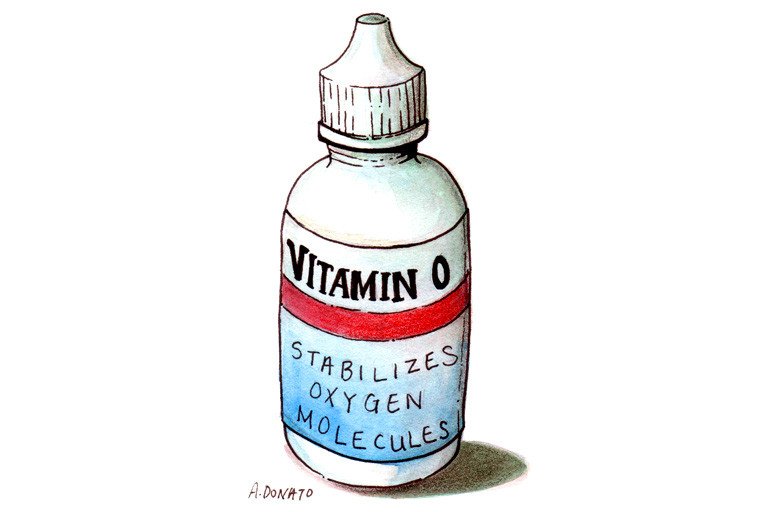
Dietary supplement advertised on the Internet and elsewhere, Vitamin O is promoted to prevent and treat cancer, HIV/AIDS, cardiovascular disease, pulmonary disease, and other chronic illnesses by detoxifying the body and improving metabolism via high doses of molecular oxygen. It is purported to contain 30,000 ppm stabilized oxygen molecules in a solution of sodium chloride and distilled water. The anticancer activity of vitamin O is based on the theory that cancer cells grow in an oxygen-poor environment and cannot proliferate in oxygen-rich conditions.
Vitamin O was advertised in national newspapers for mail-order purchase until the Federal Trade Commission (FTC) filed a complaint against its marketers, Rose Creek Health Products, Inc., and Staff of Life, Inc., in March 1999. The FTC found, contrary to the advertisement claims, that Vitamin O does not allow oxygen molecules to be absorbed through the gastrointestinal system, does not prevent or treat any physical ailment or disease, does not have a beneficial effect on human health, has not been proven effective by medical or scientific research, and was not developed by NASA for use of astronauts (1).
Purported Uses
- Arthritis
- Cancer prevention
- Cancer treatment
- Cardiovascular disease
- Chronic obstructive pulmonary disorders
- Cognitive improvement
- Common cold
- Headaches
- HIV and AIDS
- Hypertension
- Infections
- Influenza
- Insomnia
- Recovery from illness
- Relaxation
- Strength and stamina
Mechanism of Action
Vitamin O's supposed efficacy is based on the idea that most degenerative diseases (e.g., cancer, arthritis, heart disease, Alzheimer's disease, and chronic fatigue syndrome) result from decreasing level of atmospheric oxygen caused by industry and deforestation. Stress, toxins, and the modern diet of processed foods, fats, sugar, alcohol, white flour, and caffeine are said to make the body oxygen deficient because more oxygen is required to metabolize them (1). Vitamin O's marketers misappropriate the discovery of higher atmospheric oxygen levels in past geologic eras to conclude that the human body evolved to function at higher concentrations of oxygen than is now available; and that the dissolved oxygen content of most people's bodies is considerably lower than that needed to maintain sufficient metabolism; lower the level of dissolved oxygen in a person's body, the greater the susceptibility to disease. None of the claims is supported by laboratory or clinical evidence.
Pharmacokinetics
No formal pharmacokinetic studies have been performed.
Warnings
The Federal Trade Commission charged the marketers of Vitamin O with making false health claims in March 1999, for which the marketers paid $375,000 in consumer compensation (2). None of the health claims made for Vitamin O has been substantiated.
Literature Summary and Critique
Vitamin O supplements have not been evaluated in laboratory or clinical studies.
References
- Federal Trade Commission v. Rose Creek Health Products, Inc., The Staff of Life, Inc., and Donald L. Smyth. Complaint For Permanent Injunction and Other Equitable Relief. March 15, 1999. Available at: http://www.ftc.gov/os/1999/03/rosecreekcmp.htm. Accessed March 21, 2011.
- Federal Trade Commission. “Marketers of 'Vitamin O' Settles FTC Charges of Making False Health Claims; Will Pay $375,000 for Consumer Redress.” News release; May 1, 2000. Available at: http://www.ftc.gov/opa/2000/05/rosecreek2.htm. Accessed March 21, 2011.
Consumer Information
How It Works
Bottom Line: Vitamin O does not treat or cure cancer.
Vitamin O is a dietary supplement that is marketed on the Internet. Supporters claim that it contains a high concentration of oxygen molecules (30,000 parts per million) dissolved in distilled water, which is unlikely because the maximum solubility of oxygen in water at room temperature is only 7500 parts per million. Vitamin O can be classified as an oxygen therapy because it is based on the idea that cancer and many other diseases are caused by a build-up of toxins in the body due to pollution, processed foods, and other factors. Promoters believe that by supplying high levels of oxygen to the body, vitamin O can detoxify the organs and kill cancer cells. Studies have shown that this is not true. Laboratory studies show that cancer cells grow rapidly when supplied with high levels of oxygen, and that low levels of oxygen do not cause the formation of new cancer cells. Secondly, oxygen is absorbed through the thin linings of the lungs, not the thick mucosal surfaces of the GI tract.
Purported Uses
None of the following claims is supported by scientific evidence:
- To treat arthritis
- To prevent and treat cancer
- To manage heart disease
- To treat lung disease
- To sharpen the mind
- To treat infections, such as the flu and the common cold
- To treat headaches
- To treat HIV and AIDS
- To lower high blood pressure
- To promote sleep
- To improve recovery from illness
- To relieve stress
- To improve strength and stamina
Research Evidence
The safety or efficacy of Vitamin O have not been tested.
Patient Warnings
- In March 1999, the Federal Trade Commission (F.T.C.) charged Rose Creek Health Products, Inc., and Staff of Life, Inc., the producers of Vitamin O, with making false health claims; these companies had to pay $375,000 in consumer compensation and are barred from selling this product under false pretenses that it will benefit people with cancer, HIV/AIDS, heart disease, lung disease, or other chronic illnesses.
- No health claim made for Vitamin O has ever been supported.
Special Point
- This product is not supported by any scientific evidence.
Last updated: January 21, 2013
blood (blud)
A tissue with red blood cells, white blood cells, platelets, and other substances suspended in fluid called plasma. Blood takes oxygen and nutrients to the tissues, and carries away wastes.
Source: The National Cancer Institute's Dictionary of Cancer Terms
(http://www.cancer.gov/dictionary)
cancer (KAN-ser)
A term for diseases in which abnormal cells divide without control and can invade nearby tissues. Cancer cells can also spread to other parts of the body through the blood and lymph systems. There are several main types of cancer. Carcinoma is a cancer that begins in the skin or in tissues that line or cover internal organs. Sarcoma is a cancer that begins in bone, cartilage, fat, muscle, blood vessels, or other connective or supportive tissue. Leukemia is a cancer that starts in blood-forming tissue such as the bone marrow, and causes large numbers of abnormal blood cells to be produced and enter the blood. Lymphoma and multiple myeloma are cancers that begin in the cells of the immune system. Central nervous system cancers are cancers that begin in the tissues of the brain and spinal cord. Also called malignancy.
Source: The National Cancer Institute's Dictionary of Cancer Terms
(http://www.cancer.gov/dictionary)
cardiovascular (KAR-dee-oh-VAS-kyoo-ler)
Having to do with the heart and blood vessels.
Source: The National Cancer Institute's Dictionary of Cancer Terms
(http://www.cancer.gov/dictionary)
chronic (KRAH-nik)
A disease or condition that persists or progresses over a long period of time.
Source: The National Cancer Institute's Dictionary of Cancer Terms
(http://www.cancer.gov/dictionary)
clinical (KLIH-nih-kul)
Having to do with the examination and treatment of patients.
Source: The National Cancer Institute's Dictionary of Cancer Terms
(http://www.cancer.gov/dictionary)
detoxify (dee-TOK-sih-fy)
To make something less poisonous or harmful. It may refer to the process of removing toxins, poisons, or other harmful substances from the body.
Source: The National Cancer Institute's Dictionary of Cancer Terms
(http://www.cancer.gov/dictionary)
efficacy (EH-fih-kuh-see)
Effectiveness. In medicine, the ability of an intervention (for example, a drug or surgery) to produce the desired beneficial effect.
Source: The National Cancer Institute's Dictionary of Cancer Terms
(http://www.cancer.gov/dictionary)
GI
Refers to the stomach and intestines. Also called gastrointestinal.
Source: The National Cancer Institute's Dictionary of Cancer Terms
(http://www.cancer.gov/dictionary)
HIV
The cause of acquired immunodeficiency syndrome (AIDS). Also called human immunodeficiency virus.
Source: The National Cancer Institute's Dictionary of Cancer Terms
(http://www.cancer.gov/dictionary)
L
A measure of volume for a liquid, using the metric system. One L is equal to 1,000 cubic centimeters (cc), 1,000 milliliters (mm), or 1.0567 quarts (qt). Also called liter.
Source: The National Cancer Institute's Dictionary of Cancer Terms
(http://www.cancer.gov/dictionary)
lung (lung)
One of a pair of organs in the chest that supplies the body with oxygen, and removes carbon dioxide from the body.
Source: The National Cancer Institute's Dictionary of Cancer Terms
(http://www.cancer.gov/dictionary)
oxygen (OK-sih-jen)
A colorless, odorless gas. It is needed for animal and plant life. Oxygen that is breathed in enters the blood from the lungs and travels to the tissues.
Source: The National Cancer Institute's Dictionary of Cancer Terms
(http://www.cancer.gov/dictionary)
pulmonary (PUL-muh-NAYR-ee)
Having to do with the lungs.
Source: The National Cancer Institute's Dictionary of Cancer Terms
(http://www.cancer.gov/dictionary)
vitamin (VY-tuh-min)
A nutrient that the body needs in small amounts to function and stay healthy. Sources of vitamins are plant and animal food products and dietary supplements. Some vitamins are made in the human body from food products. Vitamins are either fat-soluble (can dissolve in fats and oils) or water-soluble (can dissolve in water). Excess fat-soluble vitamins are stored in the body’s fatty tissue, but excess water-soluble vitamins are removed in the urine. Examples are vitamin A, vitamin C, and vitamin E.
Source: The National Cancer Institute's Dictionary of Cancer Terms
(http://www.cancer.gov/dictionary)
will (wil)
A legal document in which a person states what is to be done with his or her property after death, who is to carry out the terms of the will, and who is to care for any minor children.
Source: The National Cancer Institute's Dictionary of Cancer Terms
(http://www.cancer.gov/dictionary)