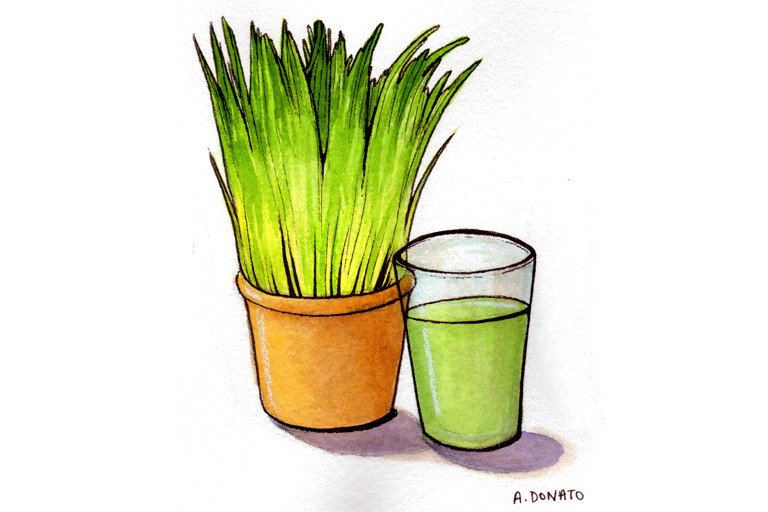
Common Names
- Wheatgrass
- Couchgrass
For Patients & Caregivers
Tell your healthcare providers about any dietary supplements you’re taking, such as herbs, vitamins, minerals, and natural or home remedies. This will help them manage your care and keep you safe.
Wheat grass juice has not been shown effective in treating cancer or AIDS.
The juice extracted from the leaves of wheat grass is believed to prevent tooth decay, reduce high blood pressure and arthritis pain, and treat chronic fatigue syndrome and the common cold. It is also being promoted as a cure for cancer and AIDS. Proponents of wheat grass believe that the chlorophyll present in the leaves increases hemoglobin content in the blood because both molecules are similar in structure. It is also thought that the enzymes present in wheat grass help rid the body of toxins and carcinogens. However, none of these claims is backed by scientific studies.
Wheat grass is not known to cause any serious side effects. However, the juice can be contaminated with mold or bacteria as the leaves are grown for 7–10 days before the juice is extracted.
-
AIDS
There is no scientific evidence that wheat grass prevents or treats AIDS. -
Chronic fatigue syndrome
No scientific evidence supports this use. -
Cancer treatment
There is no scientific evidence that wheat grass prevents or treats cancer. -
Strengthen immune system
A small study showed that wheat grass juice reduced fever and infection in patients receiving chemotherapy, but some patients also had nausea from ingesting wheat grass. Larger studies are needed. -
Reduce serum iron level
There is a small study showing wheat grass juice can act as a chelator and help reduce iron levels in patients with myelodysplastic syndrome. -
Ulcerative colitis
One small study has shown that wheat grass can relieve symptoms associated with chronic colon inflammation.
- Nausea, difficulties in swallowing the juice due to strong grass-like taste.
- Contamination by microbials is possible as wheat grass sprouts are grown for 7–10 days before the leaves are harvested.
For Healthcare Professionals
Wheat grass is prepared by sprouting wheat seeds in water for 7–10 days before harvesting the leaves. Because the leaves are fibrous and difficult to digest, the juice from the leaves is extracted and consumed raw. Proponents believe the enzymes responsible for detoxifying the body are deactivated by the cooking process. Wheat grass is also marketed as a nutritional supplement in powder form.
Wheat grass juice has been claimed to neutralize toxins and carcinogens in the body, prevent tooth decay, reduce high blood pressure, and aid in the treatment and prevention of cancer and AIDS. It is also used to improve digestion, and for common colds, cough, rheumatic pain, chronic fatigue syndrome, ulcers, and skin conditions. However, none of these claims are supported by clinical studies.
Wheat grass proponents also equate its major constituent chlorophyll to hemoglobin, and believe that wheat grass consumption can increase oxygenation in the body. However, these concepts are not supported by current scientific understanding.
Animal models suggest that wheat grass may have hypolipidemic (1) and antioxidant (2) effects. Preliminary studies in humans suggest wheat grass supplementation may reduce plasma lipid peroxidation in healthy volunteers engaged in regular exercise (3) or atherogenic lipoproteins in hyperlipidemic women (14). A small study and systematic review indicate that wheat grass juice may be helpful for ulcerative colitis (4) (5). Other studies are mixed on whether it can reduce the need for transfusions in patients with thalassemia major (6) (7) (8). Wheat grass juice may decrease myelotoxicity in breast cancer patients undergoing chemotherapy (9). There is also a report that it can reduce serum ferritin in patients with myelodysplastic syndrome (13). Larger studies are needed to evaluate these findings.
Nausea has been reported following consumption of wheat grass juice. Because it is consumed raw, microbial contamination is also a concern.
- AIDS
- Cancer
- Chronic fatigue
- Immunostimulation
- Ulcerative colitis
Wheat grass is a natural source of vitamins and minerals including vitamins A, C, E, K and B-complex, as well as iron, calcium, magnesium, and selenium. It also contains chlorophyll, amino acids, bioflavonoids such as apigenin, and phenolic compounds (3) (9) (10) (11). Some components may have antioxidant effects, as increases in glutathione and vitamin C levels have been noted (2) (4). Reductions in neutropenic fever and infection with wheat grass may relate to anti-inflammatory properties of apigenin, which can inhibit adhesion of leucocytes to endothelial cells (9) (12). Some constituents may have iron chelation activity (13).
In animal models, hypolipidemic effects occur through increased fecal cholesterol excretion (1), decreased total cholesterol and malondialdehyde levels, and increased high-density lipoprotein cholesterol (2).
Claims that raw wheat grass can “detoxify” the body and that chlorophyll can augment hemoglobin production are not supported by scientific evidence.
Nausea, difficulties in swallowing the juice due to strong grass-like taste (9).
Because wheat grass is grown for a period of 7–10 days before harvesting leaves, microbial contamination is possible. This may cause harmful effects upon ingestion.