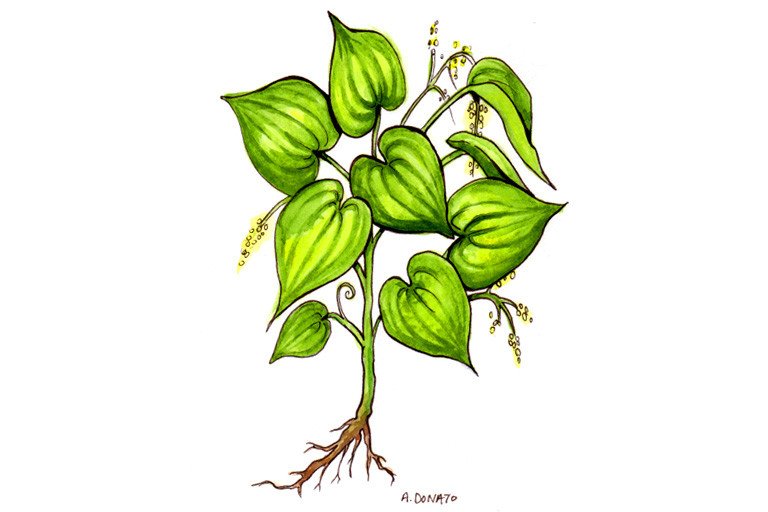
Common Names
- Colic root
- Devil’s bones
- Rheumatism root
- Yuma
- Wild yam root
For Patients & Caregivers
Tell your healthcare providers about any dietary supplements you’re taking, such as herbs, vitamins, minerals, and natural or home remedies. This will help them manage your care and keep you safe.
There is limited mixed evidence on whether wild yam might be helpful for menopausal symptoms.
Wild yam contains a compound called diosgenin that mimics estrogen and progesterone in animals. Diosgenin can be converted into active steroid compounds in the lab.
Studies in humans are quite limited. Data show mixed results on menopausal symptoms in a few small studies that use different species and formulas of wild yam extract. Another small study suggests that increasing yam intake through diet may improve sex hormone and cholesterol levels.
A lab study showed that wild yam extract has weak hormonal activity against human breast cancer cells, but this does not mean it can prevent or treat cancer.
More studies are needed to confirm whether wild yam or its extract actually has any benefits. Because wild yam has estrogenic effects, patients with hormone-sensitive cancers should talk to their physicians before consumption.
- To relieve menopausal symptoms
Wild yam has had mixed results in small studies. More research is needed. - To improve cough
Supporting evidence is lacking. - To treat rheumatoid arthritis
Supporting evidence is lacking.
For Healthcare Professionals
Derived from the root of a twining vine, wild yam was traditionally used for its antispasmodic and anti-inflammatory properties to treat menopausal symptoms, gastrointestinal ailments, muscle spasm, asthma, joint pain, and rheumatoid arthritis (1) (2).
Wild yam has antiproliferative (3) and antimitotic effects (4) in vitro. Animal models suggest antinociceptive, anti-inflammatory, and antidiabetic effects (1) (18) (24). In other preclinical studies, the active constituent diosgenin had estrogenic and progestogenic effects (3) (5) (6) (7) (19) and restored moderately decreased sperm motility in mice (20). Dioscorin, another protein, appeared to reduce weight gain and total visceral lipids, and improve impaired glucose tolerance in mice (21).
Small studies on whether wild yam can relieve menopausal symptoms are mixed: one suggested that an oral D. alata formula was more effective than placebo (8), but another showed a topical D. villosa formula was ineffective (9). In other small studies, an oral diosgenin-rich yam extract appeared to enhance cognitive function (22), and sex hormone and lipid profiles appeared to improve with dietary yam intake (10). However, larger studies are needed to confirm whether wild yam in any form actually has any benefits for menopausal symptoms.
Wild yam extract is sold as a dietary supplement, liquid extract, or cream. Diosgenin in wild yam has been used as raw material for synthetic progesterone, but there is no evidence that the human body can convert diosgenin into progesterone. Because wild yam has estrogenic effects, patients with hormone-sensitive cancers should talk to their physicians before consumption.
- Arthritis
- Cough
- Menopause
The steroid saponin diosgenin in wild yam modulates cell signaling involved in growth, differentiation, apoptosis, and oncogenesis (14). In vitro studies suggest wild yam extract protects against human breast cancer proliferation by acting as a weak phytoestrogen (3). A molecular docking study of estrogen mimics in phytochemicals from dietary herbal supplements found that D. villosa docked strongly with the estrogen receptor (23). However, the D. villosa species has been noted to induce chronic kidney injury via profibrotic pathways in animal models (15).