Health Care Professional Information
Common Name
Colic root, china root, devil’s bones, rheumatism root, yuma, wild yam root
Clinical Summary
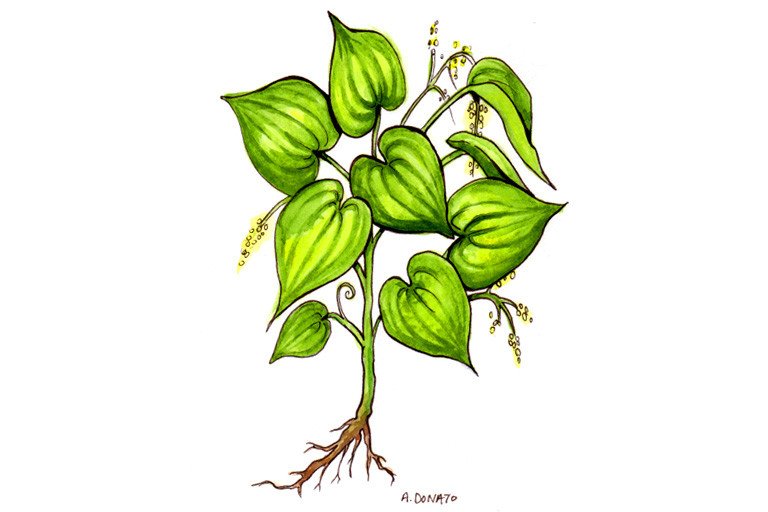
Derived from the root of a twining vine. Wild yam was traditionally thought to have antispasmodic properties and was promoted for gastrointestinal and menstrual dysfunction (1). Diosgenin, a saponin found in wild yam was shown to have estrogenic and progestogenic effects in mice (2) (3) (4) (9), but there is no scientific evidence that this substance can be converted into hormones (1). It also demonstrated antiproliferative effects in vitro (10), but failed to relieve menopausal symptoms (5).
Side effects are minimal; however, large doses can cause nausea, vomiting and diarrhea (1).
Patients should be warned that some wild yam extract creams have been promoted as a natural source of progesterone, but they were found to contain synthetic progesterone (6).
Purported Uses
- Amenorrhea
- Colic
- Cough
- Dysmenorrhea
- GI disorders
- Menopausal symptoms
- Pregnancy-related nausea and vomiting
- Rheumatoid arthritis
- Sexual dysfunction
- Spasms
- Urinary tract disorders
Mechanism of Action
Most theories suggest that the active ingredient in wild yam is the steroid saponin, diosgenin. Diosgenin has been shown to stimulate mammary gland growth (2) and reduce body weights (3) in ovariectomized mice. Diosgenin does not exist freely in wild yam but rather as the saponins dioscin and gracillin. It is thought that diosgenin can be converted by the human body into progesterone and other steroid hormones via dehydroepiandrosterone (DHEA). No scientific evidence supports this theory of internal conversion (1) (6).
Pharmacokinetics
Animal studies show that diosgenin is poorly absorbed. The absorbed portion is quickly distributed into the liver, adrenals and walls of the gastrointestinal tract and undergoes extensive biotransformation. Diosgenin and the metabolites are eliminated through the bile and excreted in the feces (7) (8).
Warnings
Patients should be warned that creams containing extracts of wild yam have been promoted as a natural source of progesterone, when in reality they contain synthetic progesterone not connected to wild yam (6).
Contraindications
Patients with hormone-sensitive cancers should avoid wild yam because it has weak estrogenic activity.
Dosage (Inside MSKCC Only)
This field is only visible to only Inside MSKCC users.
References
- DerMarderosian A. The Review of Natural Products. St. Louis: Facts and Comparisons, 1999.
- Aradhana, Rao AR, Kale RK. Diosgenin—a growth stimulator of mammary gland of ovariectomized mouse. Indian J Exp.Biol 1992;30:367-70.
- Benghuzzi H, Tucci M, Eckie R, Hughes J. The effects of sustained delivery of diosgenin on the adrenal gland of female rats. Biomed.Sci.Instrum. 2003;39:335-40.
- Accatino L, Pizarro M, Solis N, Koenig CS. Effects of diosgenin, a plant-derived steroid, on bile secretion and hepatocellular cholestasis induced by estrogens in the rat. Hepatology 1998;28:129-40.
- Komesaroff PA, Black CV, Cable V, Sudhir K. Effects of wild yam extract on menopausal symptoms, lipids and sex hormones in healthy menopausal women.Climacteric. 2001;4:144-50.
- Schulz V, Hansel R, Tyler VE. Rational Phytotherapy: A Physician's Guide to Herbal Medicine. New York: Springer, 2001.
- Cayen MN, Ferdinandi ES, Greselin E, Dvornik D. Studies on the disposition of diosgenin in rats, dogs, monkeys and man. Atherosclerosis 1979;33:71-87. PM:
- Juarez-Oropeza MA, Diaz-Zagoya JC, Rabinowitz JL. In vivo and in vitro studies of hypocholesterolemic effects of diosgenin in rats. Int J Biochem. 1987;19:679-83.
- Park MK, Kwon HY, Ahn WS, et al. Estrogen activities and the cellular effects of natural progesterone from wild yam extract in mcf-7 human breast cancer cells. Am J Chin Med. 2009;37(1):159-67.
-
Wojcikowski K, Wohlmuth H, Johnson DW, Gobe G. Dioscorea villosa (wild yam) induces chronic kidney injury via pro-fibrotic pathways. Food Chem Toxicol. 2008 Sep;46(9):3122-31.
Consumer Information
How It Works
Bottom Line: Wild yam has not been shown to prevent or treat cancer.
The roots of wild yam contain a compound called diosgenin, which showed hormonal effects that mimic estrogen and progesterone in animals. Diosgenin can be converted into other biologically active steroidal compounds in the lab and the semisynthetic form was used in early birth control pills. However, scientific study has found no evidence of such conversion in humans. A clinical trial of wild yam product on menopausal women did not show reduction in menopausal symptoms compared to a placebo.
Purported Uses
- To relieve menopausal symptoms.
Wild yam had no effect on menopausal symptoms in a clinical trial.
- To relieve menstrual dysfunction.
No scientific evidence supports this use.
- To reduce anxiety.
This is not backed by any studies.
- To treat colic.
No scientific evidence supports this use.
- To improve cough.
There are no studies to support this.
- To relieve colic and other spasms of the bowel.
No scientific evidence supports this use.
- To relieve nausea during pregnancy.
There is only anecdotal evidence.
- To treat rheumatoid arthritis.
No scientific evidence supports this use.
- To treat urinary tract disorders.
This claim is not backed by clinical evidence.
Patient Warnings
- Patients should use caution as creams containing wild yam are promoted as a natural source of the steroid progesterone.
Do Not Take If
You have hormone-sensitive cancer (wild yam has weak estrogenic activity).
Side Effects
Reported: Large doses can cause nausea, vomiting and diarrhea (6).
Last updated: September 27, 2012
clinical (KLIH-nih-kul)
Having to do with the examination and treatment of patients.
Source: The National Cancer Institute's Dictionary of Cancer Terms
(http://www.cancer.gov/dictionary)
clinical trial (KLIH-nih-kul TRY-ul)
A type of research study that tests how well new medical approaches work in people. These studies test new methods of screening, prevention, diagnosis, or treatment of a disease. Also called clinical study.
Source: The National Cancer Institute's Dictionary of Cancer Terms
(http://www.cancer.gov/dictionary)
compound (KOM-pownd)
In science, a substance that is made up of more than one ingredient.
Source: The National Cancer Institute's Dictionary of Cancer Terms
(http://www.cancer.gov/dictionary)
dehydroepiandrosterone (dee-HY-droh-EH-pee-an-DROS-teh-rone)
A substance being studied in the prevention of cancer. It is a type of steroid. Also called DHEA.
Source: The National Cancer Institute's Dictionary of Cancer Terms
(http://www.cancer.gov/dictionary)
diarrhea (dy-uh-REE-uh)
Frequent and watery bowel movements.
Source: The National Cancer Institute's Dictionary of Cancer Terms
(http://www.cancer.gov/dictionary)
estrogen (ES-truh-jin)
A type of hormone made by the body that helps develop and maintain female sex characteristics and the growth of long bones. Estrogens can also be made in the laboratory. They may be used as a type of birth control and to treat symptoms of menopause, menstrual disorders, osteoporosis, and other conditions.
Source: The National Cancer Institute's Dictionary of Cancer Terms
(http://www.cancer.gov/dictionary)
extract (EK-strakt)
In medicine, a preparation of a substance obtained from plants, animals, or bacteria and used as a drug or in drugs.
Source: The National Cancer Institute's Dictionary of Cancer Terms
(http://www.cancer.gov/dictionary)
GI
Refers to the stomach and intestines. Also called gastrointestinal.
Source: The National Cancer Institute's Dictionary of Cancer Terms
(http://www.cancer.gov/dictionary)
gland (gland)
An organ that makes one or more substances, such as hormones, digestive juices, sweat, tears, saliva, or milk. Endocrine glands release the substances directly into the bloodstream. Exocrine glands release the substances into a duct or opening to the inside or outside of the body.
Source: The National Cancer Institute's Dictionary of Cancer Terms
(http://www.cancer.gov/dictionary)
in vitro (in VEE-troh)
In the laboratory (outside the body). The opposite of in vivo (in the body).
Source: The National Cancer Institute's Dictionary of Cancer Terms
(http://www.cancer.gov/dictionary)
mammary (MA-muh-ree)
Having to do with the breast.
Source: The National Cancer Institute's Dictionary of Cancer Terms
(http://www.cancer.gov/dictionary)
nausea (NAW-zee-uh)
A feeling of sickness or discomfort in the stomach that may come with an urge to vomit. Nausea is a side effect of some types of cancer therapy.
Source: The National Cancer Institute's Dictionary of Cancer Terms
(http://www.cancer.gov/dictionary)
placebo (pluh-SEE-boh)
An inactive substance or treatment that looks the same as, and is given the same way as, an active drug or treatment being tested. The effects of the active drug or treatment are compared to the effects of the placebo.
Source: The National Cancer Institute's Dictionary of Cancer Terms
(http://www.cancer.gov/dictionary)
progesterone (proh-JES-teh-rone)
A type of hormone made by the body that plays a role in the menstrual cycle and pregnancy. Progesterone can also be made in the laboratory. It may be used as a type of birth control and to treat menstrual disorders, infertility, symptoms of menopause, and other conditions.
Source: The National Cancer Institute's Dictionary of Cancer Terms
(http://www.cancer.gov/dictionary)
reduction (ree-DUK-shun)
A chemical reaction that takes place when a substance comes into contact with hydrogen or another reducing substance.
Source: The National Cancer Institute's Dictionary of Cancer Terms
(http://www.cancer.gov/dictionary)
saponin (SA-poh-nin)
A substance found in soybeans and many other plants. Saponins may help lower cholesterol and may have anticancer effects.
Source: The National Cancer Institute's Dictionary of Cancer Terms
(http://www.cancer.gov/dictionary)
steroid (STAYR-oyd)
Any of a group of lipids (fats) that have a certain chemical structure. Steroids occur naturally in plants and animals or they may be made in the laboratory. Examples of steroids include sex hormones, cholesterol, bile acids, and some drugs.
Source: The National Cancer Institute's Dictionary of Cancer Terms
(http://www.cancer.gov/dictionary)
synthetic (sin-THEH-tik)
Having to do with substances that are man-made instead of taken from nature.
Source: The National Cancer Institute's Dictionary of Cancer Terms
(http://www.cancer.gov/dictionary)
urinary (YOOR-ih-NAYR-ee)
Having to do with urine or the organs of the body that produce and get rid of urine.
Source: The National Cancer Institute's Dictionary of Cancer Terms
(http://www.cancer.gov/dictionary)