Advances in the treatment of chronic myeloid leukemia are giving new hope to patients. Our doctors base their treatment approach on a number of factors, including the number of blasts in the bone marrow, any chromosomal abnormalities, and your overall health.
Three drugs are now available for treating CML in its chronic phase:
Our researchers were instrumental in the development of all three, which work by blocking the activity of BCR/ABL, the abnormal protein found in CML. Although none of these drugs is a cure, they can dramatically improve the lives of people with the disease and, in most cases, help to manage it for years. Your doctor may recommend imatinib as initial therapy for CML. Imatinib was the first drug discovered to be capable of controlling CML, and a very high percentage of patients in the chronic phase of the disease respond positively to it. Typically, patients’ complete blood count normalizes within the first three months of treatment, and the number of cells that contain the Philadelphia chromosome decreases.
Although imatinib is effective at controlling CML in most patients, a very small number experience adverse side effects. In addition, over time, some patients become resistant to imatinib when the BCR/ABL protein mutates and imatinib can no longer interact with it. If imatinib is not effective, your doctors may recommend one of two newer drugs called dasatinib or nilotinib. In some cases, your doctor may recommend one of these medications as upfront treatment. There is somewhat less experience with these drugs as compared with imatinib, although two recent studies suggest that compared to imatinib, dasatinib and nilotinib may be more efficient in clearing the bone marrow of leukemia cells, and may work faster. In some instances, your doctor may recommend one drug over the other if you have problems with your lungs or heart. During treatment with any of these three medications, patients are monitored frequently to assess their response and to check for side effects.
If your disease is in the accelerated phase, treatment may include the options outlined above — imatinib, dasatinib, nilotinib, and bone marrow transplantation. If you have CML that does not respond positively to imatinib, dasatinib, or nilotinib, your doctor may also suggest a drug called interferon (a type of immunotherapy) or chemotherapy. Patients may also receive transfusions of blood or blood products to relieve symptoms.
If your disease is in the blast phase, treatment is likely to include chemotherapy in addition to imatinib, dasatinib, or nilotinib. This is a difficult phase of the disease to treat. Often, stem cell transplantation is recommended if an appropriate donor is available and you are healthy enough to undergo the procedure. Because the best results with stem cell transplantation occur when CML is in the chronic or early accelerated phase, the goal of treatment during the blast phase is to first get the patient back to an earlier phase of the disease before transplantation takes place.
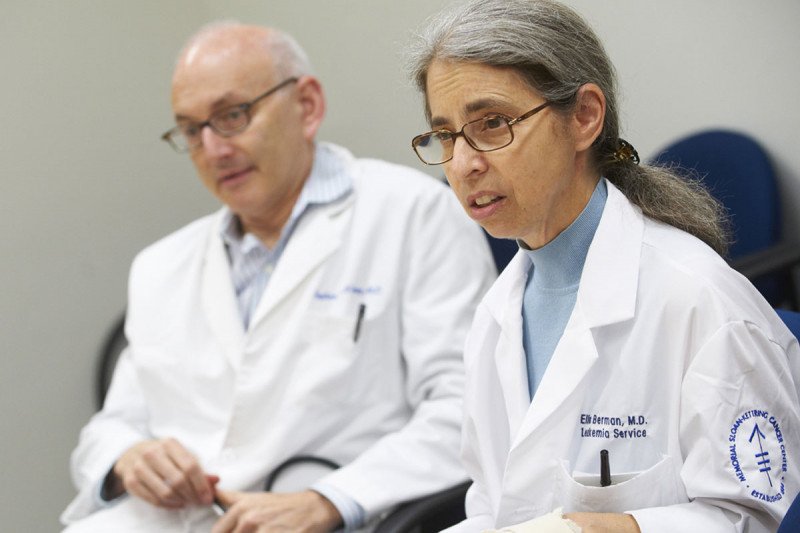
Doctors Who Treat Leukemia
At MSK, we take a team approach to care. See how we work together to help you.
Investigational Treatments
Our researchers are constantly pursuing new approaches to treat ALL — approaches that can kill tumor cells directly, inhibit the body’s production of substances that promote their growth, or enhance the immune response against leukemic cells. See an up-to-date listing of our clinical trials.
Researchers are studying the most-effective ways to use the targeted therapies that are now available (imatinib, dasatinib, and nilotinib). This includes determining the best timing and dosage. We are also working to create and test additional therapies that will block variants of the mutated BCR/ABL gene.
After a stem cell transplantation for CML, some patients experience a recurrence of the disease. A strategy developed here at MSK and at other institutions — a reinfusion of a particular type of white blood cell called lymphocytes from the original stem cell donor — may boost these patients’ ability to fight the disease. The effectiveness of this approach is now under study.
We’re available 24 hours a day, 7 days a week