
Multiple myeloma is a blood cancer that affects your bone marrow.
Multiple myeloma (MUL-tih-pul MY-eh-LOH-muh) is a rare cancer. There only are about 35,000 cases in the United States each year.
Multiple myeloma is a disease that cannot be cured. But it can be managed for many years with the right care.
Every year, MSK treat hundreds of people diagnosed with multiple myeloma or a related plasma cell disease. Our multiple myeloma team is among the most experienced in the country.
About MSK’s guide to multiple myeloma
This guide can support you and your loved ones as you learn more about this disease and related plasma cell disorders.
We share expert information about multiple myeloma symptoms and the latest treatments. We have information about multiple myeloma research studies, also known as clinical trials, that you may be able to join.
Who is this disease guide for?
- You’re waiting to learn if you have cancer
This guide gives you information about multiple myeloma so you’re better prepared.
If you want to know right away if you have cancer, we have information about MSK’s rapid diagnosis program.
- You want a second opinion
This guide explains new treatments. Learning about them can help you decide if you want a second opinion. MSK’s multiple myeloma experts offer second opinions about both diagnosis and treatment options, no matter where you live.
- You’re worried about your current treatment plan
This guide can help you learn about other treatment options. MSK experts only use the latest treatments for multiple myeloma, some only offered at MSK and very few other hospitals.
- You’re worried about your genetic risk for cancer
This guide can help you learn about your risk for cancer. We offer cancer genetic risk assessments to see if you’re at higher risk for some forms of cancer.
- You’re a caregiver to someone who has cancer
This guide has information about how to support a loved one who has cancer, even if they’re not an MSK patient. At MSK, supporting caregivers is as important as caring for people with cancer.
What is multiple myeloma?
Symptoms of multiple myeloma include bone pain or fractures, backache, getting infections often, weight loss, and fatigue (feeling very tired.)
Multiple myeloma is a blood cancer. Blood cancers are also known as hematologic (HEE-muh-tuh-LAH-jik) cancer. In general, multiple myeloma is the second most common hematologic cancer. Among Black people, it’s the most common hematologic cancer.
Multiple myeloma, also called Kahler’s disease, affects how your body makes healthy blood cells and fights infection. It starts in white blood cells called plasma cells. They’re found in your bone marrow, the spongy part of your bones that make blood cells.
Plasma cells play an important role in your immune system. They make antibodies (proteins) called immunoglobulins. These immunoglobulins find and fight viruses and bacteria when you get an infection.
A normal plasma cell can become a myeloma cell. This happens when there are changes in bone marrow and genetic changes (mutations or variants).
When myeloma cells grow quickly and multiply, it’s called multiple myeloma.
We do not know exactly why plasma cells mutate. Family history, environmental factors, and infections may play a role.
Active or inactive?
Active with symptoms: If the disease causes symptoms, it’s called active myeloma and often must be treated.
Active with no symptoms: Multiple myeloma can have markers that show strong signs of the disease, but you do not have symptoms.
There are 2 inactive conditions that can turn into myeloma. They’re called smoldering multiple myeloma (SMM) and monoclonal gammopathy of undetermined significance (MGUS).
Inactive with symptoms: Treatment starts once you have symptoms.
Inactive with no symptoms: If you do not have symptoms, we closely monitor but do not treat SMM or MGUS.
How does multiple myeloma harm your body?
Bone problems
Multiple myeloma weakens your bones and makes them more likely to fracture (break). It stops your bone marrow from making healthy blood cells.
Instead, myeloma cells build up in your bone marrow and harm your bone tissue. This causes bone lytic lesions, which are holes in your bones. Your bone tissue cannot remodel (grow back) as it normally does.
Blood problems
- Myeloma cells stop your bone marrow from making blood cells. This causes anemia (not enough red blood cells).
- Your bone marrow does not make enough white blood cells. This weakens your immune system.
- Multiple myeloma causes a level of calcium in your blood that’s higher than normal. This condition is called hypercalcemia (HY-per-kal-SEE-mee-uh).
- Your blood can thicken because of a high level of proteins. Myeloma cells make an antibody called monoclonal protein (m-protein or M-spike). They are not normal antibodies, and they do not fight infections.
- Myeloma cells make too many antibodies (proteins) called immunoglobulins. When too many extra immunoglobulins show up in your urine (pee), it’s called Bence-Jones protein. This condition harms how your kidneys work.
Why should I choose Memorial Sloan Kettering to treat multiple myeloma?
MSK’s team of multiple myeloma experts
Our multiple myeloma team is among the most experienced in the country.
- Each year, we treat about 400 people who were just diagnosed multiple myeloma or a related plasma cell disease.
- We also care for another 200 to 300 people with multiple myeloma that came back after treatment.
New multiple myeloma treatments
About 1 in 4 people with multiple myeloma have a type that’s aggressive and comes back very fast. MSK doctors are trying to find better treatments for people at high risk for multiple myeloma. Several new multiple myeloma drugs have been developed since 2000.
Experts on smoldering multiple myeloma and MGUS
People who have MGUS or smoldering myeloma do not have symptoms. MSK experts are looking at whether we can stop these conditions with changes in nutrition and the microbiome.
Some people with MGUS or smoldering myeloma are at high risk for getting active myeloma. MSK is researching whether treatment can delay symptoms, such as broken bones or kidney failure.
The latest multiple myeloma research and clinical trials
MSK researches and tests new treatments for multiple myeloma.
We lead one of 3 national myeloma groups, working with the leading experts on multiple myeloma. Our work at a national level means MSK can offer you access to some of the country’s most important multiple myeloma research.
Learn more about the latest treatments.
Our doctors are known nationally for their research on new treatments for multiple myeloma. Sometimes these studies offer therapies years before they’re available anywhere else. MSK patients can join our research studies, also known as clinical trials, to access these new treatments for multiple myeloma.
Convenient locations
You can visit MSK myeloma team experts closer to home, not just in Manhattan. We offer the same outstanding care from MSK doctors at our locations in:
- Manhattan
- Brooklyn: Boerum Hill and Flatbush
- Long Island: Commack
- New Jersey: Basking Ridge, Bergen, and Monmouth
- Westchester County: West Harrison
Plasma Cell Disorders
There are several plasma cell disorders related to multiple myeloma:
- Monoclonal Gammopathy of Undetermined Significance (MGUS)
- Smoldering myeloma (SMM)
- Amyloidosis: Light chain (AL) & other types
- Plasmacytoma: solitary or extramedullary
- POEMs
Everyone who has multiple myeloma had MGUS or SMM in the past, even 20 or 30 years ago.
Not everyone who had MGUS or SMM will get multiple myeloma. It depends on if you have certain genetic changes (mutations or variants). These changes can make MGUS or SMM turn into multiple myeloma.
Our doctors are experienced in caring for people with plasma cell diseases related to multiple myeloma. MSK experts in cancer and blood diseases will monitor you for signs MGUS or SMM is turning into multiple myeloma.
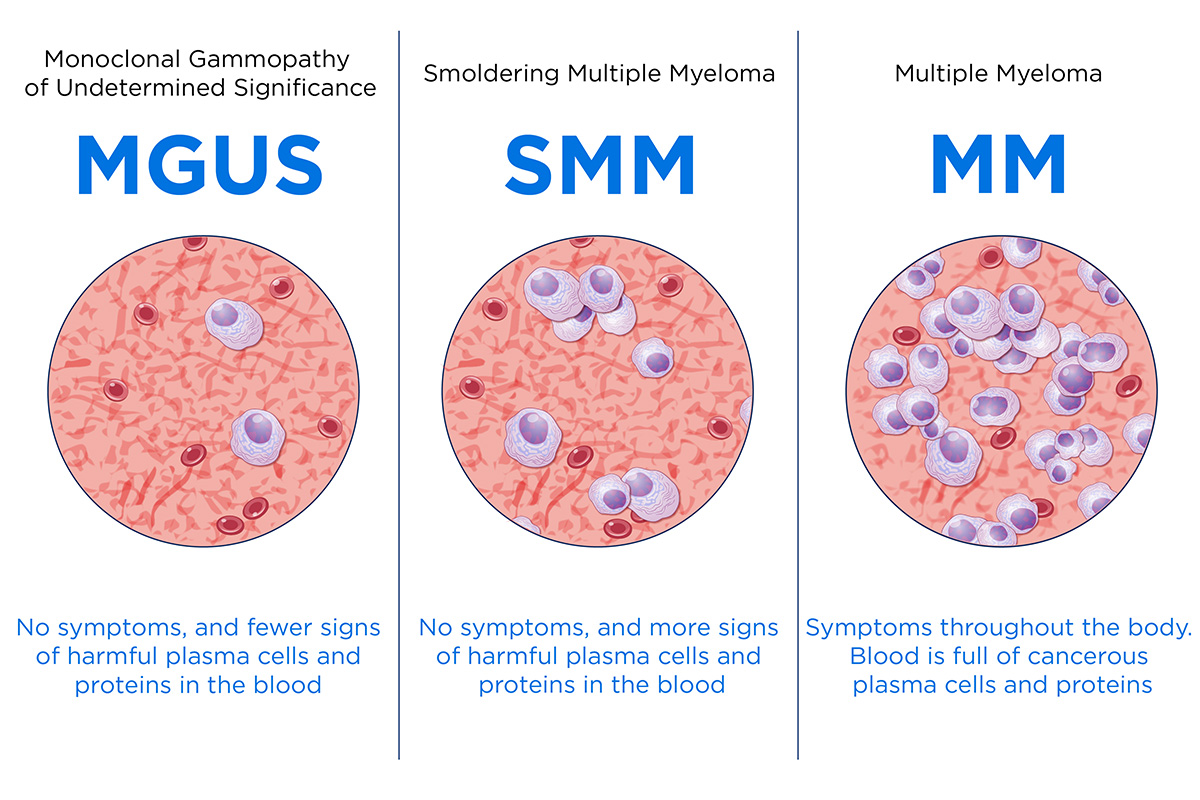
We diagnose MGUS and SMM by looking for:
- Plasma cells in your bone marrow.
- The quantity of monoclonal protein (m-protein).
- Signs of active multiple myeloma.
Your doctor will give you tests that show the stage of the plasma cell disorder. The stage tells us how far the disease has spread.
Plasma-cell disorder research
You may be able to join MSK research studies, also known as clinical trials. We’re researching whether healthy living can improve risk factors for people with MGUS or SMM. It’s possible that making these changes can prevent the disease from becoming multiple myeloma.
Learn about our Health Information Policy.


