History & Overview Annual Report President's Pages Center News Community Affairs
Make a Gift Cycle for Survival Fred's Team Rock & Run on the River Yankees Universe Fund Thomas Blake Sr. Memorial Research Fund Donating Blood & Platelets Volunteering Thrift Shop Park Avenue Potluck CELEBRATIONS
Press Releases In the News Information for Journalists News@MSKCC
Manhattan New Jersey Long Island Westchester
Working at Memorial Sloan-Kettering Work Sites College Recruitment About Nursing Job Fairs & Career Days IS Careers Job Search & Apply Online
Making an Appointment
Search About Herbs:

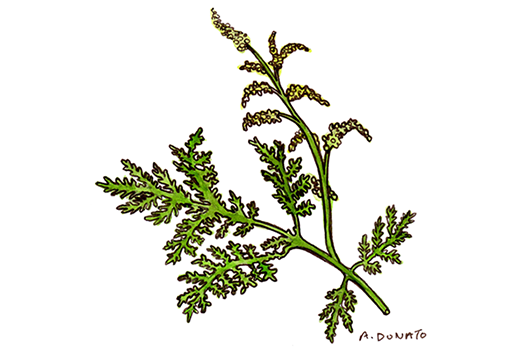
Artemisia annua

How It Works

Bottom Line: Artemisia was shown to be effective in the treatment of malaria.

Artemisia annua is an herb traditionally used in Chinese medicine to treat fever, inflammation, and malaria. A compound in Artemisia was shown to be effective in treating malaria in a clinical trial. Another case study showed that Artemisia was effective in treating chronic bladder infection. Artemisia prevented cancer cells from dividing in laboratory studies but clinical trials have not been conducted to support this.

Purported Uses

  • To treat malaria
    Several clinical trials support this use, however recurrence is more likely than with conventional antimalarial treatment.
  • To reduce inflammation
    No scientific evidence supports this use.
  • To reduce fever
    No scientific evidence supports this use.
  • To treat bacterial infections
    No scientific evidence supports this use.
  • To treat headache
    No scientific evidence supports this use.
  • To treat cancer
    Laboratory studies have shown some effect, however no clinical trials support the use in humans.

  • Research Evidence

    Treatment of malaria:
    In a clinical trial for the treatment of malaria, 132 patients were assigned to three test groups. Each group received either low-dose artemisia, high-dose artemisia or quinine (a conventional treatment for malaria). After 7 days of treatment, there were no symptoms of malaria in any of the three groups. Although artemisia was found to be as effective as quinine, researchers suggest that artemisia should not be used to treat malaria because symptoms reappeared at much faster rates in Artemisia groups. It is unclear whether artemisia is effective against strains of malaria that are resistant to quinine.

    Another study compared low-dose and high-dose Artemisia with sulfadoxine-pyrimethamine (another conventional malaria treatment) for the treatment of malaria. All 3 groups had similar numbers of cures and failures after 7 days of treatment. As with the previous study, symptoms reappeared more quickly and in greater numbers in the Artemisia groups. Therefore, Artemisia should not be used to treat malaria.

    Do Not Take If

  • You have ulcers or gastrointestinal disorders (Artemisia increases the production of stomach acid).
  • You are taking antacids, sucralfate, proton pump inhibitors, and histamine-receptor antagonists (Artemisia increases the production of stomach acid).
  • Are taking antiseizure medications (Artemisia can induce seizures making such medications less effective).

  • Side Effects

  • Abdominal pain
  • Diarrhea Nausea
  • Flu-like symptoms
  • Decreased appetite
  • Dermatitis

  • Scientific Name

    Artemisia annua

    Common Name

    Qing Hao, absinthium, sweet wormwood, and annual wormwood

    Clinical Summary

    An herb commonly known as wormwood or mugwort, Artemisia has been used in Western and Chinese medicinal formulas to treat various ailments. Terpenoids and flavonoids derived from Artemisia annua have cytotoxic activities in several human tumor cell lines (1) (2). Two of the components, artemisinin and artesunate, have been studied as anticancer treatments. The plant is traditionally used for reducing fevers, inflammation, headache, bleeding and for treating malaria and has been shown to have antibacterial properties (3). Systematic reviews on Artemisinin show that it is as effective as quinine in treating both uncomplicated and severe malaria (4) (5). However, increased risk of relapse may limit its uses (6) (7). It is unclear whether artemisia is effective against strains of malaria that are resistant to quinine. In addition, in vitro studies indicate that artemisinin may be an effective treatment for other protozoal infections such as leishmaniasis (8), Chagas' disease, and African sleeping sickness (9). Patients with gastrointestinal disorders or those taking antacids should not take artemisia because it increases the production of stomach acid (10) (11).


    Purported uses

  • Cancer treatment
  • Fever
  • Headaches
  • Infections
  • Inflammation
  • Malaria

  • Constituents

    Abrotamine, Beta-bourbonene, Farnesyl acetate, camphene, isoartemisia ketone, caryophyllene, Beta-humulene, cadinene, Delta-cadinene, Alpha-pinene, Beta-pinene, camphene, limonene, 1,8-cincole, artemisia ketone, alpha-thujone, copaene, gamma-cadinene, vitamin A (3), and artemisinin (12)

    Mechanism of Action

    Artemisia annua contains artemisinin, a compound that has known antimalarial effect by suppressing Plasmodium's ablility to use host erythrocyte protein (13). Artesunate, a semisynthetic derivative of artemisinin has an endoperoxide bridge that reacts with iron in heme to form singlet oxygen and free radicals. In addition to antimalarial effects, artemisinin also effectively induces apoptosis and cell cycle arrest of Leishmani donovani promastigotes (8). It has been shown to have an antiproliferative effect on medullary thyroid carcinoma cells (2). and induce apoptosis in a lung cancer cell line by modulating p38 and calcium signaling (14).

    Pharmacokinetics

    Absorption
    Artemisinin is absorbed faster from the tea preparations than from capsules. The maximum plasma concentrations were observed after 30 minutes following intake (15). Artesunate is rapidly absorbed and reaches maximum plasma level within 45-90 minutes. It is metabolized in the liver by hydrolysis to dihydroartemisinin (16).

    Contraindications

    Post partum women with anemia should not take Artemisia (3).
    Patients with ulcers or gastrointestinal disorders should not take Artemisia (10) (11).

    Adverse Reactions

    Reported (Oral):
  • Artemisia may cause abdominal pain, bradycardia, diarrhea, nausea, vomiting, decreased appetite, flu-like symptoms, fever, and decreased reticulocyte count.
  • A case of hepatitis was reported following consumption of a herbal supplement containing Artemisinin (17).
    Reported (Topical): Artemisia may cause dermatitis (11).

  • Herb-Drug Interactions

  • Antacids: Artemisia interferes with antacids, sucralfate, proton pump inhibitors, and histamine-receptor antagonists because it increases the production of stomach acid.
  • Antiseizure medications: Artemisia can induce seizures resulting in decreased efficacy of antiseizure medications (11).

  • Literature Summary and Critique

    Mueller MS, et al. Randomized controlled trial of a traditional preparation of Artemisia annua L. (Annual Wormwood) in the treatment of malaria. Trans R Soc Trop Med Hyg. 2004 May;98(5):318-21.
    132 patients were randomly assigned to receive 5 grams of artemisia annua herb /L (1 liter/day for 7 days); 9 grams of artemisia annua herb /L (1 liter/day for 7 days); and quinine sulphate tablets (500 mg quinine sulphate, three times daily for 7 days). There was quick resolution of parasitaemia and clinical symptoms following 7 days of treatment. Although the cure rates were 74% with Artemisia compared with 91% for quinine, researchers conclude that artemisia cannot be recommended as a substitution for quinine because symptoms reappeared at much faster rates in Artemisia groups. It is unclear whether artemisia annua is effective against strains of malaria that are resistant to quinine. Further investigation is warranted.

    Blanke CH, et al. Herba Artemisiae annuae tea preparation compared to sulfadoxine-pyrimethamine in the treatment of uncomplicated falciparum malaria in adults: a randomized double-blind clinical trial. Trop Doct. Apr 2008;38(2):113-116.
    In order to compare the efficacy and safety of Artemisia annua herb compared to sulfadoxine-pyrimethamine for the treatment of malaria induced by Plasmodium falciparum, 13 participants received 5 or 9 g Artemisia annua/L/day + placebo tablet and 10 received sulfadoxine-pyrimethamine (25 mg/kg sulfadoxine and 1.25 mg/kg pyrimethamin) + placebo tea 3.5 g Radix Gentianae/L/day. Clinical symptoms and adverse events were recorded along with the parasitological cure rates. The number of adverse events was similar between the treatment groups. Although the 7-day cure rate was similar between the groups, more failures were seen in the group receiving Artemisia annua after 28 days. Because insufficient treatment and thus incomplete cure is thought to select for treatment-resistant organisms, Artemisia annua herb monotherapy for malaria is not advised.

    References

    1. Singh NP, Lai HC. Artemisinin induces apoptosis in human cancer cells. Anticancer Res. 2004 Jul-Aug;24(4):2277-80.
    2. Zheng GQ. Cytotoxic terpenoids and flavonoids from Artemisia annua. Planta Med. 1994 Feb;60(1):54-7.
    3. Bensky D, Gamble A. Chinese Herbal Medicine, Materia Medica. Seattle: Eastland Press, Inc 1993.
    4. McIntosh HM, Olliaro P. Artemisinin derivatives for treating severe malaria. Cochrane.Database.Syst.Rev. 2000;CD000527.
    5. McIntosh HM, Olliaro P. Artemisinin derivatives for treating uncomplicated malaria. Cochrane.Database.Syst.Rev. 2000;CD000256.
    6. Mueller MS, et al. Randomized controlled trial of a traditional preparation of Artemisia annua L. (Annual Wormwood) in the treatment of malaria. Trans.R.Soc Trop.Med Hyg. 2004;98:318-21.
    7. Blanke CH, Naisabha GB, Balema MB, et al. Herba Artemisiae annuae tea preparation compared to sulfadoxine-pyrimethamine in the treatment of uncomplicated falciparum malaria in adults: a randomized double-blind clinical trial. Trop Doct. Apr 2008;38(2):113-116.
    8. Sen R, Bandyopadhyay S, Dutta A, et al. Artemisinin triggers induction of cell-cycle arrest and apoptosis in Leishmania donovani promastigotes. J Med Microbiol. Sep 2007;56(Pt 9):1213-1218.
    9. Mishina YV, Krishna S, Haynes RK, Meade JC. Artemisinins inhibit Trypanosoma cruzi and Trypanosoma brucei rhodesiense in vitro growth. Antimicrob Agents Chemother. May 2007;51(5):1852-1854.
    10. Brinker F. Herb Contraindications And Drug Interactions. Sandy, OR: Eclectic Medical Publications, 2001.
    11. Skyles AJ, Sweet BV. Alternative therapies. Wormwood. Am J Health Syst.Pharm. 2004;61:239-42.
    12. Rinner B, et al. Activity of novel plant extracts against medullary thyroid carcinoma cells. Anticancer Res 2004;24:495-500.
    13. Huang KC. The Pharmacology of Chinese Herbs, Second Edition. Boca Raton (FL): CRC Press; 1999.
    14. Mu D, Zhang W, Chu D, et al. The role of calcium, P38 MAPK in dihydroartemisinin-induced apoptosis of lung cancer PC-14 cells. Cancer Chemother Pharmacol. Apr 2008;61(4):639-645.
    15. Rath K, et al. Pharmacokinetic study of artemisinin after oral intake of a traditional preparation of Artemisia annua L. (annual wormwood). Am J Trop.Med Hyg. 2004;70:128-32.
    16. Payne AG. Exploiting intracellular iron and iron-rich compounds to effect tumor cell lysis. Med Hypotheses 2003;61:206-9.
    17. Centers for Disease Control and Prevention. Hepatitis Temporally Associated with an Herbal Supplement Containing Artemisinin --- Washington, 2008. Accessed August 13, 2009.

    Last Updated: Oct. 16, 2008
    E-mail your questions and comments to aboutherbs@mskcc.org.
    Bookmark and SharePrintEmail This Page