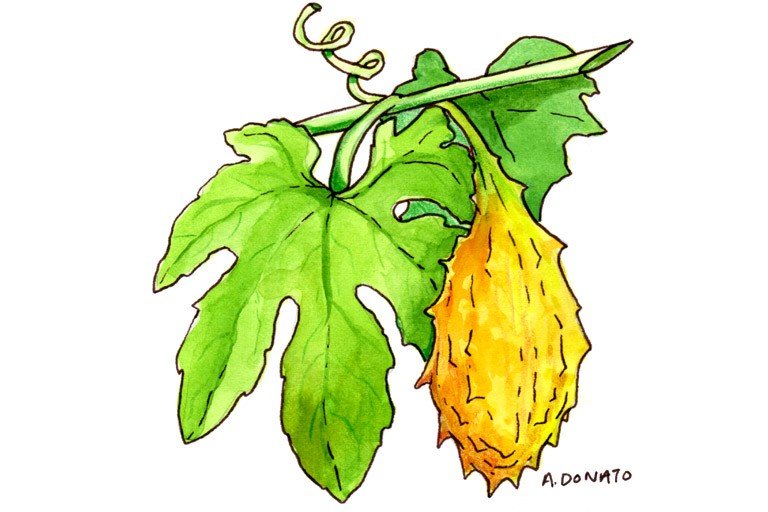
Common Names
- Bitter gourd
- Bitter cucumber
- Bitter apple
- Balsam pear
- Leprosy gourd
For Patients & Caregivers
Tell your healthcare providers about any dietary supplements you’re taking, such as herbs, vitamins, minerals, and natural or home remedies. This will help them manage your care and keep you safe.
Data on whether bitter melon can reduce lower blood sugar levels are limited.
Bitter melon is a perennial plant found in Asia, South America, East Africa, and the Caribbean. The edible fruit is used both as food and in medicine to treat diabetes, cancer, viral infections, and immune disorders.
Several active substances in bitter melon may act in a way similar to insulin. However, high-quality studies are needed to determine safety and effectiveness, and it cannot be recommended as a replacement therapy for insulin or hypoglycemic drugs.
Human studies on its effects on cancer are also lacking. One study showed it had no effect on the immune system of cervical cancer patients.
- To prevent cancer
Lab studies suggest that bitter melon extracts may kill certain cancer cells, but this has not been studied in cancer patients. - To treat diabetes
Limited data suggest bitter melon may help lower blood sugar, but a meta-analyses concluded the evidence is low quality with little safety data. Larger high-quality studies are needed. - To reduce fever
There is no evidence to support this claim. - To treat infections
Lab studies suggest bitter melon extracts can kill certain viruses, but human data are lacking.
Gastrointestinal symptoms
Case Reports
- Irregular rapid heartbeat: In a 22-year-old man who ingested bitter melon juice for a few days before being admitted for complaints of indigestion. Treatment with medications was needed.
- Gastric ulcer: In a 40-year-old man who ingested a half-liter of homemade bitter melon extract. IV fluids, GI medications, and blood transfusion were needed.
- Severe kidney injury: In a 60-year-old man with diabetes and high blood pressure who ingested an Ayurvedic formulation containing bitter melon, and in a 60-year-old woman who ingested a bitter melon extract.
- Toxicity: Ingestion of vicine from the seed may cause headache, fever, abdominal pain, and coma.
Do Not Take if:
- You are pregnant: Animal studies suggest bitter melon may cause birth defects.
- You are taking insulin: Bitter melon may have additive effects.
- You are taking diabetes medications: Bitter melon may have additive effects.
- You are taking P-gp substrate drugs: Bitter melon may increase the concentration and toxicity of these drugs. Clinical significance is not known.
- You are taking CYP450 substrate drugs: Bitter melon extract inhibits CYP2C9 and may affect the metabolism of these drugs. Clinical significance has yet to be determined.
For Healthcare Professionals
Bitter melon is a perennial plant that grows in the tropical and subtropical regions of Asia, South America, East Africa, and the Caribbean. The edible fruit is used both as food and in medicine to treat diabetes, cancer, viral infections, and immune disorders. Its bitterness is attributed to the presence of alkaloids, momordicosides, and momordicines. In vitro and animal studies suggest anticancer (1) (2) (3), antiviral (4) (5) (6), antidiabetic (31), and lipid-lowering (7) effects.
Data in humans are limited. Although bitter melon may lower blood sugar levels in both pre-diabetic (39) and diabetic patients (8) (40) (43), meta-analyses conclude the evidence is low quality with sparse safety data (44), and that more robust studies are needed (9) (40). Other preliminary data suggest supplementation may improve symptoms in knee osteoarthritis patients (41). In a study of cervical cancer patients, bitter melon had no effect on natural killer cell activity (10).
Although bitter melon is consumed as food, ingesting the seeds, extracts, and large quantities of juice can cause adverse effects.
- Cancer
- Diabetes
- Fever
- Infections
In an animal model, bitter melon extract showed hypoglycemic activity by suppressing glucose-6-phosphatase and fructose-1,6-bisphosphatase enzymes in the liver (14). It improved insulin sensitivity, glucose tolerance, and insulin signaling (15). It also reduced insulin resistance by influencing PPAR alpha and gamma expression (16) and by modulating phosphorylation status of insulin receptors and downstream signaling molecules (17). Preventive effects against insulin resistance may also occur via modulation of NF-kappa B and JNK pathways (36).
Animals fed bitter melon showed lower fatty acid synthase (18). It may affect fat and carbohydrate metabolism by stimulating thyroid hormones and adiponectin, and by enhancing AMPK activity (19). In another study, it prevented inflammation and oxidative stress, modulated mitochondrial activity, suppressed apoptosis activation, and inhibited lipid accumulation during the development of fatty liver (32).
Other experiments suggest cytotoxic activity with isolated components such as ribosome-inactivating proteins which inhibited HDAC-1 activity and induced apoptosis in prostate cancer cells (1). A triterpene extracted from bitter melon activated PPAR gamma and induced apoptosis in breast cancer cells (20). Bitter melon juice also caused apoptosis by inducing caspase-3 activation through AMPK in pancreatic cell lines (3). Similar effects were observed with methanol extracts which increased Bax and decreased the antiapoptotic protein Bcl-2 (21) (22). Other studies demonstrated reduction in metastasis via suppression of MMP-2 and MMP-9 enzymatic activities in lung adenocarcinoma cells (23). Bitter melon juice decreased phosphorylation of protein kinases Akt and ERK1/2, and viability of gemcitabine-resistant pancreatic cancer cells (37).
Gastrointestinal problems
Case Reports
- Atrial fibrillation: In a 22-year-old man who ingested bitter melon juice for a few days before admission for dyspeptic complaints, and requiring treatment with antiarrhythmics (28).
- Acute gastric ulceration: In a 40-year-old man following ingestion of a half-liter of homemade bitter melon extract. Intravenous fluids, rabeprazole, and blood transfusion were needed (29).
- Acute interstitial nephritis: In a 60-year-old man with diabetes and hypertension who ingested an Ayurvedic formulation containing bitter melon (42), and in a 60-year-old woman who ingested a bitter melon extract (45).
- Toxicity: Ingestion of vicine from the seeds may cause favism characterized by headache, fever, abdominal pain, and coma (38).
- P-gp substrates: Bitter melon inhibits P-glycoprotein and can increase the interacellular concentration and toxicity of substrate drugs, including vinblastine and paclitaxel (11) (12). Clinical significance has yet to be determined.
- CYP450 substrates: Bitter melon extract inhibits CYP2C9 and may affect the metabolism of substrate drugs (30). Clinical significance has yet to be determined.
- Insulin: Bitter melon may have an additive effect when used concomitantly (8).
- Hypoglycemics: Bitter melon may have additive effects when used concomitantly (8) (34).
- Chemotherapy drugs: In vitro studies suggest bitter melon extracts may increase bioavailability and efficacy of certain chemotherapy agents (35). Clinical significance has yet to be determined.