Common Names
- Capsaicin (topical formulations)
For Patients & Caregivers
Tell your healthcare providers about any dietary supplements you’re taking, such as herbs, vitamins, minerals, and natural or home remedies. This will help them manage your care and keep you safe.
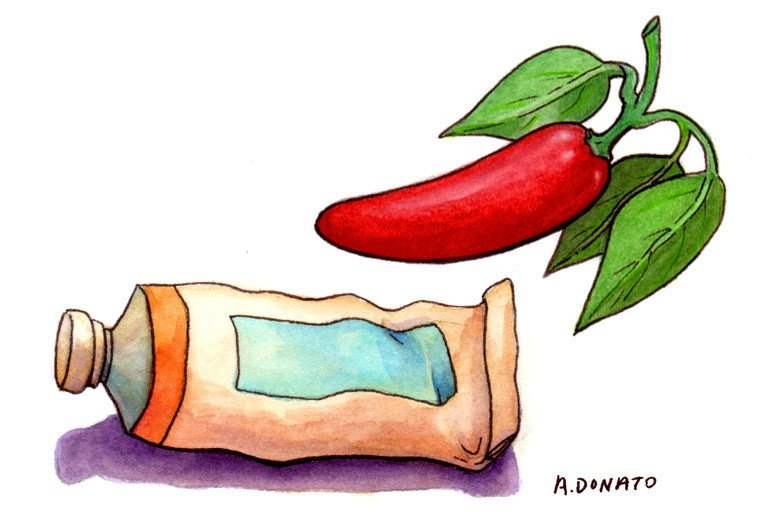
Capsaicin is the chemical in chili or cayenne peppers that makes them spicy. It has been used in traditional medicine to help with joint and muscle pain.
Capsaicin is added to skin creams, gels, ointments, lotions, and comes as a prescription-strength pain patch for relieving muscle pain. It is also added to nasal sprays to relieve chronic sneezing or a congested, runny nose.
Capsaicin is used to:
- Relieve pain caused by arthritis
- Reduce nerve pain
- Help with pain caused by strained or sprained muscle
- Relieve itching
- Treat psoriasis (skin disease that causes red, itchy scaly patches that mostly appear on your scalp, elbows, knees, and lower back)
- Relieve headache
Capsaicin also has other uses that haven’t been studied by doctors to see if they work.
It’s generally safe to eat foods with capsaicin, such as chili or cayenne peppers, but talk with your healthcare providers before taking capsaicin supplements. Herbal supplements are stronger than the herbs you would use in cooking. They can also interact with some medications and affect how they work. For more information, read the “What else do I need to know?” section below.
Side effects of using capsaicin on your skin may include:
- Burning
- Redness
- Swelling
- Dryness
- Soreness
- Itching
- Cough
- Runny eyes and nose when using nasal spray with capsaicin
- Wear gloves before applying capsaicin gels, creams, ointments, or lotions on your skin. After applying, wash your hands with soap and water so you don’t get it into your eyes or other sensitive areas of your body.
- If you’re using capsaicin for arthritis in your hands, follow the instructions on the label for how long you should leave it on.
- Don’t use capsaicin when your skin is irritated, infected, or when you have a wound.
- Talk to your healthcare provider before using capsaicin if you have high blood pressure, heart conditions, or blood vessel problems in the brain. Capsaicin may make these conditions worse.
For Healthcare Professionals
Capsaicin is the active component derived from the fruit of capsicum or cayenne pepper. It has been used in traditional medical systems as a remedy to relieve muscle and arthritic pain, and to treat cluster headaches and psoriasis. For these purposes, capsaicin is an active ingredient in some topical creams and nasal sprays. It is also available in a prescription-strength patch. Oral formulations are marketed largely for digestive and circulatory problems, poor appetite, and weight loss. (See Cayenne Pepper)
Studies support benefits of topical low-concentration capsaicin formulations for psoriasis (1), prurigo nodularis (2), pruritus ani (3), and uremic pruritis (51). It is also conditionally recommended for osteoarthritis (4), and a meta-analysis suggests it may be as effective as topical NSAIDs for osteoarthritic pain (44), but its utility for rheumatoid arthritis remains inconclusive (5). An older clinical trial shows capsaicin 0.075% cream may control post-surgical pain in cancer patients (6). A case report in a palliative care patient using capsaicin 0.025% for opioid-refractory upper extremity pain also reported benefit (7).
A high-concentration dermal capsaicin patch was shown safe and effective for postherpetic neuralgia (8), and was approved for prescription use. Data also suggest it is superior to pregabalin (45) (46), and effective for diabetic (36) (47) and non-diabetic (48) peripheral neuropathy, heterogenous neuropathic pain (37), and neuropathic pain arising from radiculopathies (38), but not HIV-associated neuropathic pain (9). A recent systematic review cites some benefit for both postherpetic neuralgia and HIV-neuropathy over controls. However, the patch is best used when other therapies have failed due to the small number of patients who may benefit (1 in 8) and unknown risks (10). Low-concentration capsaicin was determined as unlikely to have meaningful use for these conditions in clinical practice (11). Data are also limited in patients with post-mastectomy neuropathy (12).
Preliminary findings suggest improvements in swallowing function in elderly patients with dysphagia with application of 0.025% capsaicin ointment to the external auditory canal (43). Topical capsaicin can also be effective for cannabis-associated hyperemesis (39) (42) (49) (50). Only a few small studies suggest intranasal capsaicin of divergent formulations may be helpful for rhinitis (13) (14), and its effectiveness for cluster headaches is unknown (15).
There is continued controversy over whether capsaicin acts as a carcinogen, co-carcinogen, or anti-carcinogen (16) (17) (18). For example, capsaicin has demonstrated chemopreventive and antiproliferative effects against various cell lines including breast (19), bladder (20), prostate cancer cells (21). Also, a small study suggests utility of a high-concentration dermal capsaicin patch in relieving pain associated with chemotherapy-induced peripheral neuropathy (CIPN) (40). However, long-term topical application was shown to increase skin carcinogenesis in mice treated with a tumor promoter (18), although such effects may be concentration-dependent (22). Therefore, more studies are needed to clarify the roles of capsaicin in relationship to cancer.
Cayenne peppers, hot sauces containing chili peppers
- Arthritis
- Neuropathy
- Muscle pain
- Pruritus
- Psoriasis
- Headache
The analgesic effect of capsaicin is multifactorial. It depolarizes C-fiber polymodal nociceptors (23) (24). This causes the release of substance P, the neurotransmitter that relays pain signals to the brain (25), which causes an initial increase in pain. With repeated application, pain subsides due to the eventual depletion of substance P at the afferent neurons (26). Capsaicin also activates transient receptor potential vanilloid subfamily member 1 (TRPV1, also known as the capsaicin receptor) (27), causing selective and reversible defunctionalization of cutaneous sensory nerve endings expressing TRPV1 (28).
Improved swallowing function in elderly dysphagic patients, particularly glottal closure and cough reflex, was attributed to TRPV1-mediated aural stimulation of vagal Arnold’s nerve with capsaicin ointment (43).
Studies on various cancer cell lines have shown that capsaicin demonstrates chemopreventive properties by causing cell-cycle arrest and inducing apoptosis, or by generating reactive oxygen species (ROS) and depolarizing mitochondrial membranes, and through caspase activation (17) (19) (20). Alternatively, the co-carcinogenic effect of capsaicin on chemically-induced skin carcinogenesis is mediated through the epidermal growth factor receptor (EGFR), but not TRPV1 (18). Further exploration of caspaicin-induced apoptosis, in glioma cells, found inhibition of autophagy to be a likely contributor (34). Interestingly, capsaicin was also shown to induce autophagy by enhancing the levels of autophagy markers LC3-II and Atg5, increasing p62 and Fap-1 degradation and increasing caspase-3 activity to induce apoptosis in human nasopharyngeal carcinoma cells (41).
Capsaicin can irritate mucous membranes, the eyes, and broken skin. For all capsaicin creams, gels, and lotions, wear gloves during application and wash hands with soap and water afterwards to avoid spreading the active ingredient to these sensitive areas. Capsaicin use should be considered when encountering adverse cardiovascular effects in the absence of illicit substance use and especially in young patients (30).
- Patients with unstable or poorly controlled hypertension or a recent history of cardiovascular or cerebrovascular events, as this may cause an increased risk of adverse cardiovascular effects (8).
Common (over-the-counter topical): Burning, urticaria and contact dermatitis; mild to moderate coughing (6) (12); pain and pruritus at the application site (40).
Transient (intranasal): Burning sensations, lacrimation, and rhinorrhea (15).
Case reports
Coronary vasospasm and acute myocardial infarction: In a 29-year-old man following use of a topical capsaicin patch for 6 days. Improvement was seen after treating symptoms and patch removal (30).
Bilateral acute anterior uveitis: In a 38-year-old woman 1–2 days after application of an analgesic capsaicin patch for muscular neck pain. Inflammation was controlled within 1 week using topical corticosteroids, and there were no further recurrences over long-term follow-up (31).
Application site burns: Cases of serious burns have occurred following use of over-the-counter capsaicin products. In some cases, hospitalization was required. Discontinue use and seek immediate medical attention if pain, swelling, or blistering occur following application (32).
Second-degree burn with mobility sequelae: In a 41-year-old woman after application of a high-concentration topical capsaicin patch for addressing neuropathic pain (52).
- ACE inhibitors: Topical capsaicin induced cough in a patient taking ACE inhibitors (33).
- CYP450 2C19 substrates: In animal models, capsaicin inhibits CYP2C19 and can affect the intracellular concentration of drugs metabolized by this enzyme (35). Clinical relevance has yet to be determined.
- CYP450 3A4 substrates: In animal models, capsaicin induces CYP3A4, which may increase the clearance of substrate drugs when used concomitantly (35). Clinical relevance has yet to be determined.