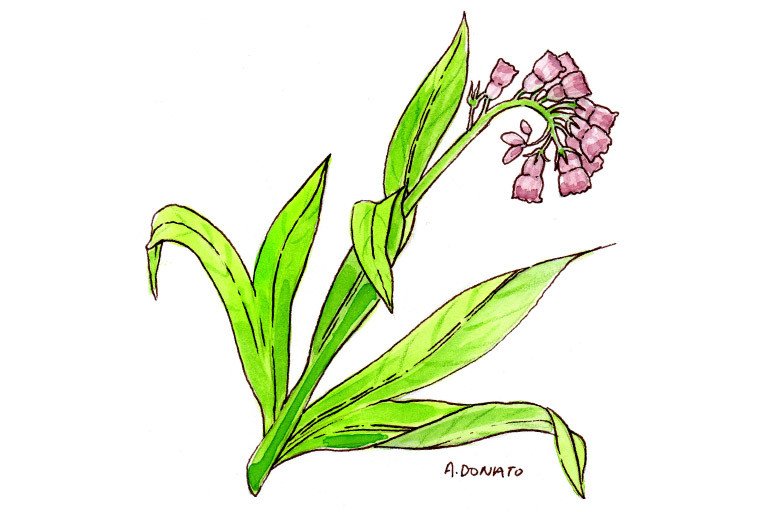
Common Names
- Slippery root
- Knitbone
- Blackwort
- Bruisewort
For Patients & Caregivers
Tell your healthcare providers about any dietary supplements you’re taking, such as herbs, vitamins, minerals, and natural or home remedies. This will help them manage your care and keep you safe.
Although comfrey has been used historically for various conditions, cases of liver toxicity have been reported.
Comfrey leaves and roots have been used for many centuries for wound healing, inflammation, and other conditions, but these effects have not been confirmed in humans through clinical trials.
Cases of liver toxicity have been reported with use of comfrey. It has also been confused with foxglove, a poisonous plant, which has resulted in several cases of accidental poisoning.
- To treat bronchitis
There is no scientific evidence to support this claim. - To treat pain
A review of herbal medicine for low back pain did not find sufficient evidence for topical use of comfrey. - To treat cancer
This claim is not backed by research. - To treat peptic ulcers
There is no scientific evidence to support this. - To improve wound healing
Lab studies show that comfrey leaves have wound healing effects, but human data are lacking.
Liver damage
Patient Warnings:
- In 2001 the FDA, along with the Center for Food Safety and Applied Nutrition, advised all dietary supplement manufacturers to remove products containing comfrey from the market.
- Comfrey contains compounds that are toxic to the liver and animal experiments suggest it can cause liver cancer.
- Comfrey has been confused with foxglove, a poisonous plant with similar leaves. Several cases of accidental ingestion of what was thought to be comfrey herbal tea occurred, resulting in poisoning and death in one case.
For Healthcare Professionals
Comfrey is a fast-growing plant whose leaves and roots have been used historically for wound healing and other conditions. Preclinical studies suggest that oral comfrey has antiproliferative effects (13), and a topical formulation showed wound healing properties (16).
Studies in humans are very limited. Although preliminary data on topical formulations suggest it may relieve pain (14) (17) (18), a Cochrane Review of herbal medicine for low back pain did not find sufficient evidence for its use (21).
Comfrey contains pyrrolizidine alkaloids that are hepatotoxic, mutagenic, and carcinogenic (13) (24), and hepatotoxicity with oral use of comfrey has been cited in the medical literature (5) (6) (7) (8) (9) (10). In addition, misidentification with foxglove has led to several cases of accidental ingestion of what was thought to be comfrey herbal tea, resulting in cardiac glycoside poisonings (15) (22) (23).
Comfrey was used since the 1930s for animal feed, but has been prohibited in Australia and New Zealand. In June 2001, the FDA asked all manufacturers to remove products containing comfrey from the market (12).
- Wound healing
- Pain
- Bronchitis
- Peptic ulcers
- Cancer
Preclinical studies suggest allantoin and rosmarinic acid compounds in comfrey may be responsible for cell proliferation and anti-inflammatory effects (20). Comfrey was also shown to stimulate granulation and tissue regeneration, and support callus formation (19).
Although systemic absorption following use of topical comfrey preparations is not known, an evaluation in human skin samples suggests there may be an overestimation of risk for pyrrolizidine alkaloid absorption (25).
- In 2001, the U.S. Food and Drug Administration along with the Center for Food Safety and Applied Nutrition, advised all dietary supplement manufacturers to remove products containing comfrey from the market (12).
- Comfrey contains unsaturated pyrrolizidine alkaloids, which are hepatotoxic, mutagenic, and carcinogenic (12) (24).
- Comfrey has been confused with foxglove, a poisonous plant with similar leaves. Several cases of accidental ingestion of what was thought to be comfrey herbal tea occurred, resulting in cardiac glycoside poisoning and death in one case (15) (22) (23).