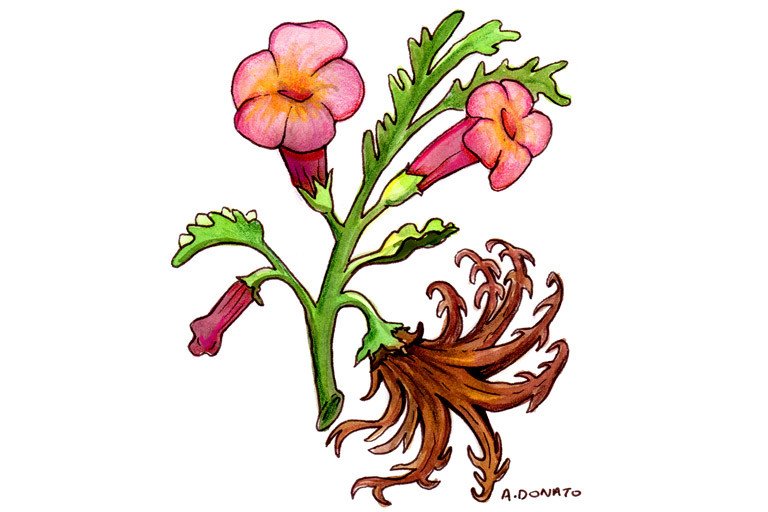
Common Names
- Grapple plant
- Wood spider
- Teltonal
- Garra del diablo
For Patients & Caregivers
Tell your healthcare providers about any dietary supplements you’re taking, such as herbs, vitamins, minerals, and natural or home remedies. This will help them manage your care and keep you safe.
Available evidence indicates that devil's claw may benefit patients with osteoarthritis of the hip or knee, and back pain.
Devil's claw is a plant native to South Africa and is used in traditional medicine to treat rheumatism, arthritis, inflammation, and stomach disorders. Currently, preparations of devil's claw root are used as anti-inflammatory agents and to relieve pain. Laboratory and animal studies show that devil's claw has anti-inflammatory, pain relieving, antioxidant and appetite suppressant effects. It also helps slow bone loss caused by inflammation. Small clinical studies indicate its benefits in patients with osteoarthritis of the hip or knee, and rheumatic disorders. Larger studies are needed to confirm these effects.
- To suppress appetite
Animal study suggests that devil's claw can suppress appetite. Human data are lacking. - To treat gastrointestinal disorders
No scientific evidence supports this use. - To reduce inflammation
Lab and animal studies show that devil's claw is effective against inflammation. - To treat osteoarthritis
Devil's claw was shown effective against osteoarthritis of the hip and knee. - To relieve pain
Clinical data indicate benefits of devil's claw for relief of back pain.
- Dyspepsia (indigestion) has been reported following consumption of a devil's claw extract.
- Ulcers and gastrointestinal bleeding have occurred with use of devil's claw root.
- Intake of a product containing devil's claw for osteoarthritis resulted in systemic hypertension in a 62-year-old healthy postmenopausal woman.
- Intestinal obstruction was reported in an 87-year-old man, due to a bezoar consisting of a herbal preparation containing devil's claw.
Patient Warnings:
A case controlled study suggests increased risk of acute pancreatitis (inflammation of the pancreas) with use of devil's claw.
Do Not Take if:
- You are taking drugs that are substrates of Cytochrome P450 1A2/2C8/2C9/2C19/2D6 and 3A4 enzymes: Devil's claw may increase the risk of side effects of these drugs. But according to another study, the interaction may not have any clinical significance.
- You are taking drugs that are substrates of P-glycoprotein: Devil's claw may increase the risk of side effects of these drugs. Clinical significance is not known.
For Healthcare Professionals
Devil’s claw is a flowering plant native to South Africa whose dried tuberous roots are used in supplemental forms to reduce inflammation and pain. Its extracts have historically been used to treat fevers, rheumatism, appetite stimulation, arthritis, inflammation, and stomach disorders.
Preclinical studies indicate that devil’s claw has antioxidant (5), anti-inflammatory (9) (15), analgesic (16), anti-osteoporotic (17) (18) and appetite suppressant (19) effects.
Limited clinical data suggest benefits of devil’s claw/formulas containing devil’s claw for osteoarthritis of the hip or knee (6) (27) (28), knee pain (29), back pain (7) (20), gonarthritis (24), and rheumatic disorders (21). Confirmatory studies are needed (25).
- Anorexia
- GI disorders
- Inflammation
- Muscle pain
- Osteoarthritis
- Pain
Harpagide, an iridoid glycoside isolated from devil’s claw, is responsible for the herbs’s anti-inflamamtory effects. It was shown to inhibit the production of inflammatory cytokines including interleukins IL-1beta, IL-6, and tumor-necrosis factor (TNF-alpha) in mouse macrophage cells (15). A devil’s claw extract also demonstrated anti-inflammatory activity via inhibiting the induction of pro-inflammatory gene expression, possibly by blocking the activator protein (AP-1, a transcription factor) pathway (9).
Harpagide may also prevent bone loss by regulating the stimulation of osteoblast differentiation and the suppression of osteoclast formation in mice (17). In another study, it was shown to block lipopolysaccharide (LPS)-induced bone loss in a model of inflammatory osteoporosis. However, harpagide was not effective in preventing bone loss mediated by ovariectomy in postmenopausal osteoporosis (18).
Investigations of the mechanisms underlying the pain-releiving activity of devil’s claw showed involvement of the heme oxygenase-1/carbon monoxide (plays a role in nociceptive processing) system in carrageenan-induced inflammatory pain (22). Devil’s claw exerts antioxidant effects by scavenging both superoxide and peroxyl in a dose dependent manner (5).
Beta-sitosterol, a sterol found in devil’s claw, has anticancer properties but the mechanism of action is unknown (23).
- A case controlled study suggests increased risk of acute pancreatitis with use of devil’s claw (10).
- Dyspepsia has been reported following consumption of a devil’s claw extract (6).
- Ulcers and gastrointestinal bleeding have occurred with use of devil’s claw root (11).
- Intake of a product containing devil’s claw for osteoarthritis resulted in systemic hypertension in a 62-year-old healthy postmenopausal woman (12).
- Intestinal obstruction requiring a laparotomy: In an 87-year-old man, due to a bezoar consisting of a herbal preparation containing devil’s claw (26).
- Cytochrome P450 enzymes: Devil’s claw root can inhibit CYP1A2/2C8/2C9/2C19/2D6 and 3A4, and may interact with substances metabolized by these enzymes (8). But conflicting data suggest that the interactions are not clinically relevant (13).
- P-Glycoprotein (P-gP): Devil’s claw modulates both the activity and expression of P-Gp, and may affect the transport of drugs mediated by this protein (14). Clinical significance is not known.