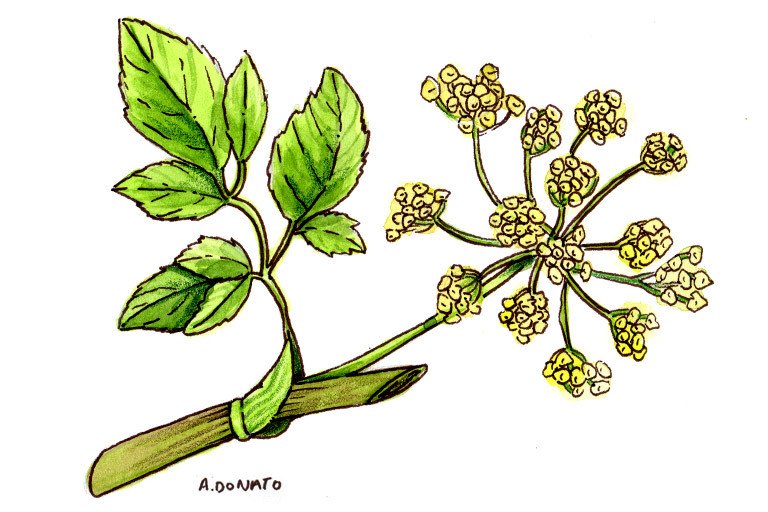
Common Names
- Chinese angelica
- Dang gui
- Tang kuei
- Tan kue
- Female ginseng
For Patients & Caregivers
Tell your healthcare providers about any dietary supplements you’re taking, such as herbs, vitamins, minerals, and natural or home remedies. This will help them manage your care and keep you safe.
Dong quai is an herb used in traditional Chinese medicine to treat menstrual (monthly period) cramps and menopausal (permanent end to your menstrual cycle) symptoms such as hot flashes.
You can take dong quai in supplemental form as a pill or liquid extract.
Dong quai is used to:
- Treat premenstrual symptoms such as breast swelling and tenderness, mood swings, bloating and headache
- Treat menstrual cramps
- Treat symptoms of menopause (permanent end of menstrual cycles) such as hot flashes
Dong quai also has other uses that haven’t been studied by doctors to see if they work.
Talk with your healthcare provider before taking dong quai supplements. Herbal supplements can interact with some medications and affect how they work.
For more information, read the “What else do I need to know?” section below.
Side effects of using dong quai may include:
- Photosensitivity (sensitivity to light)
- Photodermatitis (skin sensitivity to light, causing swelling, itching, or redness)
- Loss of appetite
- Feeling bloated
- Diarrhea (loose or watery bowel movements)
- Fever (temperature is 100.4° F (38° C) or higher)
- Talk with your healthcare provider if you’re taking blood thinners such as warfarin (Coumadin®, Jantoven®). Dong quai may increase your risk of bleeding.
- Avoid dong quai if you’re pregnant. Dong quai can raise your risk of miscarriage (when a pregnancy ends on its own).
- Avoid dong quai if you’re breastfeeding.
- Talk to your healthcare provider if you have a hormone-sensitive cancer (like some breast or prostate cancers). Dong quai may worsen your condition.
For Healthcare Professionals
Dong quai is an herb, the root of which has a long history of use in traditional Chinese medicine. It is often combined with other herbs in formulations. Dong quai is also available as a dietary supplement and is promoted as a woman’s herb for menstrual and menopausal symptoms.
Dong quai extracts demonstrated antitumor (7) (8) (9) (10), pro-apoptotic (40) (41), anti-metastatic (41), anti-tuberculosis (TB) (11), neuroprotective (32), and hematopoeitic (34) effects in vitro. In animal models, polysaccharides extracted from dong quai root showed protective effects against cyclophosphamide-induced toxicity (12), doxorubicin-induced cardiotoxicity (13), and radiation-induced pneumonitis (14).
Formulas containing dong quai improved clinical outcomes in patients with acute coronary syndrome and mild-to-moderate renal insufficiency (46), and prevented radiation-induced dermatitis in breast cancer patients (49). A systematic review determined benefits of dong quai against amenorrhea induced by antipsychotic drugs (47).
Epidemiological data suggest positive associations between dong quai use and reduced risks of overall diabetes-related mortalities (50), and subsequent endometrial cancer in breast cancer survivors (39). It may also be useful in long-term management of post-operative ovarian endometriotic cysts (51) but findings of its effectiveness against menopausal symptoms are inconclusive (1) (2) (3) (4) (5) (6) (29) (33). Dong quai was also ineffective against hot flashes in men (31).
Of note, dong quai showed estrogenic activity in vitro (15), stimulated proliferation of MCF-7 cells (16) (17) (48), and promoted growth of estrogen receptor-positive breast tumors in a murine model (48). Patients with hormone-sensitive cancers should consult with their physicians before using this herb.
- Premenstrual syndrome
- Dysmenorrhea
- Menopausal symptoms
Ferulic acid, a constituent of dong quai, may play an important role in treating osteoarthritis by reducing hydrogen peroxide-induced interleukin IL-1beta, tumor necrosis factor TNF-alpha, matrix metalloproteinases MMP-1 and MMP-13, and by increasing SOX9 gene expression. SOX9 is a protein involved in the establishment and maintenance of the phenotype of chondrocytes (35). Dong quai polysaccharides demonstrated anti-osteoarthritic activity by stimulating insulin-like growth factor 1 (IGF1) and IGF1 receptor gene expression, thereby promoting UDP-sugars and glycosaminoglycan synthesis (37). Another compound promotes wound healing and bone regeneration by inducing osteoblast proliferation and hyaluronic acid deposition (25).
An aqueous extract from dong quai showed estrogen-agonist activity, and stimulated proliferation of both estrogen receptor-positive and -negative breast cancer cells (17). It also protected against radiation-induced pneumonitis by downregulating proinflammatory cytokines such as TNF-alpha and TGF-beta1 in a murine model (14). Subcutaneous injection of dong quai extract protected mice against cyclophosphamide-induced cytotoxicity by promoting recovery from leukopenia (12). The antitumor effects of dong quai may be due to its inhibitory effects on invasion and metastasis of carcinoma cells (9) and by suppression of tumor growth (7) (8) (10) that may be mediated by Nur77-dependent apoptosis (23) (24). However, dong quai extracts also promoted angiogenesis – which plays a key role in both physiologic and disease processes – by inducing proliferation and migration of endothelial cells by upregulating VEGF expression (26).
- Pregnant and breastfeeding women should avoid dong quai (27).
Bloating, apetite loss (18), diarrhea, photosensitivity (19), gynecomastia (20), and hypertension (43).
Case Report
Subarachnoid hemorrhage: In a 53-year-old woman following use of an herbal supplement containing red clover, dong quai, and Siberian ginseng for hot flashes. Her symptoms resolved after discontinuing use of the supplement (30).
Acute hydroxychloroquine retinopathy: In a 37-year-old woman after using hydroxychloroquine as a reproduction-facilitating medication along with herbal medicines including dong quai. Her symptoms improved after stopping both hydrochloroquine and dong quai (52).
Anticoagulants: Dong quai may have additive anticoagulant effect (21). However, this appears to be limited in a human study (44).
Cytochrome P450 substrates: Prolonged use of dong quai can induce CYP3A4 by activating pregnane X receptor (36). This may reduce the blood levels and effectiveness of substrate drugs. Clinical relevance is not known.
Lisinopril [angiotensin converting enzyme (ACE) inhibitor]: Concurrent use with dong quai exacerbated anemia in a murine model (42). Clinical relevance has yet to be determined.
Dual antiplatelet therapy (DAPT) with aspirin (ASA) and clopidogrel (CLP): Coadministration with dong quai significantly altered the pharmacokinetics of DAPT with increased systemic exposure in a murine model. Clinical relevance is not known. (45)
Clozapine: Dong quai was found to be a moderate-to-strong inducer of clozapine metabolism in two case reports (53).
Elevated PT / INR (21)