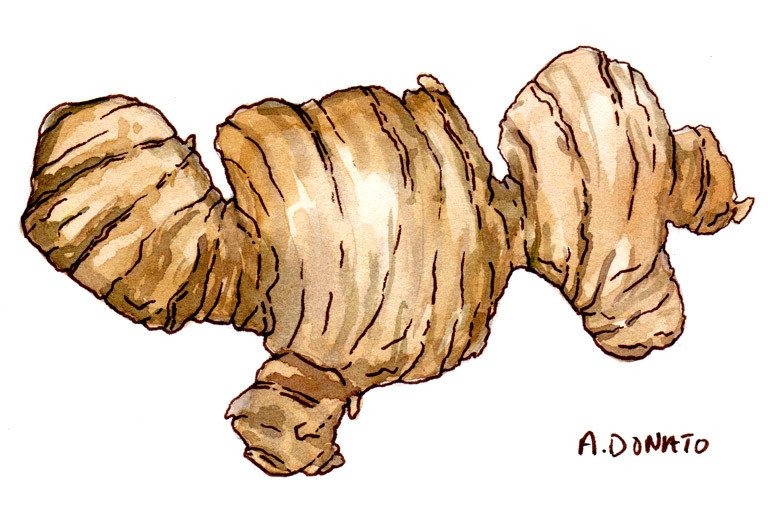
Common Names
- Ginger root
- Shen jiang
For Patients & Caregivers
Tell your healthcare providers about any dietary supplements you’re taking, such as herbs, vitamins, minerals, and natural or home remedies. This will help them manage your care and keep you safe.
Ginger may help relieve or prevent nausea and vomiting.
Ginger root contains compounds that may help relieve or prevent nausea and vomiting. These substances can increase the flow of saliva and digestive juices and may also help calm the stomach and intestines. Some studies have found ginger may help nausea caused by chemotherapy, but larger studies are needed to confirm these effects.
Eating fresh ginger in high doses can have blood-thinning effects by preventing platelets from sticking together. Laboratory studies suggest that ginger can protect brain cells from the plaques that cause Alzheimer’s disease, but this effect has not been studied in humans.
-
To stimulate appetite
Ginger is known to stimulate saliva flow and digestive secretions, but clinical trials are lacking. -
To relieve indigestion
Compounds in ginger are known to stimulate saliva flow and digestive juices, reduce gas, and calm the digestive system, but human data are lacking. -
To treat diarrhea
Compounds in ginger are known to calm the digestive system, but clinical data are lacking. -
To treat nausea and vomiting
Some studies support the short-term use of ginger for chemotherapy-associated nausea and vomiting and motion sickness. However, ginger supplements should not be used around the time of surgery because of blood-thinning effects. It is also not suggested for use during pregnancy because of risks to the developing embryo. -
To treat arthritis
A few studies have been conducted with positive results, but more research is needed. -
To treat respiratory ailments
Certain compounds in ginger may reduce inflammation and protect against certain viruses, but human studies are lacking. -
To treat drug withdrawal symptoms
A small animal study suggests that ginger may help ease withdrawal symptoms from drugs like morphine. However, clinical data are lacking.
- Heartburn
- Skin irritation, swelling, and redness
Case reports
- Nosebleed, slow blood clotting: In a 76-year-old woman on long-term blood-thinning therapy who took ginger products. Clotting returned to normal after discontinuing ginger and with vitamin K administration.
- Severe fatigue and bleeding: In a 65-year-old patient who was on multiple medications and also took natural products like DHA, blueberry and ginger extract supplements, licorice, and pineapple juice. Some combination of these were determined to contribute to the problem, which was resolved with discontinuation of several products while limiting the intake of others.
- Fatal bleeding: In an 80-year-old man on a blood thinner with a history of irregular heartbeat. He presented with 1-day history of vomiting blood and black stool that began 3 days after taking a boiled mixture of ginger and cinnamon.
Patient Warnings:
- Due to its blood-thinning effects, ginger supplements should be stopped 2 weeks before surgery, and should not be used immediately after surgery to control nausea or vomiting.
- Ginger supplements should be avoided in patients with bleeding disorders.
- Ginger supplements should be avoided during pregnancy or lactation.
- Ginger supplements should be avoided by individuals with gallstones.
Do Not Take if:
- You are taking warfarin or other blood thinners: Ginger supplements may increase the risk of bleeding.
- You are taking NSAIDs, nonsteroidal anti-inflammatory drugs: Ginger supplements may increase risk of bleeding when used with these drugs.
- You are taking insulin or medication to lower blood glucose: Ginger supplements may cause larger reductions in glucose levels. Clinical relevance is not known.
- You are taking tacrolimus: Ginger supplements increase the blood levels of this drug and may increase side effects. Clinical relevance is not known.
- You have a bleeding disorder: Ginger supplements may increase bleeding time.
- You have gallstones: Ginger supplements may increase the flow of bile.
- You are having surgery: Ginger supplements may increase risk of bleeding.
- You are pregnant or lactating: The effect of ginger supplements on human gestational development are unknown.
For Healthcare Professionals
Derived from the rhizome of the plant, ginger is native to Asia and used as food and medicine. In traditional Chinese medicine, ginger is used to expel “cold”, “wind” and “dampness”, and is believed to stop the reverse flow of Qi (energy) (1). Western use has been primarily for gastrointestinal symptoms and respiratory ailments. Preclinical studies indicate that ginger has antiemetic (2), anticancer (3) (4) (5) (6), anti-inflammatory (6) (7) (8), anti-drug-dependence (9), and hypoglycemic effects (7). It may also protect against Alzheimer’s disease (10) (11) (12).
Ginger influences gastric emptying in healthy individuals (13) and may promote feelings of satiety (14). Data suggest its effectiveness for treating dysmenorrhea (55) (62), as well as moderate efficacy against osteoarthritic and chronic low back pain (15) (16). As an adjunct to standard care, ginger may also be beneficial for treating migraine (63). Although clinical trials indicate that ginger can reduce nausea and vomiting, (17) (18) (19) (20) (69) (70) it should be avoided perioperatively due to anticoagulant/antiplatelet effects (21) (22) (23) (24) (25) (26), and during pregnancy since animal studies highlight concerns regarding embryo development (26) (27). Dietary ginger seems to be without these effects (28) (29) (30), although some studies suggest that high concentrations of fresh ginger have antiplatelet effects (31).
In oncology settings, ginger may prevent chemotherapy-induced nausea and vomiting (CINV) (33) (34) (35) (36), but a systemic review cited the need for further research (37). Another study suggested that adjuvant ginger supplementation may improve CIN-related quality of life and cancer-related fatigue (58). The bioactive compound 6-gingerol may also improve overall CINV, appetite, and quality of life (59). However other studies did not show benefit with ginger as an adjunct to CINV prophylaxis (60), or in patients receiving high-dose cisplatin except in female and head and neck cancer subgroups (61).
Supplementation may have chemopreventive effects for those at increased risk for colon cancer with normal-appearing colonic mucosa (38). Larger studies are needed to confirm potential benefits of ginger supplementation for symptom control or for chemoprevention.
Other studies report ginger aromatherapy to be useful in reducing nausea and vomiting in postoperative patients (64), but data on CINV are mixed (56) (65) (66).
- Appetite stimulant
- Gas, indigestion
- Diarrhea
- Nausea, vomiting
- Arthritis
- Respiratory ailments
- Drug withdrawal
Antiemetic actions are attributed to shogaol and gingerol compounds present in the rhizome, which stimulate flow of saliva, bile, and gastric secretions, and galanolactone, which can act as a competitive antagonist at serotonin 5-HT3 receptors (2) (22). Additional activities include stimulation of antral contractions, reduction of postprandial antral area, and acceleration of gastric emptying (13). Ginger inhibits thromboxane formation and platelet aggregation (43). However, these effects appear to be dose- and formulation-dependent (eg, dried, fresh, or extract) (31).
In vitro studies suggest that fresh ginger stimulates mucosal cells to secrete IFN-β to combat viral infection (32), while certain ginger preparations reduced lipopolysaccharide-induced secretion of IL-8 in human bronchial epithelial cells (8), and inhibited human telomerase reverse transcriptase and c-Myc expression in human lung cancer cells (44).
In other studies, gingerol induced apoptosis of gastric cancer cells through TRAIL-dependent caspase 3/7 activation (3) and inhibited cell-cycle progression by reducing cyclin D1 expression (4). It also inhibited secretion of angiogenic cytokines such as VEGF and IL-8 in ovarian cancer cells (5). In animal models, shogaol reduced tumor growth by damaging microtubules and by inducing mitotic arrest (3). Increased levels of circulating antioxidant and phase II enzymes and reduced lipid peroxidation levels are mechanisms by which ginger might protect against DMH-induced colon cancers (45).
- Perioperative setting: Ginger supplements should not be used in the perioperative setting due to the potential risk for increased bleeding (21) (24), in line with the general caution to avoid herbs that have antiplatelet and anticoagulation properties, although a systematic review found inconclusive evidence. Further study is warranted (57).
- Bleeding disorders: Likewise, ginger supplements should be avoided in patients with bleeding disorders (46).
- Gallstones: Individuals with gallstones should avoid ginger supplements due to potential cholagogic effects (49).
- Pregnancy: Ginger supplements should be avoided during pregnancy or lactation due to lack of data on human fetal outcomes and concerns regarding embryo development in animal studies (27) (47). The German Commission E also contraindicates ginger for morning sickness during pregnancy (48).
Common: Heartburn and dermatitis (36) .
Case reports
- Overanticoagulation: A 76-year-old woman on long-term phenprocoumon therapy developed an elevated INR and epistaxis following use of ginger products. INR returned to normal after discontinuing ginger along with administration of vitamin K (50).
- Severe fatigue and bleeding: In a 65-year-old polymedicated patient who also consumed many natural products including docosahexaenoic acid (DHA), blueberry and ginger extract supplements, licorice, and pineapple juice (68). Some combination of these were determined to potentiate acetylsalicylic acid effects. The patient was advised to discontinue ginger and blueberry extracts as well as the pineapple juice, and also reduce DHA dosage and limit licorice, which helped to resolve symptoms.
- Fatal bleeding: In an 80-year-old man on dabigatran with a history of non-valvular atrial fibrillation. He presented with 1-day history of hematemesis and black stool that began 3 days after taking a boiled mixture of ginger and cinnamon (67).
- NSAIDs: Ginger may increase bleeding risk with concomitant use of drugs such as diclofenac or ibuprofen (26).
- Anticoagulants / antiplatelets: Because ginger can inhibit thromboxane formation and platelet aggregation, simultaneous use with anticoagulants may increase bleeding risk (51), although a systematic review determined that current evidence is inconclusive. Further study is warranted (57).
- Hypoglycemics / insulin: Ginger may cause additive reductions in blood glucose (7). Clinical relevance is not known.
- Tacrolimus: Pretreatment with ginger increased plasma levels of tacrolimus (52). Clinical relevance is not known.
- Cyclosporine: Concomitant ginger use resulted in decreased blood concentrations of cyclosporine in vivo (54). Clinical relevance is not known.