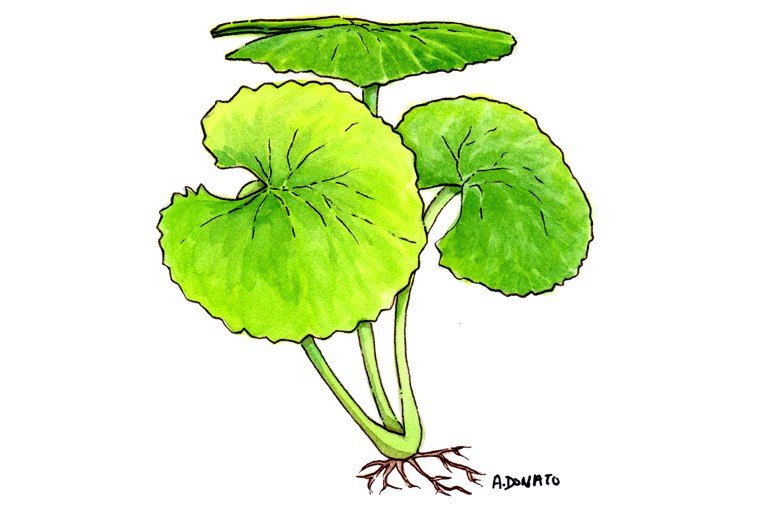
Common Names
- Indian pennywort
- Hydrocotyle
- Mandukaparni
- Madecassol
- TECA
For Patients & Caregivers
Tell your healthcare providers about any dietary supplements you’re taking, such as herbs, vitamins, minerals, and natural or home remedies. This will help them manage your care and keep you safe.
Only a few studies suggest that gotu kola may be helpful for wound healing or poor circulation. Larger studies that confirm such results are needed.
Gotu kola is a plant that contains many biologically active compounds. Although this botanical is popular in traditional medicines, it has mostly been studied in the lab. A variety of properties have been described, including improved wound healing and anti-inflammatory effects.
Only a few studies have been conducted in humans. Some data suggest gotu kola can decrease venous pressure in people with venous insufficiency, speed wound healing, relieve anxiety, or improve cognition. However, there is insufficient evidence to support its use for any of these conditions.
- To lower high blood pressure
Several clinical trials suggest that gotu kola can reduce venous hypertension in patients with chronic venous insufficiency, but there is no evidence that this herb can treat typical (arterial) high blood pressure. - To treat chronic venous insufficiency
Several clinical trials suggest benefit. - To treat wounds or burns
Only a few lab and human studies suggest that gotu kola might reduce inflammation and speed wound healing. However, a topical cream did not prevent or delay radiation dermatitis in breast cancer patients undergoing treatment. Additional studies are needed. - To improve cognitive function
A preliminary study suggests benefit, but a meta-analysis did not find strong enough evidence to support the use of gotu kola for cognitive function improvement. Larger well-designed studies are needed.
- Skin rash
- Liver toxicity
Do Not Take if:
- You are taking CYP450 substrate drugs: Lab studies suggest gotu kola may increase the risk of side effects of these drugs. Clinical relevance has yet to be determined.
Special Point:
- Gotu kola should not be confused with kolanut. Gotu kola does not contain caffeine and has not been shown to have stimulant properties.
- Depending on where gotu kola is grown, the amount of active compounds in this herb can vary widely.
For Healthcare Professionals
Gotu kola is an evergreen perennial plant that is prevalent in East Asia and many parts of South Africa. Extracts from the leaf and whole plant are used for a variety of conditions including venous insufficiency, varicose veins, wound healing, scleroderma, and scars.
Preclinical data suggest neuroprotective (13), chemopreventive (14) (19), and antioxidant properties (20). The active constituent madecassoside may also have cardioprotective and antiarthritic effects (4) (5). Topical application of an asiaticoside extracted from gotu kola appeared to enhance burn wound healing (6).
Only a few studies have been conducted in humans, however. Data show a reduction in lower extremity edema with gotu kola compared to placebo in patients with chronic venous insufficiency (1) (2) (3). With respect to wounds, one study suggests an oral extract may speed healing in diabetic patients (22). In small studies of topical products, gotu kola improved symptoms in burn wound patients (29), but did not prevent or delay radiodermatitis in breast cancer patients undergoing treatment (32).
Other small studies suggest that oral supplementation with gotu kola may alleviate generalized anxiety disorder (16) and improve cognitive function and mood in the elderly (7), although a meta-analysis did not find strong enough evidence to support its use (30). Larger well-designed studies are needed to confirm these effects.
Gotu kola should not be confused with kolanut. Gotu kola does not contain any caffeine and has not been shown to have stimulant properties.
- Circulation
- Wounds
- Memory
Triterpenoids have been identified as active constituents. Asiaticoside demonstrates anti-inflammatory effects by inhibiting lipopolysaccharide-induced fever and inflammatory response, including production of serum TNF-alpha, IL-6, PGE2, liver myeloperoxidase activity, and expression of brain COX-2 protein (23). Asiaticoside also promotes wound healing by stimulating collagen and glycosaminoglycan synthesis and angiogenesis (6). Another study showed that a gotu kola extract may regulate stress-induced premature senescence by preventing repression of DNA replication and mitosis-related gene expression (24).
A water extract of gotu kola prevented the formation of intracellular beta-amyloid aggregates in a mouse model of Alzheimer’s disease with high amounts of beta-amyloid (25).