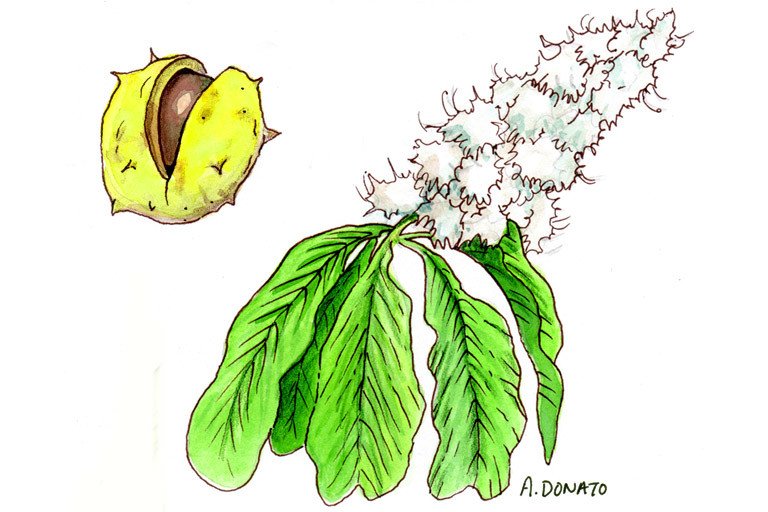
Common Names
- Chestnut
- Marron europeen
- Escine
- Escin
- Aescin
For Patients & Caregivers
Tell your healthcare providers about any dietary supplements you’re taking, such as herbs, vitamins, minerals, and natural or home remedies. This will help them manage your care and keep you safe.
Horse chestnut may help treat chronic venous insufficiency, but its long-term effects are not known.
Horse chestnut is a seed extract. One of its active components is aescin, which may reduce inflammation and increase vein tone. It also reduces the release of enzymes that typically increase with chronic vein diseases. Other compounds in horse chestnut generally improve blood vessel tone. In some studies, horse chestnut extract was effective against chronic venous insufficiency.
A compound called aesculetin may act as an anticoagulant and blood thinner, and is therefore often excluded from over-the-counter horse chestnut products.
- To treat circulatory disorders
Several clinical trials support the use of horse chestnut as short-term treatment for chronic venous insufficiency, but long-term effects are unknown. - To treat vein inflammation
No scientific evidence supports this use. - To treat varicose veins
This claim is not backed by any evidence. - To treat diarrhea
There is no scientific evidence to back this claim. - To treat hemorrhoids
There are no data to support this.
Case reports
- Chestnut seed poisoning: In a 46-year-old male who mistook horse chestnut seed for Korean chestnut. Symptoms included epigastric pain, nausea, sweating, and palpitations as well as slight increases in liver enzymes, serum amylase, and pancreatic amylase.
- Intestinal obstructions: Several cases requiring surgery for removal have occurred with the excessive consumption of horse chestnuts.
- Life-threatening kidney rupture: In a patient with a benign kidney tumor, after taking horse chestnut seed extract for venous insufficiency.
- Heart inflammation and shortness of breath: In a 32-year-old man who consumed 3 boxes of horse chestnut paste over 6 weeks.
Patient Warnings:
- Horse chestnut seeds are toxic, and can cause major stomach irritation, vomiting, muscle twitching, incoordination, redness, facial swelling, and other serious conditions. They can also be easily mistaken for edible chestnuts.
Do Not Take if:
- You are taking warfarin, aspirin, or other blood thinners: Horse chestnut products that contain aesculin may increase bleeding risk. Check to make sure that your horse chestnut product is aesculin-free.
- You are taking CYP450 substrate drugs: Horse chestnut may increase their side effects while reducing the effectiveness of such drugs.
For Healthcare Professionals
Horse chestnut, a tree native to the Balkan Peninsula, has been used in traditional medicine for centuries. The seed extract is used as a dietary supplement to support vascular function. Horse chestnut should not be confused with sweet chestnut.
Lab studies suggest that aescin, or escin, in horse chestnut has anti-inflammatory (1), neuroprotective (1), and antitumor (2) (3) effects, and may enhance gemcitabine efficacy (18).
Data from earlier trials suggest horse chestnut seed extract has efficacy against chronic venous insufficiency (4) (5) and is safe and well tolerated (6) (7) (8), but a Cochrane review of rutosides did not find any clear evidence of benefit for post-thrombotic syndrome (10). Other studies suggest aescin may improve sperm quality in patients with varicocele-associated infertility (14).
Patients with compromised renal or hepatic function should not consume horse chestnut products.
- Circulatory disorders
- Phlebitis
- Varicose veins
- Diarrhea
- Hemorrhoids
Aescin, a natural mixture of triterpenoid saponins isolated from the seed of horse chestnut, has been identified as the active principle. Its anti-inflammatory effects involve downregulation of inflammatory gene expression and upregulation granulocyte-macrophage colony-stimulating factor production, which also confers neuroprotection (1).
Aescin may reduce chronic venous insufficiency via inhibition of elastase and hyaluronidase, both involved in enzymatic proteoglycan degradation, which constitutes part of the capillary endothelium and is the main component of the extravascular matrix (19). Contraction of veins and arteries with horse chestnut may be partially mediated through 5-HT(2A) receptors (20). It also reduced platelet aggregation in vitro (20).
Beta-aescin and 5-fluorouracil inhibited human hepatocellular carcinoma cells, perhaps via synergistic effects including cell-cycle arrest, induction of apoptosis, caspase-3, -8 and -9 activation, and Bcl-2 downregulation (17). Escin potentiated gemcitabine efficacy in part through NF-κB inhibition and consequent inhibition of c-Myc, COX-2, cyclin D1, survivin, Bcl-2, and Bcl-xL, and caspase-3 activation (18).
Horse chestnut seeds are toxic, and can cause major stomach irritation, vomiting, muscle twitching, incoordination, redness, facial swelling, paralysis, low blood pressure, and collapse (21). They can also be easily mistaken for edible chestnuts.
Case reports
Chestnut seed poisoning: In a 46-year-old male who mistook horse chestnut seed for Korean chestnut. Symptoms included epigastric pain, nausea, sweating, and palpitations as well as slight increases in liver enzymes, serum amylase, and pancreatic amylase (23).
Intestinal obstruction: Caused by excessive consumption of horse chestnuts. In cases with bezoars, surgical removal was required (12) (15).
Life-threatening kidney rupture: In a patient with a benign kidney tumor after taking horse chestnut seed extract for venous insufficiency. Symptoms improved after an emergency embolization (16).
Pericarditis and dyspnea: In a 32-year-old man who had consumed 3 boxes of horse chestnut paste over 6 weeks (13).
- Anticoagulants / antiplatelets: Horse chestnut may have additive effects due to aesculin, a hydroxycoumarin (9).
- CYP450 substrates: In animal studies, aescin both inhibited and induced 1A2, 2C9, and 3A4, and may affect the intracellular concentration of drugs metabolized by these enzymes (22). Clinical relevance has yet to be determined.