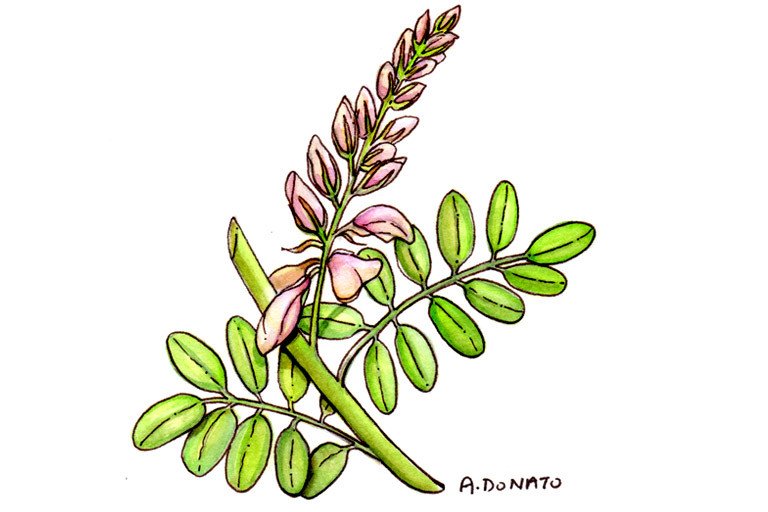
Common Names
- Indigo
For Patients & Caregivers
Tell your healthcare providers about any dietary supplements you’re taking, such as herbs, vitamins, minerals, and natural or home remedies. This will help them manage your care and keep you safe.
Evidence on whether indirubin can treat chronic conditions is lacking.
Indirubin is derived from the Indigo Plant (Isatis Root, Isatis Leaf). It has also been created synthetically in the lab. In Asia, it is part of combination formulas used clinically and in traditional herbal prescriptions to treat chronic conditions such as inflammation, gastrointestinal diseases, and some forms of cancer. Animal studies suggest this substance may help keep cancer cells from reproducing. Indirubin may also reduce inflammation by inhibiting part of the immune response.
Studies of indirubin in humans are very limited and side effects with some formulations have been reported. Well-designed clinical trials are needed to confirm safety and effectiveness of this compound for various conditions.
- To treat cancer
There is a lack of evidence to support this use. Case reports and initial analyses suggest possible benefits in leukemia, but well-designed clinical trials are needed to confirm safety and effectiveness. - To reduce inflammation
A small study in patients with head and neck cancer suggest that indirubin, taken as indigowood root powder, may reduce mucosal damage from radiation therapy. Additional studies are needed to confirm this effect. - To treat psoriasis
A few studies suggest topical formulations can treat inflammatory skin conditions such as psoriasis and contact dermatitis. - To treat gastrointestinal conditions
Oral I. naturalis has been used in clinical trials in Asia for ulcerative colitis and other gastrointestinal conditions, but results are preliminary and severe adverse events have been reported.
With oral I. naturalis: Liver dysfunction, abdominal pain, nausea, and headache
Case reports
- Inflamed colon: In 2 women with a history ulcerative colitis who took oral I. naturalis. In one case, alleviation of the condition required surgery.
- Lower abdominal pain and bloody stools: Caused by self-treatment with I. naturalis in a 44-year-old woman with ulcerative colitis who used this product for several months to replace her standard medications.
- Bluish-black patches in the small intestine: Related to the use of I. naturalis in a 57-year-old woman with Crohn's disease.
- Inflamed pancreas: In an 11-year old boy after 2 doses of I. naturalis to treat Crohn's disease. The condition improved after the product was discontinued.
- High blood pressure that affects the lung and heart: A serious condition known as pulmonary arterial hypertension has been reported in multiple cases of patients treated with oral I. naturalis for ulcerative colitis. Symptoms have included swelling, shortness of breath, cold limbs, and chest pain and required acute medical care.
Patient Warnings:
- There have been serious adverse effects in patients treated with oral I. naturalis for gastrointestinal conditions. Therefore, this product should not be used outside of clinical trials.
Do Not Take if:
You are taking CYP450 3A4 substrate drugs: Lab studies suggest that indirubin, a component of the isatis plant, may affect how these drugs are metabolized. Clinical relevance has yet to be determined.
Special Point:
- This product is currently not sold as a dietary supplement. It is only available for preclinical and clinical studies.
For Healthcare Professionals
Indirubin is extracted from the indigo plant (Isatis Root, Isatis Leaf). It is a part of combination formulas used in traditional Chinese medicine (TCM) and clinically in Asia to treat chronic conditions including inflammation, gastrointestinal diseases, and some forms of cancer (21). For example, Dang Gui Long Hui Wan which contains Indigofera tinctoria has been used to treat chronic myelogenous leukemia (CML), while Qing Dai (Indigo naturalis) has been used topically for psoriasis and orally for ulcerative colitis.
In vitro and animal studies indicate anti-inflammatory (2), antitumor (14) (15), antiangiogenic (19), and neuroprotective (16) effects. Indirubin also inhibits cyclin-dependent kinases in tumor cells (5) (6). A derivative of indirubin enhanced the cytotoxic effects of adriamycin (17).
Studies of indirubin in humans are limited. A few clinical trials suggest topical I. naturalis ointment is effective for psoriasis (18) (22) and atopic dermatitis (23) (35). Oral I. naturalis induced a clinical response in ulcerative colitis (24) (25), but the trial was stopped due to a prior case of pulmonary arterial hypertension, possibly related to a self-purchased product (26). In addition, a subsequent national survey in Japan identified 11 cases of PAH in UC patients as well as other adverse events (27). Short-term indigo administration in patients with mild to moderate UC appeared to be effective without serious adverse events, but the study was small and additional research is needed (36). In patients with Crohn’s disease, preliminary analyses suggest only modest benefit (28).
Interim trial analysis of oral chemotherapy with an I. naturalis formulation versus intravenous chemotherapy for acute promyelocytic leukemia suggests it is as effective and may reduce hospital stays (29), but the final analysis has yet to be published. A small study of indirubin in the form of indigowood root powder for patients with head and neck cancer found a reduction in mucosal damage from radiation therapy (3). Although there are case reports of positive effects following long-term use of indirubin in CML (7), well-designed clinical trials are needed to confirm its role.
- Cancer
- Inflammation
- Psoriasis
- GI conditions
Aryl hydrocarbon receptor (AhR) ligand, the active component of Indigo naturalis, may promote mucosal healing via induction of IL-22 from innate lymphoid cells (30). Indirubin and derivatives modulate inflammation-associated signaling including NF-kappaB, STAT3, TGF-ss, and AhR (21). In human skin samples, indirubin produced anti-psoriatic effects by modulating proliferation and differentiation of keratinocytes (10).
Anticancer and neuroprotective properties are attributed to inhibition of cyclin-dependent kinases (CDKs) and glycogen synthase kinase-3 by competing with ATP binding sites (31). Indirubin-3-oxime inhibits growth of human laryngeal cancer cells via CDK inhibitor p21, cyclin D1 inhibition, and caspase-3 activation (1). In human neuroblastoma cells, it may induce cell-cycle arrest by altering mitochondrial function (20). Indirubin may also help inhibit microtubule assembly to further reduce rates of cell reproduction (11). In vivo, antiangiogenic and antiproliferative effects of an indirubin derivative was attributed in part to inhibition of VEGF/VEGFR-2 signaling (19).
Oral I. naturalis: Liver dysfunction, abdominal pain, nausea, and headache (24) (27) (32) (36)
Case reports
- Pulmonary arterial hypertension: Multiple cases in patients with ulcerative colitis treated with I. naturalis (24) (26) (27).
- Phlebitis-induced colitis: In 2 women with a history ulcerative colitis who took oral I. naturalis; one case required surgery (32). Researchers also noted other reports of ischemic lesions of the colonic mucosa.
- Ischemic colitis: Induced by self-treatment with I. naturalis in a 44-year-old woman with ulcerative colitis who used this product for several months to replace her standard medications (37).
- Acute pancreatitis: In an 11-year old boy after 2 doses of I. naturalis to treat pediatric Crohn’s disease (33). The condition improved after the product was discontinued.
- Pseudomelanosis: Identified during endoscopy and related to the use of I. naturalis in a 57-year-old woman with Crohn’s disease (38).
CYP450 3A4 substrate drugs: Indirubin, a component of the isatis plant, activates CYP3A4 gene transcription through the human pregnane receptor. Clinical relevance is not yet known (34).