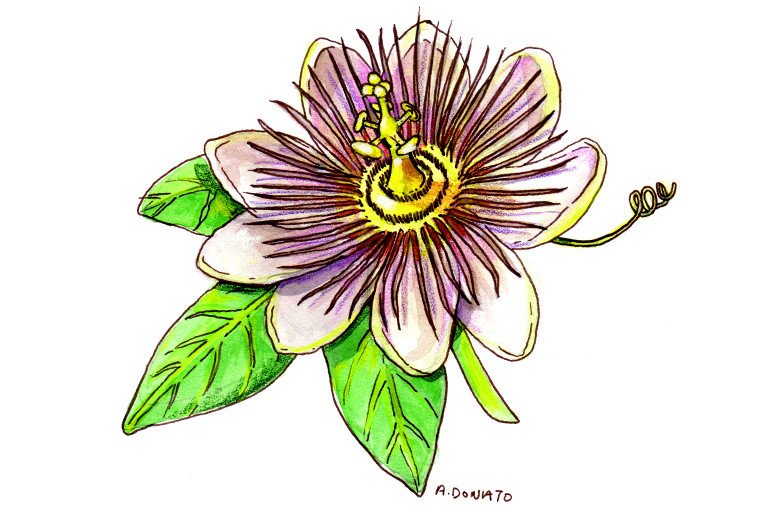
Common Names
- Maypop
- Apricot vine
- Passion vine
- Passiflore
For Patients & Caregivers
Tell your healthcare providers about any dietary supplements you’re taking, such as herbs, vitamins, minerals, and natural or home remedies. This will help them manage your care and keep you safe.
Passionflower may reduce anxiety, but its long-term safety and effectiveness are not known.
Passiflora incarnata is a perennial wildflower that is commonly found in the southern United States. Passionflower extract is contained in many dietary supplement products marketed as sleep aids or anxiety relievers. A handful of studies in humans support these claims, although it is still unknown whether passionflower extracts are safe and effective in the long-term. Scientists are not sure how this herb works, but have speculated that compounds in passionflower may interact with receptors in the brain that would mediate a relaxation response. Studies done in mice suggest that passionflower extracts have mild anti-inflammatory and anti-seizure activity.
Because animal studies show disrupted sexual behavior in male offspring, passionflower should be avoided during pregnancy. It may also interact with certain medications as well as have added effects with St. John's wort and/or valerian.
- To relieve anxiety
Small studies suggest that passionflower may be as effective as oxazepam, a common drug used for treating general anxiety, and help reduce anxiety in presurgical patients. - As a sleep aid, for insomnia
Passionflower may reduce anxiety (see above), which may help induce sleep. A small study showed benefits of passionflower in sleep quality in healthy adults. - To treat nerve pain
Evidence is lacking to support this claim. - To treat attention-deficit hyperactivity disorder (ADHD)
A small study in children suggests that passionflower may reduce ADHD symptoms similar to a prescription drug but with fewer side effects.
- Dizziness
- Sedation
- Lack of muscle coordination
- Allergic reaction
- Impaired cognitive function
Large doses may result in central nervous system depression and slowed or irregular heart rhythms.
Case reports
- A 34-year-old woman required hospital admission with symptoms of nausea, vomiting, decreased heart rate, and heart rhythm abnormalities after using a passionflower supplement.
- A patient who self-medicated with valerian and passionflower while on anti-anxiety therapy experienced hand tremors, dizziness, throbbing and muscular fatigue suspected to be caused by using these products together.
- Passionflower was among the 10 most frequently reported plants to cause neurotoxicity and gastrointestinal symptoms (29).
Do Not Take if:
- You are taking pentobarbital: Passionflower may have additive effects. Clinical relevance is not known.
- You are taking benzodiazepines such as Ativan® or Valium®: Passionflower may increase the sedative effects of these medications. Clinical relevance is not known.
- You are taking drugs that prolong the QT interval (eg, azithromycin, dasatinib, fingolimod): The QT interval shows the electrical activity in the heart's lower chambers, the ventricles. Because lab analyses suggest passionflower may also prolong QT interval with large doses, it is not known whether passionflower may have added cardiac effects with these medications.
- You are pregnant: Passionflower should be avoided because it may cause uterine contraction and behavioral dysfunction in offspring.
For Healthcare Professionals
Passiflora incarnata is a perennial wildflower that is prevalent in the southern United States. Its extracts are used in supplemental forms to treat insomnia, anxiety, epilepsy, neuralgia, and withdrawal syndromes associated with opiates or benzodiazepines. It is also found in over-the-counter preparations to reduce symptoms associated with menopause and hyperactivity.
Animal models suggest antidiabetic (19), antiasthmatic (20), and seizure suppression effects (21). Passionflower also reduced seizure severity, immobility, and retained brain levels of serotonin and noradrenaline (21). In another study, its extracts were shown to produce anxiogenic effects, although two of these extracts also showed an anticonvulsant effect against seizures (6).
A pilot study of passionflower for generalized anxiety showed comparable efficacy to oxazepam (3) and a systematic review determined it may improve symptoms associated with neuropsychiatric disorders (30). In patients undergoing surgery (5) (16), and dental extractions (28) (31) (32), preoperative use of passionflower was reported to reduce anxiety. In healthy adults, consumption of a low-dose passionflower tea produced short-term benefits in sleep quality (17). Another study showed passionflower had comparable effects to a prescription drug for the treatment of ADHD (22).
When used concurrently, passionflower was shown to enhance the pharmacologic effects of St. John’s wort (18).
- Benzodiazepine withdrawal
- Drug withdrawal symptoms
- Epilepsy
- Insomnia
- Neuralgia
- Attention-deficit hyperactivity disorder (ADHD)
The alkaloid constituents harman and harmaline are thought to produce monoamine oxidase inhibition (1), while maltol and gamma-pyrone derivatives cause activation of gamma amino butyric acid (GABA) receptors that may account for anxiolytic and sedative properties (11). Chrysin has also been identified among the bioactive metabolites with central nervous system (CNS) suppression activity (21).
In vitro, modulation of the GABA system by passionflower includes affinity to GABA(A) and GABA(B) receptors, and effects on GABA uptake (24). Antiradical activities observed are attributed to flavonoids such as isovitexin (25). An isolated benzoflavone moiety is suspected as being the strongest aromatase inhibitor in passionflower, although the flavone chrysin also has these properties (26).
In an animal reproductive and developmental study, passionflower produced sexual behavioral disruption in male adult rats that was not accompanied by alterations in plasma testosterone levels, reproductive-related organs, and glands weights or sperm count, and was potentially attributed to aromatase inhibition (27). In seizure models, protection against post-ictal depression not seen with diazepam controls point to activity from metabolites in passionflower rather than as a result of its seizure suppression effects (21).
Passionflower also exhibits mild anti-inflammatory activity. An ethanolic extract of passionflower reduced carrageenan-induced edema, leukocyte migration, and granuloma formation in mice, although the effect was less than that seen with aspirin (13).
Dizziness, sedation, ataxia, allergic reaction, and impaired cognitive function (3) (4).
Large doses may result in central nervous system depression and bradycardia, prolonged QTc and ventricular tachycardia (4).
Case reports
Nausea, vomiting, bradycardia, and abnormal electrocardiogram: ECG changes included non-sustained ventricular tachycardia, QTc prolongation, and nonspecific ST-T wave changes in a 34-year-old woman requiring hospital admission (7).
Hand tremors, dizziness, throbbing and muscular fatigue: In a patient who self-medicated with valerian and passionflower while on lorazepam treatment. An additive or synergistic effect is suspected to have caused these symptoms (14).
Passionflower was among the 10 most frequently reported plants to cause neurotoxicity and gastrointestinal symptoms (29).
Pentobarbital: Passionflower may potentiate the effects of pentobarbital (2). Clinical relevance is not known.
Benzodiazepines: Passionflower may increase the sedative effects of benzodiazepines by increasing the binding activity of benzodiazepines to GABA receptors (14). Clinical relevance is not known.
Drugs that prolong the QT interval (eg, azithromycin, dasatinib, fingolimod): The pharmacologic profile of passionflower also suggests prolonged QT interval with large doses (4), and it is not known whether passionflower may have added cardiac effects with these medications.
Herb-Herb Interaction
St. John’s wort: Passionflower was shown to enhance the potency of St. John’s wort (18). Clinical significance of this interaction is not known.