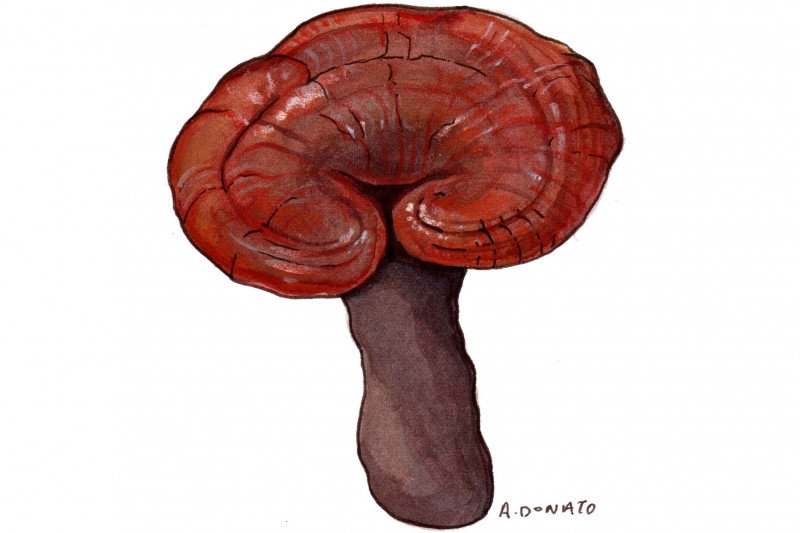
Common Names
- Ling zhi
- Lin zi
- Mushroom of immortality
For Patients & Caregivers
Tell your healthcare providers about any dietary supplements you’re taking, such as herbs, vitamins, minerals, and natural or home remedies. This will help them manage your care and keep you safe.
Reishi mushroom is used in many Asian countries to increase energy, boost the immune system, and for general health. Reishi supplements come as capsules, tablets, extracts, powders, and teas.
Reishi mushroom is used to:
- Boost the immune system
- Increase strength and stamina
- Lower cholesterol
- Treat lower urinary tract symptoms (having to pee at night, weak urine flow, peeing more times than usual, and not being able to control urine flow) in males
Reishi also has other uses that haven’t been studied by doctors to see if they work.
Talk with your healthcare providers before taking reishi supplements. Herbal supplements are stronger than the herbs you would use in cooking. They can also interact with some medications and affect how they work. For more information, read the “What else do I need to know?” section below.
Side effects of reishi may include:
- Nausea (feeling like you’re going to throw up)
- Insomnia (trouble falling asleep, staying asleep, or waking up too early)
- Liver injury
- Talk to your healthcare provider if you’re on blood thinners such as warfarin (Coumadin®, Jantoven®). Reishi mushroom can increase your risk of bleeding.
- Talk to your healthcare provider if you’re on immunosuppressants. Reishi may not be safe for you.
- Talk to your healthcare provider if you’re taking reishi mushroom spore powder. It may increase the levels of a substance called CA72-4 in your body. This may show up on your test results and interfere with your cancer treatment.
For Healthcare Professionals
Reishi mushroom is a fungus that holds an important place in the traditional medical systems of China, Japan, Korea and other Asian countries for its health-promoting effects. It is used as an immunostimulant by patients with AIDS and cancer. The active constituents include both beta-glucan polysaccharides and triterpenes (46) (47).
Extracts of reishi were shown to have immunomodulatory (2) (4) (5), renoprotective (9), anti-inflammatory (36), and hepatoprotective (37) properties both in vitro and in vivo. Clinical studies indicate its benefits in improving lower urinary tract symptoms (LUTS) in men (10) (20), and in exerting mild antidiabetic effects and improving dyslipidemia (29). However, randomized controlled trials do not support the use of reishi for reducing cardiovascular risk factors associated with type 2 diabetes (38) (43), and reishi did not influence blood or anthropometric measurements in patients with fibromyalgia (49). A pilot study of reishi spore powder did not find it helpful in treating patients with Alzheimer’s disease (AD) (1).
Preclinical findings indicate that reishi has immunomodulatory (45) and chemopreventive effects (21) (46), alleviates chemotherapy-induced nausea (13), enhances the efficacy of radiotherapy (22), and increases sensitivity of ovarian cancer cells to cisplatin (27). It may also help prevent cisplatin-induced nephrotoxicity (28).
In small clinical studies, reishi increased plasma antioxidant capacity (6) (7), enhanced both immune and tumor response in cancer patients (8) (40) (44) (50) (51), and suppressed development of colorectal adenomas (41). Remission of hepatocellular carcinoma has also been reported in a few cases in a single study (23), and a formula containing reishi and ligustrum helped maintain the quality of life in non-small cell lung cancer patients undergoing chemotherapy (48). But a reishi extract was found to have toxic effects in leukocytes (14). Also, patients undergoing treatment for gastrointestinal cancer had higher levels of the serum tumor marker CA72-4 after taking reishi spore supplements (42). Further research is needed to determine the safety and effectiveness of reishi as an adjunctive cancer treatment.
- Immunostimulation
- Strength and stamina
- High cholesterol
- Lower urinary tract symptoms
Beta glucans, polysaccharides present in reishi, demonstrated antitumor and immunostimulating activities (18) (40). Its triterpene compounds may inhibit tumor invasion by reducing matrix metalloproteinase expression (16), and tumor metastases by limiting attachment to endothelial cells (17). Findings also indicate that reishi induces natural killer (NK) cell cytotoxicity against various cancer cell lines via activation of the natural cytotoxic receptors (NKG2D/NCR) and mitogen-activated protein kinase (MAPK)-signaling pathways, which result in exocytosis of perforin and granulysin (31). Reishi polysaccharides were shown to increase expression of the major histocompatibility (MHC) class I and costimulatory molecules on melanoma cells, resulting in enhanced antitumor cytotoxicity (32). In ovarian cancer cells, reishi induced G2/M phase cell cycle arrest, activated caspase 3 to induce apotosis, increased p53, and inhibited Akt expression (27).
Nausea and insomnia have been reported (43) (44).
Case reports
- Hepatoxicity: Two cases with the use of powdered reishi mushroom, leading to death in one instance (24) (25).
- Pseudoparasitosis/Chronic diarrhea: In a 49-year-old man with non-Hodgkin’s lymphoma following prolonged consumption of powdered reishi mushroom extract (26).
- Pseudoparasitosis: Due to similarity in structure with Clonorchis sinensis ova, in a patient with a history of long-term ingestion of reishi mushrooms (39).
- Hypereosinophilia with hepatic nodules: In a 61-year-old man who underwent surgery for rectal adenocarcinoma. He had been taking reishi for liver function. Eosinophil counts and liver enzymes resolved and nodules disappeared after discontinuing use (52).
- Anticoagulants / Antiplatelets: Reishi can increase the risk of bleeding (12).
- Immunosuppressants: Reishi can enhance immune response (8).
- Chemotherapeutic agents: Reishi can increase plasma antioxidant capacity, and in theory may interact with chemotherapeutic agents that rely on free radicals (6).
- Cytochrome P450 substrates: In vitro, reishi polysaccharides inhibited CYP2E1, CYP1A2, and CYP3A, and may affect the intracellular concentration of drugs metabolized by these enzymes (15) (53). Clinical relevance is not known.