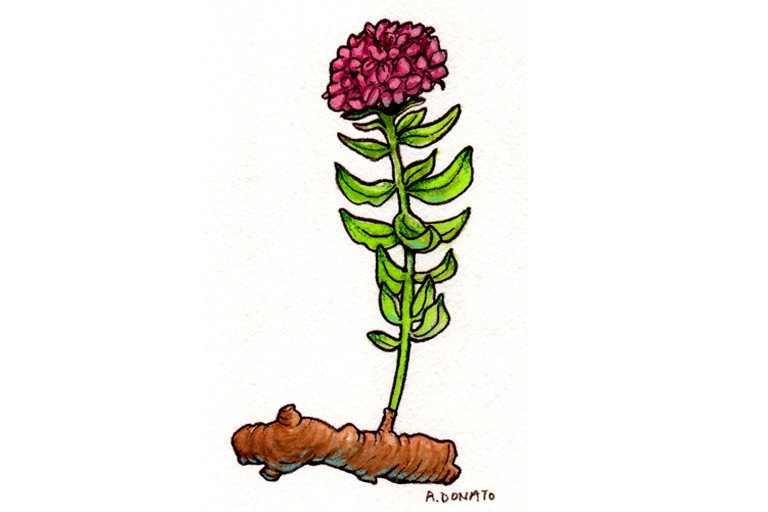
Common Names
- Golden root
- Rose root
- Hong Jing Tian
- Rose root extract
- Rosenroot
- SHR-5
For Patients & Caregivers
Tell your healthcare providers about any dietary supplements you’re taking, such as herbs, vitamins, minerals, and natural or home remedies. This will help them manage your care and keep you safe.
Rhodiola is an herb used in traditional medicine in Eastern Europe and Asia. It also comes as tablets, capsules, and liquid extracts.
Rhodiola is used to:
- Manage stress
- Manage fatigue (feeling very tired or having less energy than usual)
- Improve endurance (your ability to do physical activity for a long time)
- Treat depression
Rhodiola has other uses, but doctors have not studied them to see if they work.
Talk with your healthcare provider before taking rhodiola supplements. Herbal supplements are stronger than the herbs you would use in cooking. Supplements can also interact with some medications and affect how they work. For more information, read the “What else do I need to know?” section below.
Side effects of taking rhodiola may include:
- Dizziness (feeling faint or lightheaded)
- Dry mouth
- Talk to your healthcare provider if you’re taking a blood thinner, such as warfarin (Coumadin®, Jantoven®). Rhodiola can affect the way it works.
- Talk to your doctor if you’re taking anti-seizure medications such as phenytoin (Dilantin®). Rhodiola may increase your risk of having side effects.
For Healthcare Professionals
Rhodiola is a plant used in traditional medicine in Eastern Europe and Asia to enhance physical and mental performance, stimulate the nervous system, and reduce depressive symptoms. Although Rhodiola rosea extract and its key constituent salidroside have been researched, data in humans are limited.
In vitro studies suggest that salidroside may have neuroprotective (8) (9) and anticancer effects (10). Animal data suggest benefits with rhodiola on cognitive function, but most studies were determined to have a high risk of bias (24).
In humans, preliminary data suggest rhodiola supplementation may improve physical endurance (1) and mental performance (2) (3), and reduce fatigue (4) (5) and stress (19) (20). Other small studies suggest it may improve symptoms of generalized anxiety disorder (6) and mild to moderate depression (7). In one study, it was better tolerated and had fewer side effects than sertraline, although it was also less effective (22). A systematic review evaluating rhodiola trials determined that higher reporting quality and better methodological quality are needed (25).
In patients with breast cancer receiving epirubicin, a small study suggests that salidroside may have cardioprotective effects (11), but larger confirmatory studies are needed.
- Stress
- Fatigue
- Endurance
- Depression
In vitro studies suggest that salidroside, a key constituent, confers neuroprotective effects via NO pathway inhibition (9), induces antioxidant enzymes thioredoxin, heme oxygenase-1, and peroxiredoxin-I; downregulates proapoptotic Bax protein; and upregulates antiapoptotic Bcl-XL proteins (8). Rhodiola constituents may also have synergistic antioxidant activity (17) and potential antidepressant effects may be due to inhibition of monoamine oxidases A and B (13). In human breast cancer cells, salidroside induced cell-cycle arrest and apoptosis via mechanisms as yet unidentified, but independent of the estrogen receptor (10).
In animal models, rhodiola exhibits dose- and time-dependent Th1 and Th2 cytokine modulation effects (16).
- Patients taking prescription antidepressant medications should use rhodiola with caution as concurrent use was reported to cause tachyarrhythmia (18).
- CYP3A4 substrates: In preclinical studies, rhodiola inhibits CYP3A4 and can affect the intracellular concentration of drugs metabolized by this enzyme (12) (21). Clinical relevance is yet to be determined.
- CYP2C9 substrates: Rhodiola modestly inhibits CYP2C9, and may affect drugs metabolized by this enzyme, particularly those with a narrow therapeutic index such as phenytoin and warfarin (23).
- P-glycoprotein substrates: In preclinical studies, rhodiola was shown to inhibit P-gp activity and can interfere with the metabolism of certain drugs (12) (21). Clinical relevance is yet to be determined.
- Antidepressants: Rhodiola has MAO inhibition activity and may increase serotonergic side effects (13). Clinical relevance is yet to be determined.
- Antihypertensives: Rhodiola has MAO inhibition activity and may increase hypotensive side effects (13). Clinical relevance is yet to be determined.
- CNS Stimulants: Rhodiola has MAO inhibition activity and may enhance the hypertensive effect (13). Clinical relevance is yet to be determined.