History & Overview Annual Report Center News Community Affairs Code of Conduct
Make a Gift Cycle for Survival Fred's Team Yankees Universe Fund Thomas Blake Sr. Memorial Research Fund Donating Blood & Platelets Volunteering Thrift Shop Park Avenue Potluck CELEBRATIONS
Press Releases In the News Information for Journalists News@MSKCC
Manhattan New Jersey Long Island Westchester
Working at Memorial Sloan-Kettering Work Sites College Recruitment About Nursing Job Fairs & Career Days IS Careers Job Search & Apply Online
Making an Appointment
Search About Herbs:

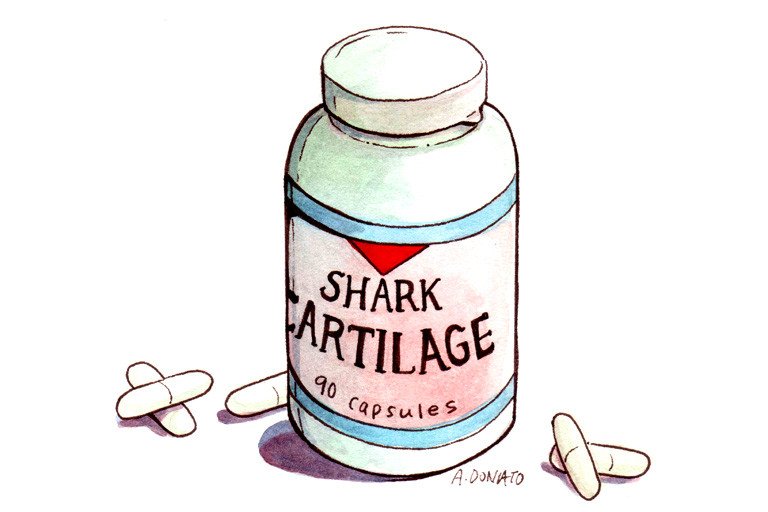
Shark Cartilage

How It Works

Bottom Line: Shark cartilage is not effective in treating cancer.

Since cartilage is a body tissue in which no blood vessels are present, researchers guessed that certain molecules isolated from shark cartilage could inhibit the growth of blood vessels. This action, called anti-angiogenesis, was seen when shark cartilage was directly applied to tumors in a test tube. However, when these extracts were given by mouth (how all over-the-counter shark cartilage supplements are taken), no anti-tumor effect occurred in mice or in humans.
A purified shark cartilage product called Neovastat (AE-941) can reduce tumor size in animals. However, it did not improve survival in lung cancer patients.

Purported Uses

  • To treat and prevent cancer
    Studies in animals and humans do not support this use. Even though shark cartilage showed promise in laboratory studies, it is probably not absorbed through the gut into the bloodstream.
  • To stimulate the immune system
    No scientific evidence supports this use.
  • To reduce inflammation in conditions such as arthritis, osteoarthritis, hemorrhoids, colitis, and psoriasis
    No scientific evidence supports this use.
  • For faster wound healing
    No scientific evidence supports this use.
  • To reduce bone loss in osteoporosis
    No scientific evidence supports this use.
  • To treat degenerative eye conditions such as glaucoma, macular degeneration, and diabetic retinopathy
    No scientific evidence supports this use
  • To treat Kaposi sarcoma
    There is one case report of regression of Kaposi sarcoma in a man who took low-dose shark cartilage for a prolonged period. However, this may have been a chance occurrence, so it does NOT support the use of shark cartilage for this disease.

  • Warnings

  • This product is regulated by the FDA as a dietary supplement. Unlike approved drugs, supplements are not required to be manufactured under specific standardized conditions. This product may not contain the labeled amount or may be contaminated. In addition, it may not have been tested for safety or effectiveness.

  • Do Not Take If

    You have a history of liver disease (In one patient, prolonged use of shark cartilage was associated with liver dysfunction, which reversed upon discontinuation of the supplement).

    Side Effects

  • Gastrointestinal effects have been reported but are rare: Nausea, vomiting, upset stomach, constipation, diarrhea, and loss of appetite.
  • Hypoglycemia (low blood sugar) was reported in one patient with type II diabetes.
  • Tell your doctor immediately if you develop the following symptoms: fever, jaundice (yellowing of the skin), nausea, vomiting, diarrhea, and/or yellowing of the whites of the eyes. These may indicate serious liver problems.

  • Special Point

  • Over-the-counter shark cartilage supplements contain varying amounts of shark cartilage. Some are composed mainly of fillers and may not have any biological activity. Furthermore, it is debated whether the large proteins responsible for shark cartilage's activity are absorbed through the gastrointestinal tract, or whether they are simply digested and rendered useless.
  • The Federal Trade Commission has barred three manufacturers from making unsupported health claims for their shark cartilage products.

  • Brand Name

    Carticin, Cartilade™, BeneFin™, Neovastat (Æ-941)

    Clinical Summary

    Obtained from the spiny dogfish shark and hammerhead shark (13), shark cartilage is promoted as a dietary supplement to treat cancer (18) (19) (20) (22), arthritis, osteoporosis, Kaposi's sarcoma (23), macular degeneration, psoriasis (21), and inflammatory disorders.
    Shark cartilage extracts show antiangiogenic and antitumor activities in vitro (3) (9) and in animal models (4) (6) (10), but clinical use remains controversial due to lack of bioavailability data and unsatisfactory patient outcomes in clinical trials (13) (24). Shark cartilage has been studied for Kaposi's sarcoma (23), metastatic renal cell carcinoma (22), and multiple myeloma (20) in early phase clinical trials. A recent study showed that Neovastat (AE-941), purified shark cartilage extract, did not improve survival in patients with non-small cell lung cancer (25). Neovastat has shown efficacy against psoriasis (21).

    Most trials report low toxicity, but regular consumption of a shark cartilage supplement was associated with reversible hepatic dysfunction in a 57-year-old man (15).
    The Federal Trade Commission has barred three manufacturers from making unsubstantiated claims of efficacy for their shark cartilage products.
    Shark cartilage should not be confused with bovine cartilage.

    Purported uses

  • Arthritis
  • Cancer prevention
  • Cancer treatment
  • Colitis
  • Diabetic retinopathy
  • Glaucoma
  • Hemorrhoids
  • Immunostimulation
  • Inflammation
  • Kaposi Sarcoma
  • Macular degeneration
  • Osteoarthritis
  • Osteoporosis
  • Psoriasis
  • Wound healing

  • Constituents

  • Glycoproteins: Sphyrnastatin 1 and 2
  • Glycosaminoglycans: Chondroitin sulphate, keratan sulphate
  • Calcium salts
  • Proteins: Collagen

  • Mechanism of Action

    The glycoproteins sphyrnastatin 1 and 2 and other unidentified factors (13) are thought responsible for the activity of shark cartilage (SC), which shows strong antiangiogenic activity and inhibition of tumor neovascularization in numerous in vitro and animal studies (12). Theories for its mechanism include interference with endothelial cell migration and adhesion via modification of adhesion protein organization and inhibition of collagenase (11). Intraperitoneal administration suppresses sarcoma-180 growth and B16-F10 melanoma metastasis in mice (6) (9), but oral bioavailability is questionable based on the results of mouse models (5).

    The manufacturers of Neovastat (AE-941), a shark cartilage extract, report that in vitro this formulation inhibits embryonic vascularization (1), endothelial cell proliferation (2), tubulogenesis, VEGF binding to endothelial cells, VEGF-dependent tyrosine phosphorylation of the VEGF receptor, and the VEGF-dependent increase in vascular permeability. They also claims that it inhibits serine elastase and matrix metalloproteinase activity. Oral administration of Neovastat has produced anti-tumor effects in mouse models (4)

    Pharmacokinetics

    Large macromolecules such as those associated with the antiangiogenic properties of shark cartilage are not usually absorbed by the intestinal tract and may be digested by proteolytic enzymes in the gut, but studies show that certain large proteins can be absorbed. No bioavailability studies with shark cartilage preparations are published, as it is unclear which active component to look for in the blood (13). One study in humans found a significant decrease in endothelial cell density within an inert subcutaneous implant following oral administration of a liquid shark cartilage extract, giving some support to the oral bioavailability of its antiangiogenic factors (14). The manufacturers of Neovastat (AE-941) claim that phase I-II trial results show that it is orally bioavailable and safe, but data from this study have not been published (13).

    Warnings

  • Commercially available supplements contain varying amounts of shark cartilage. Some are composed primarily of fillers and may not have any biological activity.
  • Neovastat (AE-941) is a highly purified extract of shark cartilage. It is an investigational new drug and is not available to the general public. Other shark cartilage products may not have similar properties.

  • Contraindications

    Patients with liver disease should use shark cartilage supplements with caution.

    Adverse Reactions

    Frequent: Altered taste.
    Infrequent: Nausea, vomiting, dyspepsia, constipation, diarrhea, anorexia, hypoglycemia in a known type II diabetic patient (22).
    Case Report: A 57-year-old man experienced nausea, vomiting, diarrhea, anorexia, jaundice, low-grade fever, scleral icterus, and elevated liver function tests after consuming a shark cartilage supplement for 10 weeks. Normal liver function resumed after discontinuation of the supplement (15).

    Herb-Drug Interactions

    None known

    Lab Interactions

    Periodic liver function tests should be performed with long-term use.

    Literature Summary and Critique

    Lu C, Lee JJ, Komaki R, et al. Chemoradiotherapy With or Without AE-941 in Stage III Non-Small Cell Lung Cancer: A Randomized Phase III Trial. J Natl Cancer Inst 2010;102:1-7.
    In this Phase III clinical trial, 379 patients with unresectable stage III non-small cell lung cancer (NSCLC) were randomized to receive 120 ml of AE-941 or placebo orally for six years along with chemotherapy (combination of carboplatin and paclitaxel, or cisplatin and vinorelbine). The primary and secondary endpoints were overall survival and time to progression, progression-free survival, tumor response rate, and toxic effects. Addition of AE-941 to standard chemotherapeutic regimens did not affect overall survival nor the secondary endpoints compared to placebo. This study shows that shark cartilage products are not useful for the treatment of NSCLC.

    Miller DR, et al. Phase I/II trial of the safety and efficacy of shark cartilage in the treatment of advanced cancer. J Clin Oncol 1998;16:3649-55.
    An open-label, nonrandomized phase I/II study of Cartilade™ shark cartilage (SC) supplementation in 60 patients with stage III and IV recurrent, refractory, and/or metastatic solid tumors. Patients received 1 g/kg SC powder daily in three divided doses. Ten patients were either lost to follow up or refused further therapy before 6 weeks. Five patients withdrew because of gastrointestinal toxicity. No complete or partial responses were observed. Overall, no improvement in FACT-G quality of life scores was observed. Survival was not compared to a historical control and patient number was too small to make meaningful statistical comparisons. This trial does not support the use of commercially available shark cartilage supplements in the treatment of end-stage cancers.

    Batist G, et al. Neovastat (AE-941) in refractory renal cell carcinoma patients: report of a phase II trial with two dose levels. Ann Oncol 2002;13:1259-63.
    This was a phase II trial to determine the safety and efficacy of Neovastat (AE-941). Either 60 ml/day or 240 ml/day of Neovastat was given orally to 144 patients with solid tumors refractory to standard treatments. Neovastat seems to be well tolerated by patients at these dose levels. Taste alteration was the most common side effect. However, no dose-limiting toxicity was reported. On the 22 patients with renal cell carcinoma, the high-dose group had significantly longer survival than the low-dose group (16.3 months vs 7.1 months; p=0.01). However, this trial was not randomized. Some patients who started on the lower dose (60 ml/day) were subsequently reassigned to take the higher dose (240 ml/day). The author pointed out that due to the design of the study, no firm conclusions can be drawn on the efficacy of Neovastat.

    References

    1. Gingras D. Shark cartilage extracts as antiangiogenic agents: smart drinks or bitter pills? Cancer Metastatis Rev 2000;19:83-6.
    2. Falardeau P, et al. Neovastat, a naturally occurring multifunctional antiangiogenic drug, in phase III clinical trials. Semin Oncol 2001;28:620-5.
    3. Sheu JR, et al. Effect of U-995, a potent shark cartilage-derived angiogenesis inhibitor, on anti-angiogenesis and anti-tumor activities. Anticancer Res 1998;18:4435-42.
    4. Barber R, et al. Oral shark cartilage does not abolish carcinogenesis but delays tumor progression in a murine model. Anticancer Res 2001;21:1065-70.
    5. Horsman MR, Alsner J, Overgaard J. The effect of shark cartilage extracts on the growth and metastatic spread of the SCCVII carcinoma. Acta Oncol 1998;37:441-5.
    6. Weber MH, Lee J, Orr FW. The effect of Neovastat (AE-941) on an experimental metastatic bone tumor model. Int J Oncol 2002;20:299-303.
    7. Gingras D, et al. Matrix proteinase inhibition by AE-941, a multifunctional antiangiogenic compound. Anticancer Res 2001;21:145-56.
    8. Dupont E, et al. Antiangiogenic and antimetastatic properties of Neovastat (AE-941), an orally active extract derived from cartilage tissue. Clin Exp Metastasis 2002;19:145-53.
    9. Lee A, Langer R. Shark cartilage contains inhibitors of tumor angiogenesis. Science 1983;221:1185-7.
    10. Davis PF, et al. Inhibition of angiogenesis by oral ingestion of powdered shark cartilage in a rat model. Microvasc Res 1997;54:178-82.
    11. Chen JS, et al. Shark cartilage extract interferes with cell adhesion and induces reorganization of focal adhesions in cultured endothelial cells. J Cell Biochem 2000;78:417-28.
    12. Oikawa T, et al. A novel angiogenic inhibitor derived from Japanese shark cartilage (I). Extraction and estimation of inhibitory activities toward tumor and embryonic angiogenesis. Cancer Lett 1990;51:181-6.
    13. Ernst E, Cassileth BR. How useful are unconventional cancer treatments? Eur J Cancer 1999;35:1608-13.
    14. Berbari P, et al. Antiangiogenic effects of the oral administration of liquid cartilage extract in humans. J Surg Res 1999;87:108-13.
    15. Ashar B, Vargo E. Shark cartilage-induced hepatitis. Ann Intern Med 1996;125:780-1.
    16. Fetrow CW, et al. Professional's Handbook of Complementary and Alternative Medicines. Philadelphia: Springhouse; 1999.
    17. Mathews J. Media feeds frenzy over shark cartilage as cancer treatment. J Natl Cancer Inst 1993;85:1190-1.
    18. Leitner SP, et al. Two phase II studies of oral dry shark cartilage powder (SCP) with either metastatic breast or prostate cancer refractory to standard treatment. Proc Am Soc Clin Oncol 1998;17:A240.
    19. Rosenbluth RJ, et al. Oral shark cartilage in the treatment of patients with advanced primary brain tumors. A phase II pilot study. Proc Am Soc Clin Oncol 1999;18:A554.
    20. Miller DR, et al. Phase I/II trial of the safety and efficacy of shark cartilage in the treatment of advanced cancer. J Clin Oncol 1998;16:3649-55.
    21. Sauder DN, et al. Neovastat (AE-941), an inhibitor of angiogenesis: Randomized phase I/II clinical trial results in patients with plaque psoriasis. J Am Acad Dermatol 2002;47:535-41.
    22. Batist G, et al. Neovastat (AE-941) in refractory renal cell carcinoma patients: report of a phase II trial with two dose levels. Ann Oncol. 2002 Aug;13(8):1259-63.
    23. Hillman JD, et al. Treatment of Kaposi sarcoma with oral administration of shark cartilage in a human herpesvirus 8-seropositive, human immunodeficiency virus-seronegative homosexual man. Arch Dermatol. 2001 Sep;137(9):1149-52.
    24. Loprinzi CL, et al. Evaluation of shark cartilage in patients with advanced cancer: a North Central Cancer Treatment Group trial. Cancer 2005; 105(1): 176-82.
    25. Lu C, Lee JJ, Komaki R, et al. Chemoradiotherapy With or Without AE-941 in Stage III Non-Small Cell Lung Cancer: A Randomized Phase III Trial. J Natl Cancer Inst 2010;102:1-7.

    Last Updated: May. 28, 2010
    E-mail your questions and comments to aboutherbs@mskcc.org.
    Bookmark and SharePrintEmail This Page