Common Names
- Juzen-taiho-to
- SQT
- TJ-48
- Sipjeondaebo-tang
For Patients & Caregivers
Tell your healthcare providers about any dietary supplements you’re taking, such as herbs, vitamins, minerals, and natural or home remedies. This will help them manage your care and keep you safe.
Current evidence is insufficient to support use of Shi Quan Da Bu Tang for cancer treatment.
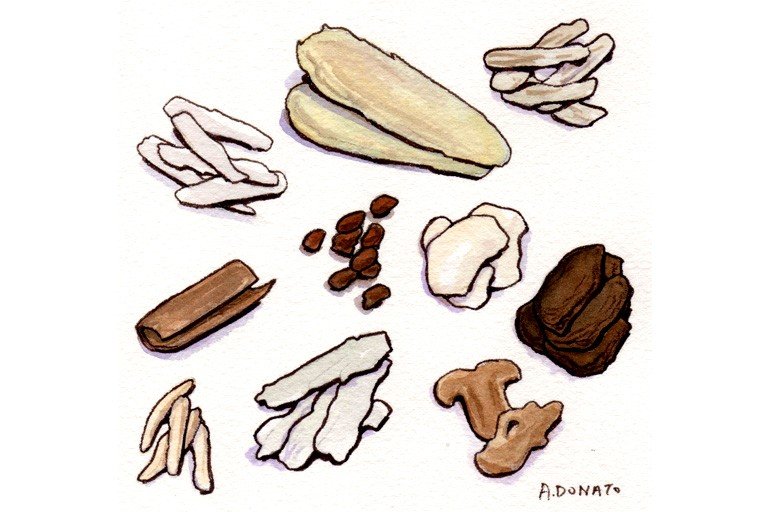
Shi Quan Da Bu Tang is an herbal formula that consists of Panax ginseng (Ginseng), Angelica sinensis (Dong quai), Paeonia lactiflora (Peony), Atractylodes macrocephala (Atractylodes), Poria cocos (Hoelen), Cinnamomum cassia (Cinnamon), Astragalus membranaceus (Astragulus), Liqusticum wallichii (Cnidium), Glycyrrhiza uralensis (Licorice), and Rehmannia glutinosa (Rehmannia).
It is used in traditional Asian medicine to treat fatigue, anemia, appetite loss, dry or scaly skin, night sweats, dry mouth, and cancer. Breast cancer patients should consult with their physicians before using this formula because dong quai and ginseng may stimulate the growth of breast cancer cells.
- Appetite loss
Evidence is lacking to support this claim. - Anemia
Preliminary data show that the formula helps improve anemia. - Cancer treatment
Small studies of cancer patients suggest it may help improve survival and decrease chemotherapy-associated side effects, but more studies are needed. - Dry skin
Evidence is lacking to support this claim. - Dry mouth
Evidence is lacking to support this claim. - Fatigue
This formula is traditionally used for fatigue. One preliminary trial suggests benefit in cancer patients, but results from another trial in patients with chronic fatigue were mixed. - Night sweats
Evidence is lacking to support this claim.
Do Not Take if:
- You have hypersensitivity to any of the components in the formula.
For Healthcare Professionals
Shi Quan Da Bu Tang is an herbal formula that consists of 10 herbs: Panax ginseng (Ginseng), Angelica sinensis (Dong quai), Paeonia lactiflora (Peony), Atractylodes macrocephala (Atractylodes), Poria cocos (Hoelen), Cinnamomum cassia (Cinnamon), Astragalus membranaceus (Astragalus), Liqusticum wallichii (Cnidium), Glycyrrhiza uralensis (Licorice), and Rehmannia glutinosa (Rehmannia) (1). Also known as Juzen-taiho-to in Japan, it is used in traditional medicine to alleviate fatigue, anemia, appetite loss, dry or scaly skin, night sweats, and dry mouth, and to treat cancer. Supporters believe the formula’s beneficial effects are due to interactions between its components.
Preclinical studies suggest that Shi Quan Da Bu Tang may protect against Alzheimer’s disease (13) and may prevent muscle atrophy by lowering oxidative stress (19). It also exhibits antitumor and antimetastatic properties (2) (3) (4) (5) (6) (12), as well as radio- (7) and myeloprotective effects (17).
Preliminary clinical data indicate it helps improve anemia (14) (15) (16) and is effective in preventing recurrent acute otitis media in children (20). Data on whether it can improve symptoms in adults with chronic fatigue are mixed (26).
In oncology settings, the formula has been reported to exert immunomodulatory effects in pancreatic cancer patients (21), increase survival time in patients with lung cancer (8) (27), and alleviate hematotoxicity in patients with breast cancer receiving chemotherapy (18). Additional trials are underway to determine effectiveness against cancer-related fatigue (22) and anorexia (23) as well as cold hypersensitivity in hands and feet (24). Preliminary results from one trial suggest improvements in cancer-related fatigue and quality of life (28).
Breast cancer patients should consult their physicians before using this formula because dong quai and ginseng may stimulate the growth of breast cancer cells (11).
- Appetite loss
- Anemia
- Cancer
- Dry skin
- Dry mouth
- Fatigue
- Night sweats
Studies using murine models suggest that Shi Quan Da Bu Tang has antitumor and antimetastatic effects (2) (3) (4) (6) that are mediated by stimulation of macrophages and natural killer cells. Other preclinical studies demonstrated radioprotective effects as evidenced by an increase in spleen colony forming units in mice exposed to radiation (7) along with stimulating hemopoiesis in vitro (9).
Adjuvant treatment may improve progression-free survival in patients with postoperative recurrence of non-small cell lung cancer by preventing nutritional disorders (27).
- Hypersensitivity to any of the components in the formula.
- S-1(Tegafur/gimeracil/oteracil): In a murine model, repeated doses of Shi Quan Da Bu Tang inhibited absorption of gimeracil, an inhibitor of 5-FU metabolism, leading to increased elimination and reduced plasma levels of 5-FU. Clinical relevance is not known (25).