Enlarge Image
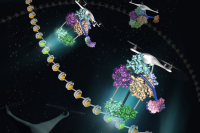
SMC proteins and a model of the Smc5/6 complex
The chromosome is at the center of all genetic processes. Its faithful duplication, repair and transmission are key for genomic stability and for the proper development of an organism. Consequently, the perturbation of these processes can lead to many human diseases, including various cancers. Studying the mechanisms of chromosomal metabolism therefore provides an important avenue for finding cures for cancer and other human diseases.
Our lab is interested in the identification of new players that are involved in chromosomal organization and function and in the revelation of the molecular mechanisms that govern these transactions. Our previous work identified a novel octameric protein complex that contains two important chromosomal organizer proteins, Smc5 and Smc6 (picture on right). Smc5/6 proteins belong to the SMC (Structural maintenance of Chromosome) protein family, members of which often serve as dynamic molecular linkers of the genome that can actively fold, tether and manipulate DNA strands. The most well known SMC family members, Smc1/3 and Smc2/4, are the cores of two protein complexes called cohesin and condensin, respectively. These two protein complexes can link sister chromatids (cohesin) or pack chromatids into chromosomes (condesin). Studies from our group as well as others suggest that the Smc5/6 complex plays important roles in maintaining chromosomal stability, such as dealing with DNA damage and organizing repetitive chromosomal regions at telomeric DNA and rDNA loci (picture below).
mms21 mutations lead to the disruption of telomeric (green) and nucleolar (blue) structures
In addition, we discovered an interesting function of the Smc5/6 complex: one of its subunits, Mms21, is able to promote the addition of a small ubiquitin-like protein modifier (SUMO) to specific target proteins. Although SUMO resembles ubiquitin at the sequence level, their effects on target proteins are different. Recent studies have shown that SUMO can work as a molecular switch to change protein properties and serves as an important regulator in many aspects of cell physiology. The ability of Mms21 to reversibly modify other proteins with SUMO suggests a role in regulating the function of its target proteins. We showed that such regulation is important for dealing with DNA damage, perhaps by altering the protein interaction and/or recruiting repair proteins to the damaged chromosomal regions. Discovering the substrates that are sumoylated by Mms21 is critical for our understanding of these regulations. We showed that Mms21 can sumoylate Smc5 and another repair protein Yku70 both in vivo and in vitro. Identification of the sumoylation sites of these substrates and revelation of a complete repertoire of Mms21 substrates will be needed to fully understand the effect of this modification during DNA repair and in chromosomal organization.
SUMO mutants exhibit clonal lethality
The functions of the other five subunits of the Smc5/6 complex are currently unknown. However, the Nse1 subunit contains a RING finger motif often found in ubiquitin E3 enzymes, indicating that it could regulate ubiquitination. It is clear that we have just begun to appreciate the multi-functionality of the Smc5/6 complex. It will be exciting to reveal the molecular mechanisms by which this “protein machine” can coordinate different functions and regulate various chromosomal activities.
Ulp1 exhibits biased localization at the nuclear envelope
Ulp1 (green) is localized to a sub-region of the nuclear envelope (blue), which is not in contact with the nucleolus (red).
Our studies also extend to other players of the sumoylation pathway. We found that many mutants in the SUMO pathway lead to a unique growth defect, termed clonal lethality (picture on right). Colonies formed by these mutants have rough edges, while colonies formed by wild-type and most other mutants are smooth. The indented regions of the nibbled colonies contain poorly growing cell lineages, while the protruding areas contain normal cells. We demonstrated that this defect is due to a failure to regulate the amplification of an extrachromosomal DNA in yeast, the 2-micron plasmid. As the 2-micron plasmid utilizes the host replication and repair machineries for its own amplification, defects in regulating 2-micron levels in mutants of the sumoylation pathway may indicate a more global role of this pathway in genomic maintenance. Indeed, we and others showed that sumoylation and its reverse process, desumoylation, are important for the maintenance of genomic integrity and DNA repair. For example, a desumoylating enzyme Ulp1 is tightly regulated by its localization at a sub-region of the nuclear periphery by binding to the nuclear pore complexes (picture below). This anchorage mechanism is important to prevent Ulp1 from unregulated desumoylation and to ensure successful DNA repair.
Currently, we are investigating the functions of the Smc5/6 complex in different aspects of chromosomal activities and illustrating the roles of each subunit of the complex. We are also pursuing the question of how sumoylation regulates various aspects of chromosomal metabolism during normal growth and in response to DNA damage.
We use yeast as a model system to address these questions because the Smc5/6 complex and sumoylation pathways are conserved between yeast and humans, and the yeast system offers great technical advantages. We are employing a combination of genetic, biochemical, cell biological and genomic approaches to tackle the questions from different angles.
The work on the Smc5/6 complex and sumoylation will greatly advance our understanding of how aberrant chromosomal organization and regulation can contribute to human diseases.
Helpful Web resources for research and class
more