
Cáncer de próstata
¿La detección temprana del cáncer de próstata es adecuada para usted? Depende.
Las pautas de detección dependen de su riesgo personal de tener cáncer de próstata. Memorial Sloan Kettering recomienda realizarse un análisis de sangre del antígeno prostático específico (PSA) alrededor de los 45 años.
Hay varias razones por las que las pruebas de detección a esa edad ofrecen más beneficios que riesgos:
- Los resultados son un buen indicador del riesgo de tener cáncer de próstata a lo largo de la vida.
- Podemos realizar un seguimiento exhaustivo de los hombres que corren mayor riesgo.
- El cáncer de próstata es más curable cuando se detecta a tiempo.
- Los hombres con bajo riesgo de tener cáncer de próstata pueden someterse a menos pruebas de detección, no someterse a ninguna o comenzar a realizarlas a una edad más avanzada.
Es importante encontrar el equilibrio adecuado entre los beneficios y los riesgos para usted. Hable con su médico sobre cuándo comenzar y dejar de hacerse las pruebas de detección, y con qué frecuencia hacérselas.
MSK Direct es un beneficio que le brinda acceso guiado a atención oncológica especializada. Le ofrecemos recursos y apoyo durante su atención oncológica.
Learn about six cancers that typically affect men the most, when screening may be appropriate, and the signs and risk factors you shouldn’t ignore.
Opening — Men’s Health
“Today, we’re going to focus on men’s health and, specifically, six cancers that are important for men to understand: colorectal, prostate, male breast, lung, skin, and testicular cancer.
The goal today isn’t to overwhelm you with statistics or medical information. It’s to help you understand what your risk may be, when screening may be appropriate, and what changes or symptoms you shouldn’t ignore.
And one thing I want to emphasize from the beginning is that screening recommendations are not one-size-fits-all. Your age, family history, genetics, smoking history, and other risk factors can all affect when or whether you should be screened.
Some of these cancers have established screening recommendations, while others don't have routine screening. But that doesn't mean there's nothing you can do to protect your health.
As we go through these, think about your own risk factors and whether there are any conversations you need to have with your healthcare provider.”
Colorectal Cancer
“Let’s start with colorectal cancer.
Colorectal cancer is the third most common cancer diagnosed in men in the United States, and approximately 1 in 23 men will develop it during their lifetime.
The good news is that colorectal cancer is one of the cancers where screening can do more than just find cancer early. Some screening tests can actually identify precancerous polyps before they become cancer.
For people at average risk, MSK recommends beginning colorectal cancer screening at age 45.
If you're at higher risk because of things like family history or other risk factors, you should talk with your healthcare provider about when screening should begin.
And if you're 75 or older, it's worth having a conversation with your provider about whether screening continues to make sense for you. Routine screening generally isn't recommended after age 85.
One thing I want to emphasize here is that 45 is the recommendation for people at average risk. If you have a close family member who has had colorectal cancer or certain types of polyps, your screening recommendations may be different.
So if you're 45 or older and haven't talked with someone about colorectal cancer screening, this is a good conversation to have.
And remember, screening is intended for people who don't have symptoms. If you're experiencing things like blood in your stool, a persistent change in bowel habits, unexplained weight loss, or other concerning changes, don't wait until you're due for screening—talk with your healthcare provider.”
Prostate Cancer
Next, let’s talk about prostate cancer.
Other than skin cancer, prostate cancer is the most common cancer among men in the United States. In fact, about 1 in 8 men will be diagnosed with prostate cancer at some point in their lifetime.
Prostate cancer screening is a little different from some of the other screenings we’ve talked about because it really involves a conversation about the potential benefits and risks of testing.
The PSA, or prostate-specific antigen, is a simple blood test. There is clear evidence that PSA testing can reduce the number of deaths from prostate cancer. At the same time, prostate cancer can often grow very slowly and may never cause problems during a person’s lifetime. So, screening isn’t necessarily a straightforward “yes or no”—it’s about understanding your individual risk and making an informed decision with your provider.
At MSK, we recommend starting with a baseline PSA blood test at age 45. Between ages 50 and 70, PSA testing may be repeated depending on your previous results. And between 71 and 75, you should talk with your doctor about whether continuing PSA testing makes sense for you.
One really important point I want to emphasize is that a screening test is not a diagnosis.
If your PSA level is elevated, that does not automatically mean you have prostate cancer, and it does not necessarily mean you need a biopsy. Your doctor may repeat the test, look at how your PSA has changed over time, and consider other factors before determining what, if anything, needs to happen next.
Your personal and family history also matters. If you have a close family member who has had prostate cancer, especially if they were diagnosed at a younger age, be sure to let your healthcare provider know.
So, the key takeaway here is: know your risk and have a conversation with your healthcare provider about whether and when PSA screening is right for you.
Male Breast Cancer
“Breast cancer is something we often associate with women, but men can develop breast cancer too.
It's much less common in men—about 100 times less common—but it does happen. Approximately 1 in 800 people assigned male at birth are at risk of developing breast cancer during their lifetime.
Men who develop breast cancer tend to be older, often around ages 65 to 70.
Because breast cancer is relatively uncommon in men, there are currently no routine breast cancer screening recommendations for men, even for men who carry a BRCA mutation.
But no routine screening doesn't mean you should ignore changes.
If you notice a new lump in the breast or underarm, changes to the nipple, nipple discharge, or changes in the skin, those are things to bring to your healthcare provider.
And if you have a family history of breast cancer, a BRCA mutation, or other risk factors, talk with your provider about your individual risk and whether additional monitoring makes sense for you.
The important distinction here is that screening recommendations apply to people without symptoms. If you notice a change, don't wait for a screening recommendation—get it evaluated.”
Lung Cancer
“Next is lung cancer.
Lung cancer is the second most common cancer in U.S. men, after prostate cancer, and it is the leading cause of cancer death.
For people who meet certain age and smoking-history criteria, screening can be particularly important.
MSK recommends annual lung cancer screening for people between ages 50 and 80 who currently smoke or quit within the past 15 years and have a smoking history of at least 20 pack-years.
A pack-year is essentially a way of measuring how much you've smoked over time. One pack a day for 20 years equals 20 pack-years. But you could also reach 20 pack-years by smoking two packs a day for 10 years or half a pack a day for 40 years.
One thing I especially want to point out is that you may still qualify for screening even if you've quit smoking. If you quit within the past 15 years and meet the other criteria, it's worth talking with your provider.
It's also important to understand that screening isn't appropriate for everyone. If someone has another serious illness that would make additional testing or treatment very difficult, their healthcare provider may recommend against screening.
And again, screening doesn't mean you have cancer. It's a way to look for lung cancer earlier in people who have a higher risk.
So if you're between 50 and 80 and have a significant smoking history, ask your provider whether annual lung cancer screening is right for you.”
Skin Cancer
“Now let's talk about skin cancer.
Men have a higher risk of developing skin cancer than women, particularly as they get older.
There are a number of factors that can contribute to this, including spending more time outdoors, outdoor occupations, less consistent sunscreen use, and sometimes waiting longer to have changes checked.
For skin cancer, there isn't a standard routine screening test for everyone.
Instead, MSK recommends regularly checking your own skin—about once a month.
Look for spots or moles that are new or changing. Pay attention to changes in size, shape, color, or anything else that looks different from the rest of your skin.
And if you notice something that doesn't look right, don't just wait and see what happens. Have it evaluated by a healthcare provider.
Skin cancer prevention is also something you can actively work on. Protecting your skin from UV exposure, using sunscreen, wearing protective clothing, and avoiding tanning beds can all help reduce your risk.
So this is a good example of where prevention and early detection go hand in hand.”
Testicular Cancer
“Finally, let's talk about testicular cancer.
Testicular cancer is rare—it accounts for about 1% of cancers affecting men. Unlike many cancers, it tends to affect younger men.
People in their teens, 20s, and 30s are more likely to develop testicular cancer.
There isn't a standard routine screening test for testicular cancer.
Instead, it's important to be aware of changes. A lump, swelling, pain, or an area of hardness in the testicle can be a sign of a problem and should be evaluated by a healthcare provider.
And while hearing the word ‘cancer’ can understandably be concerning, remember that not every lump or change is cancer. The important thing is not to try to diagnose yourself. If something is new or unusual, have it checked.
So while this isn't something you need to routinely screen for, knowing what's normal for you and paying attention to changes is important.”
Transition to Takeaways
“So we've talked about six different cancers, and you may be thinking, ‘Okay, but what am I actually supposed to do with all of this?’
I want to leave you with a few practical things.
First, know your family history. If you don't know whether your parents, siblings, or children have had cancer, that's worth finding out.
Second, know your risk factors. Your age, smoking history, genetics, family history, and other factors can change when you should be screened.
And third, know when you last had your recommended screenings. If you're not sure, that's a great reason to have a conversation with your healthcare provider.
And remember: screening is only one part of cancer prevention. Not smoking, protecting your skin from UV exposure, staying physically active, maintaining a healthy weight, and limiting alcohol can also help reduce your risk of certain cancers.”
Men’s Health Takeaways / Closing
“As we wrap up, the biggest message I want you to take away today is that there isn't one approach to cancer screening that works for everyone.
Some cancers have routine screening recommendations. Others don't. And that doesn't mean those cancers aren't important—it means we need to pay attention to risk factors and changes in our bodies.
And one of the biggest barriers to early detection can be something very simple: putting off the appointment, ignoring a change, or telling yourself you'll deal with it later.
So if something doesn't feel right, don't wait.
Know your risk. Know your screening options. Take action.
Talk with your healthcare provider about which screenings are right for you based on your age, family history, and risk factors.
And most importantly, don't wait for symptoms to take your health seriously. Make cancer screening and preventive care part of your regular health routine.
A conversation with your healthcare provider today could make a difference in finding cancer earlier—and in some cases, preventing it altogether.”
Obtenga más información sobre la salud de la próstata en los hombres

El jefe de Urología, James Eastham, habla con un paciente sobre las pautas para la detección del cáncer de próstata.
¿Qué es la próstata?
La próstata es una glándula que se encuentra en las personas asignadas como hombres al nacer. Se encuentra entre la vejiga y el recto, y ayuda a producir semen.
¿Qué es el cáncer de próstata?
El cáncer de próstata es el segundo cáncer más común entre los hombres en los Estados Unidos. Pero las pruebas de detección ayudan a detectar más de 9 de cada 10 casos de cáncer de próstata en un estadio temprano, cuando el cáncer solo se encuentra en la glándula prostática.
¿Cuáles son los signos de alerta del cáncer de próstata?
Muchas veces, el primer signo es un hallazgo anormal en un examen de detección de rutina. Muchos hombres con cáncer de próstata no notan ningún signo. Los síntomas comunes incluyen:
- Necesidad de orinar (hacer pis) con frecuencia
- Necesidad de orinar con más frecuencia durante la noche
- No poder orinar
- Problemas para iniciar o detener el chorro de orina
- Sentir con frecuencia dolor o rigidez en la región lumbar, las caderas o la parte superior de los muslos
- Dolor al eyacular o problemas para tener una erección
Experimentar estos síntomas no significa que tenga cáncer de próstata. Podría tener una próstata agrandada, una afección llamada hiperplasia prostática benigna, que no es cáncer.
Hable con su médico si tiene alguno de estos síntomas. Asegúrese de obtener un diagnóstico, y un tratamiento si es necesario.
¿Qué es la detección del cáncer de próstata? ¿Cuándo debo hacerme pruebas de detección?

Los hombres afroamericanos tienen un mayor riesgo de padecer cáncer de próstata y pueden beneficiarse de las pruebas de detección periódicas.
Una de las mejores formas de detectar el cáncer de próstata es un análisis de sangre en el que se mide el nivel de antígeno prostático específico (PSA), una proteína producida en la glándula prostática.
Es posible que algunos hombres no se beneficien del tratamiento de inmediato porque el cáncer de próstata puede crecer lentamente. Tratarlo demasiado pronto puede ser innecesario, especialmente porque, entre los efectos secundarios, se incluyen problemas con la función urinaria y sexual. Hable con su proveedor de atención primaria sobre los riesgos y los beneficios de las pruebas de detección del cáncer de próstata.

Pautas de detección del cáncer de próstata
Aquí hay más información sobre las pruebas de PSA:
If you are between 45 and 49, talk with your doctor about a baseline PSA test.
- If the PSA level is 3 or higher, talk with your doctor about getting more screening tests.
- If the PSA level is between 1 and 3, see your doctor for another PSA test every 2 to 4 years.
- If the PSA level is less than 1, see your doctor for another PSA test between ages of 51 and 55.
MSK’s researchers recommend that all men ages 50 to 59 should get their PSA level checked.
- If the PSA level is 3 or higher, talk with your doctor about getting more screening tests.
- If the PSA level is between 1 and 3, see your doctor for another PSA test every 2 to 4 years.
- If the PSA level is less than 1, you should see your doctor for another PSA test at age 60.
Men ages 60 to 70 should get their PSA level checked.
- If the PSA level is 3 or higher, talk with your doctor about getting more screening tests.
- If the PSA level is between 1 and 3, see your doctor for another PSA test every 2 to 4 years.
- If the PSA level is less than 1, you do not need more screening.
If you are between 71 and 75, talk with your doctor about whether you should get a PSA test. This decision is based on your past PSA levels and current health.
MSK does not recommend prostate cancer screening for men ages 76 or older. A high PSA level does not usually mean you should have a prostate biopsy. Often, your doctor will repeat the PSA test in a few months. It will show if the PSA level is still high. If it is, it may not be caused by cancer.
¿Cuáles son los factores de riesgo del cáncer de próstata?
Edad: El mayor factor de riesgo es la edad, especialmente después de los 50 años. Más de 6 de cada 10 tumores de próstata se detectan en los hombres a los 65 años o más.
Antecedentes familiares:Otro factor de riesgo importante son los antecedentes familiares. Quizá su padre, hermano u otro pariente consanguíneo cercano haya tenido cáncer de próstata. Si es así, tiene el doble de probabilidades de tener la enfermedad que una persona sin antecedentes familiares de la enfermedad.
Cambio en los hábitos urinarios: Si tiene problemas con la vejiga, podría deberse a que tiene cáncer de próstata u otra enfermedad.
Etnia: El cáncer de próstata es más común entre los afroamericanos que entre los hombres de otras etnias. Además, tiende a ser más agresiva. MSK no recomienda pautas de detección diferentes para los afroamericanos, ya que recomendamos que todos los hombres se realicen pruebas de PSA a los 45 años.
Hable con su médico sobre la posibilidad de hacerse la prueba antes si tiene un riesgo elevado, pero le han indicado que empiece a hacerse las pruebas más adelante.


Cáncer del testículo
Entre los signos más comunes del cáncer del testículo, se encuentran el dolor, la hinchazón o un bulto o endurecimiento en el testículo. Si encuentra un bulto en un testículo, vaya a su proveedor de cuidados de la salud de inmediato.
Las gónadas masculinas (testículos) se encuentran debajo del pene Son 2 glándulas pequeñas con forma de huevo que producen y almacenan esperma. La piel floja que los rodea se llama escroto.
Factores de riesgo del cáncer del testículo
El cáncer del testículo no está asociado a ningún hábito, actividad o estilo de vida.
Pero hay 2 factores de riesgo importantes que pueden aumentar la probabilidad de tener la enfermedad.
- Testículo no descendido. Los testículos descienden (caen) desde el abdomen hasta el escroto antes del nacimiento. Si nació con un testículo que no descendió, tiene un mayor riesgo de tener cáncer del testículo. Es así incluso si se ha sometido a una cirugía para solucionar el problema.
- Ya tuvo cáncer del testículo. Si ha tenido cáncer en uno de los testículos, tiene más probabilidades de tener cáncer en el otro. Sin embargo, el riesgo de que esto ocurra durante su vida es bajo (entre el 1% y el 2%). De cada 100 personas que han tenido cáncer del testículo, solo 1 o 2 lo volverán a tener.
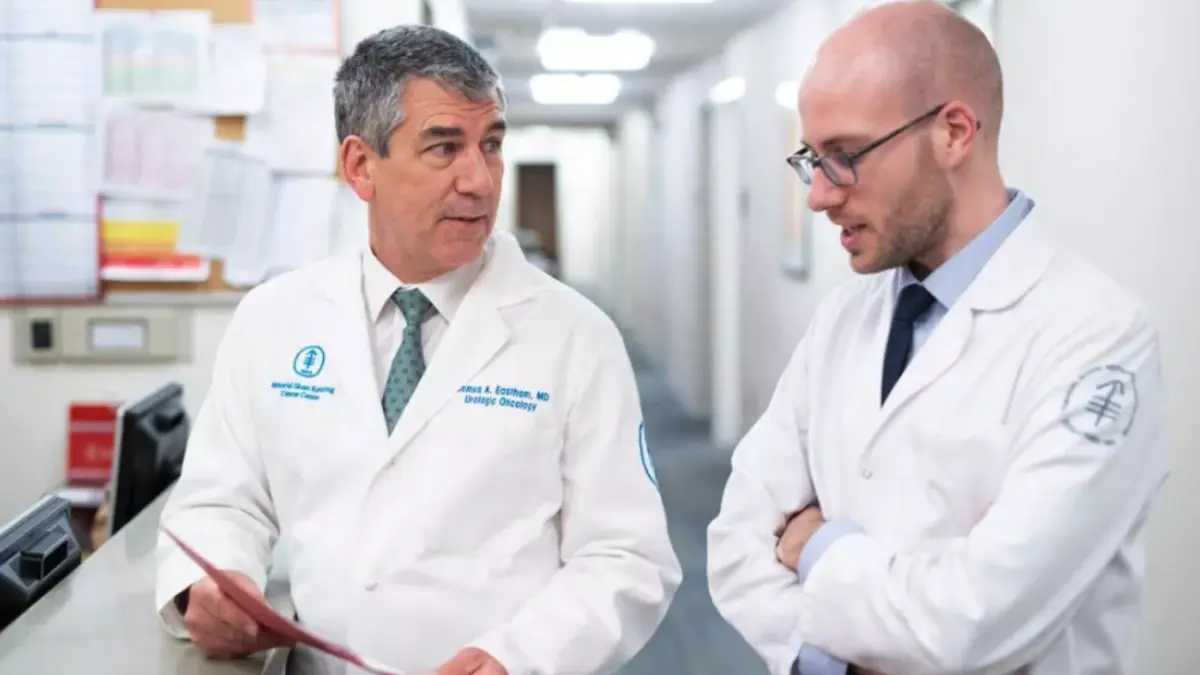
Dr. Eastham speaks with an associate.
Signos y síntomas
Entre los signos más comunes del cáncer del testículo, se encuentran el dolor, la hinchazón o un bulto o endurecimiento en el testículo. Si encuentra un bulto en un testículo, vaya a su proveedor de cuidados de la salud de inmediato.
Los síntomas menos comunes son, entre otros, los siguientes:
- Dolor en la parte baja del abdomen (vientre) o la ingle
- Sensibilidad en la zona del pecho
- Un bulto indoloro en el testículo
- Pesadez en el escroto
- Dolor de espalda
Estos síntomas no siempre quieren decir que tenga cáncer. Consulte con su proveedor de cuidados de la salud si tiene algunos de ellos. Es muy importante detectar el cáncer a tiempo, para que sea más fácil de tratar.
Cáncer de mama en el hombre
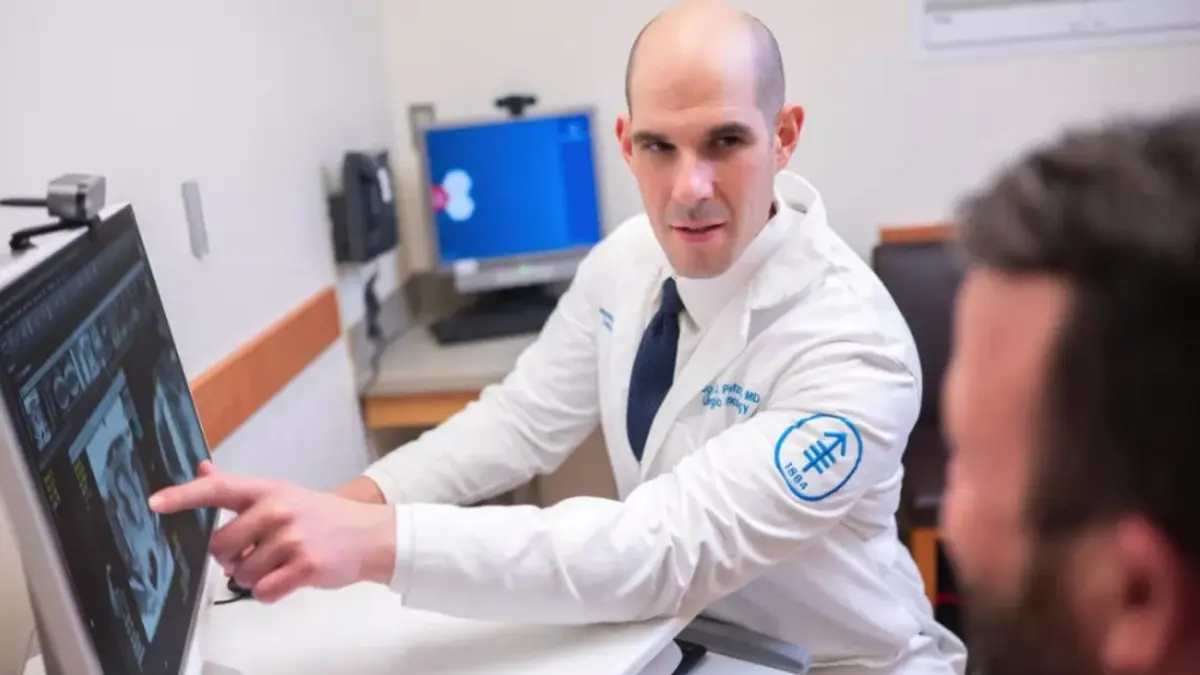
Dr. Pietzak confers with an associate.
El cáncer de mama afecta tanto a hombres como a mujeres, pero es aproximadamente 100 veces menos frecuente en los hombres.
En MSK, contamos con especialistas que atienden regularmente a hombres con cáncer de mama. Somos conscientes de que un hombre con esta enfermedad puede sentirse aislado, y estamos aquí para brindarle nuestro apoyo en todo momento.
¿Quiénes corren mayor riesgo de tener cáncer de mama masculino?
Aproximadamente 1 de cada 800 personas asignadas como hombres al nacer corren el riesgo de tener cáncer de mama durante su vida. Los hombres con cáncer de mama con frecuencia lo tienen más tarde en la vida, alrededor de los 65 a 70 años.
Tiene un mayor riesgo de padecer cáncer de mama masculino en estos casos:
- Tiene antecedentes familiares de cáncer de mama masculino
- Tiene una mutación en el gen BRCA1 o BRCA2, dos genes que están asociados al cáncer de mama
- Tiene un síndrome genético como el síndrome de Klinefelter, que aumenta la producción de estrógeno en el cuerpo
- Es una mujer transgénero que toma o ha tomado hormonas estrógenas
¿Los hombres deben hacerse pruebas de detección del cáncer de mama?
En la actualidad, no hay recomendaciones para la detección del cáncer de mama en hombres debido a que no es muy frecuente, incluso en hombres con una mutación en el gen BRCA. Sin embargo, a medida que continuamos aprendiendo sobre el cáncer de mama masculino, es posible que descubramos que ciertas poblaciones de hombres deberían someterse a exámenes de detección de forma rutinaria. Si usted es un hombre transgénero o una persona no binaria, puede tener riesgo de padecer cáncer de mama de todos modos. Esto es así incluso si se sometió a una cirugía torácica masculinizante. Hable con su médico sobre su riesgo personal de tener cáncer de mama masculino.