
Conozca los signos y los síntomas del cáncer colorrectal.
La forma más fácil de cuidar el colon es revisar el color de las heces y aprender qué significa. Los cambios en el color y la forma de las heces son indicadores importantes de la salud del colon. Lo que se considera normal depende de lo que sea normal para usted. La frecuencia de las defecaciones es diferente para cada persona. Comprender los hábitos intestinales del cuerpo le ayudará a identificar de inmediato los cambios que pueden reducir el riesgo de tener cáncer.
Su empleador se ha asociado con Memorial Sloan Kettering para ofrecerle MSK Direct, un programa que le brinda acceso guiado a atención oncológica especializada. Le ofrecemos recursos y apoyo durante su atención oncológica.
Watch this short video to learn about the signs and symptoms of colorectal cancer.
Síntomas del cáncer colorrectal
Watch as Memorial Sloan Kettering’s Center for Young Onset Colorectal and Gastrointestinal Cancers Co-Director, Dr. Robin Mendelsohn, answers your questions and learn: colorectal cancer risk factors (including family history and diet), how colorectal cancer screening can help find the disease early when it is most curable and screening options including an easy, at home option.
El cáncer colorrectal afecta tanto a hombres como a mujeres. En los primeros estadios del cáncer colorrectal, es posible que no haya síntomas. Ser proactivo es importante para protegerse y detectar el cáncer en una fase inicial, cuando es más tratable. El cáncer colorrectal tiene un índice de supervivencia del 90 por ciento si se detecta temprano. El cuerpo de cada persona es diferente, por eso confíe en su instinto y no dude en consultar a su médico si nota alguno de los siguientes síntomas:
- sangrado rectal o sangre en las heces
- cambios en los hábitos intestinales, como diarrea, estreñimiento o heces estrechas, que duran más de unos días
- ganas persistentes de ir al baño
- dolor abdominal inexplicable que dura más de unos días
- pérdida de peso involuntaria
- fatiga inexplicable
- anemia
En general, presentar estos síntomas no significa que tenga cáncer colorrectal, pero debe ponerse en contacto con su médico si alguno de estos problemas es grave o dura más tiempo del que cree que debería.
¿Qué es el cáncer de colon?
El cáncer de colon se forma dentro del intestino grueso, que mide alrededor de cinco pies y medio de largo (poco más de 1.5 metros). Los primeros cinco pies del intestino grueso se llaman colon. El recto son las últimas seis pulgadas (15 cm) del intestino grueso. El cáncer que se presenta en los dos órganos se agrupa, y esto se denomina cáncer colorrectal.
El cáncer colorrectal puede crecer lentamente durante varios años. Por lo general, el cáncer de colon comienza como un pequeño crecimiento anormal en las paredes internas del colon. A esto se le llama pólipo. Algunos pólipos pueden convertirse en cáncer con el tiempo.
El cáncer de colon a menudo está contenido dentro del colon. Pero si no se trata, puede diseminarse a otros órganos, con mayor frecuencia al hígado y los pulmones.
Un pequeño porcentaje de casos de cáncer de colon se debe a causas genéticas que pueden transmitirse de padres a hijos.
El cáncer colorrectal es el tercer diagnóstico de cáncer más común tanto en hombres como en mujeres.
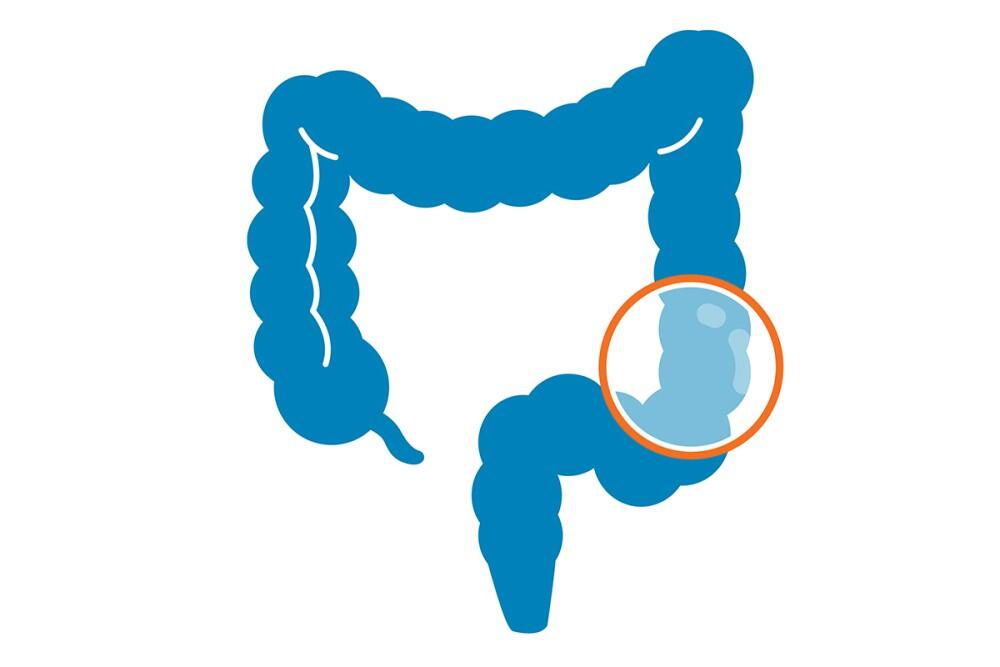
Ilustración del intestino grueso o colon con pólipos.
Detección del cáncer colorrectal
En MSK, el método preferido para detectar el cáncer de colon es la colonoscopia. Es la única prueba que permite examinar los pólipos y extirparlos. Esto significa que la colonoscopia puede detectar y prevenir el cáncer de colon.
Su equipo de atención puede recomendarle otras pruebas de detección en función de sus circunstancias personales. Haga clic aquí para obtener más información sobre otros métodos de detección.
During a colonoscopy, a thin, flexible tube with a light and a video camera on its tip is placed in your colon so your doctor can search for polyps. A tool at the end of the scope can remove polyps if they are found. It’s the most effective way to find and remove them.
A colonoscopy is the only screening method that not only detects cancer at its earliest stages but can also prevent it.
Age 45 or Over
- Everyone should be screened via colonoscopy.
Under Age 45
If you have any of the following, you should talk to your doctor about when to get screened:
- symptoms for colorectal cancer
- a family history of colorectal cancer or precancerous polyps
- a personal history of inflammatory bowel disease, such as ulcerative colitis or Crohn’s colitis
- inherited disorders and other risk factors
- Your care team will prescribe a clear-liquid diet, a liquid bowel prep, and laxatives to clear out your bowel during the 24 hours before the test. It is very important that your colon is empty for the colonoscopy.
- You will be sedated during the exam and monitored throughout and after the colonoscopy until you are fully awake.
- You must have a responsible care partner take you home after the procedure.
- Ask your doctor after the colonoscopy about how often you should be screened.
Although preparation can be inconvenient, a colonoscopy enables your doctor to detect potentially precancerous signs, such as fleshy growths called polyps, and remove them.
If there is suspicion that you may have cancer based on your test results, one of our specialists will conduct a biopsy. In this test, a doctor removes a small piece of tissue with a special instrument. One of our expert pathologists (doctors who specialize in diagnosing disease) examines the tissue sample under a microscope.
Your care team may recommend CT and MRI scans to determine the stage of the cancer and to see if it has spread to other organs.
If you have been diagnosed with colorectal cancer, you may be facing a lot of difficult questions and feel overwhelmed. We want to help you regain control of your life with compassionate, personalized care from our team of experts. Your care team will include doctors, nurses, and other experts whose only focus is colon cancer.
MSK specialists from all areas of colon cancer care will tailor a plan specifically for you. Our areas of expertise include surgery, chemotherapy, radiation therapy, rehabilitation, follow-up care after treatment, and quality-of-life issues. Having all of MSKs experts work together helps us ensure that we choose the best combination of therapies to treat the cancer and give you the best possible outcome.

Los 45 años no son la edad mágica para hacerse pruebas de detección.
This is the story of one of those patients, Rebecca Genter Lerner, a 32-year-old diagnosed with stage 3 colon cancer just weeks before her wedding day.
REBECCA GENTER LERNER
January 2021 was the happiest time.
Ian and I were planning our wedding; we were starting our lives together. And then the world came crashing down.
I was diagnosed with stage 3 colon cancer.
DR. ANDREA CERCEK
Typically, we see colorectal cancer affecting individuals in their 60s and 70s. But more recently, over the last several decades, there’s been a steady rise in patients under the age of 50.
And why this is happening is still unknown.
REBECCA GENTER LERNER
I was a marathon runner. I was a healthy eater. I didn’t smoke; I barely drank.
DR. ROBIN MENDELSOHN
There are issues that really affect those under 50 that were not being addressed.
So Memorial Sloan Kettering established the Center for Young Onset Colorectal and Gastrointestinal Cancers.
DR. ANDREA CERCEK
Good to see you. How’s everything?
The focus of the center really is to pay attention to the patient as a whole.
REBECCA GENTER LERNER
From the first point of contact with the Young Onset Center, I felt so incredibly taken care of.
DR. ANDREA CERCEK
Your labs look perfect.
REBECCA GENTER LERNER
It felt like I was the only patient they were caring for.
DR. ROBIN MENDELSOHN
All our patients get a social work consult. We offer them nutrition, integrative medicine, psychology/psychiatry consult so that they get the whole spectrum of care.
DR. ANDREA CERCEK
Many of these patients are looking to start families, so fertility preservation is critical.
REBECCA GENTER LERNER
I was diagnosed at 32. The later I went to start a family, the harder it might be.
ANNE CASSON
I’m one of the fertility clinicians at MSK.
REBECCA GENTER LERNER
So that was an immediate conversation that my team at MSK brought up with me.
HADLEY MAYA
As the center’s dedicated clinical social worker, my relationship with patients begins right at the onset of their care.
REBECCA GENTER LERNER
February 4th was my surgery.
HADLEY MAYA
What is most important to me is that patients have a safe space to process what they’re going through.
REBECCA GENTER LERNER
Hadley helped me navigate some really complex conversations that I didn’t know how to handle.
DR. KARUNA GANESH
You can see every cell in this organoid.
DR. ANDREA CERCEK
Another really important aim of our center is to get to the bottom of this question as to why this is happening and to really focus on the research, who are the people at risk, and how we can better screen them and prevent this cancer from occurring at such a young age.
REBECCA GENTER LERNER
I think one of the most special things about the experience with the Young Onset Center is the relationships that I made with all of the people on the team. They’ve become like family over the last year.
En los últimos años, ha habido un aumento preocupante del cáncer de colon en personas de entre 20 y 30 años que no tienen antecedentes familiares de la enfermedad ni factores de riesgo típicos.
En la actualidad, la edad recomendada para comenzar a hacerse pruebas de detección del cáncer de colon es de 45 años. Hable con su médico de atención primaria sobre el horario adecuado para usted.
El Centro de Cáncer Colorrectal en Personas Jóvenes de MSK es la primera clínica de su tipo en el mundo dedicada solamente a las necesidades específicas de las personas menores de 45 años que tienen cáncer colorrectal. Los médicos, enfermeros y especialistas de MSK tienen una experiencia incomparable en cirugía, quimioterapia, radioterapia, rehabilitación y cuestiones referidas a la calidad de vida. Trabajaremos en colaboración con usted para determinar un plan de atención óptimo, y así obtener el mejor resultado posible.
Pregunte a su médico si una colonoscopia antes de los 45 años es adecuada para usted.
¿Cuál es mi riesgo de tener cáncer colorrectal?
Las personas con un mayor riesgo de tener cáncer colorrectal pueden beneficiarse de hacerse pruebas de detección más tempranas y frecuentes. Si usted tiene un riesgo superior al promedio, le recomendamos que consulte con su médico para obtener recomendaciones personalizadas. Entre algunos factores de riesgo que aumentan la probabilidad de tener cáncer colorrectal, se encuentran hábitos de vida que se pueden cambiar.
Siga estos consejos saludables:
- Coma una variedad de frutas y verduras con alto contenido en fibra, como frambuesas, alcachofas, guisantes y brócoli.
- Incluya otros alimentos con alto contenido de fibra que son buenos para las bacterias intestinales, como los garbanzos, las lentejas y los frijoles (por ejemplo, frijoles rojos, pintos y blancos).
- Elija los granos integrales.
- Tome una cantidad suficiente de agua.
- Consuma menos carnes rojas, procesadas o carbonizadas, que tienen un alto contenido de grasas saturadas.
- Limite el consumo de alcohol y productos con azúcar añadido.
- Evite usar productos derivados del tabaco.
- Haga ejercicio para mantener un estilo de vida saludable.
Otros factores de riesgo no se pueden controlar, como la edad, los antecedentes familiares y las mutaciones genéticas. Si tiene antecedentes familiares de cáncer colorrectal, es posible que sea candidato para someterse a exámenes genéticos y recibir asesoramiento. A través de un examen y un asesoramiento genéticos, se pueden analizar el riesgo de cáncer y las recomendaciones para su manejo médico.
Obtenga más información sobre los exámenes genéticos para el cáncer de colon

Una variedad saludable de frutas, verduras, cereales y otros alimentos ricos en fibra.