
Scientists at MSK have developed a new nanoparticle-based approach to breaking down fibrosis in cancer and other diseases, which could make immunotherapy more effective. Learn about their findings in laboratory models.

Memorial Sloan Kettering Cancer Center (MSK) today announced the following awards and appointments:Joan Massagué Awarded Kennedy Award from the Institu...

Article
Learn about a blood test using carbon nanotubes that could potentially detect brain tumors.

Education
Learn how a new cancer engineering PhD program is attracting leading scientists to come to MSK.
Education
Read about a first-of-its kind PhD program that enables aspiring scientists to tackle tough cancer problems.

Learn how MSK researchers are investigating the use of nanoparticles to carry drugs across the blood-brain barrier.
Learn about MSK’s visionary new cancer engineering PhD Program.
The Gerstner Sloan Kettering Graduate School of Biomedical Sciences (GSK) at Memorial Sloan Kettering Cancer Center (MSK) today announced The Pat and Ian Cook Doctoral Program in Cancer Engineering, made possible by a generous gift of $15 million from Pat and Ian Cook.

Learn why post-doctoral researcher Mijin Kim believes Memorial Sloan Kettering is an excellent choice for early career biomedical researchers, as she enjoys her recognition as a STAT Wunderkind, class of 2023.

By detecting molecular signatures in the blood, the sensor may help improve cancer screenings.

Could an implantable IUD help detect cancer early, when it is most curable? Scientists at the Sloan Kettering Institute are betting yes.

In the News
Read our key takeaways from the second half of the American Association for Cancer Research’s 2019 annual meeting.

In the Lab
A collaboration between a nanotechnology scientist and a visual artist leads to a promising diagnostic test and a new art form.
In the Lab
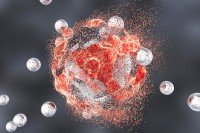
Researchers devised a novel method to ferry drugs to head and neck cancers using nanoparticles that naturally stick to a protein in tumor blood vessels.
In the Lab
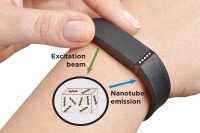
Learn how tiny sensors made of nanotubes could serve as implantable devices that offer a noninvasive way to monitor cancer and its treatments.
In the Lab
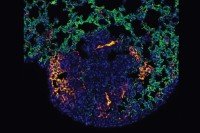
A protein in blood vessels that plays a role in cancer metastasis is a promising target for delivering cancer drugs to tumors using nanoparticles.
Memorial Sloan Kettering Cancer Center (MSK) molecular pharmacologist Daniel Heller, PhD, and colleagues have identified a new strategy to target drugs specifically to cancer sites, including metastatic tumors. The approach involves nanoparticles designed to mimic a mechanism that tumors themselves use to metastasize throughout the body. This work, which will be featured on the cover of the June 29 issue of Science Translational Medicine, was applicable across a wide range of tumor and drug types and can potentially be applied to other conditions including vascular and autoimmune diseases.
Snapshot
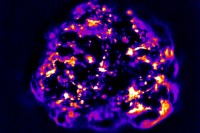
MSK nanotechnology researchers have developed an innovative approach for measuring the permeability of living tumors.
In the Lab
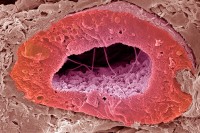
Memorial Sloan Kettering scientists have engineered a tiny particle that could ferry drugs directly to the kidneys and prevent their uptake in other organs.
Announcement
The new center brings together scientists and clinicians working in various fields who will use the power of imaging to speed research and innovations in cancer care.

Video
Learn about Daniel Heller, who creates new nanoscale materials that are specially designed to improve biological research or solve clinical problems.

Event
Every year, MSK gives high school students and their teachers the opportunity to learn about cutting-edge biomedical research from our scientists.