Ji Chuan Jian
Purported Benefits, Side Effects, and More
Common Names
- Ji-Chuan decoction
- Benefit the River Decoction
- Benefit the Flow Decoction
- Desert Broomrape & Dong Quai Formula
For Patients & Caregivers
Tell your healthcare providers about any dietary supplements you’re taking, such as herbs, vitamins, minerals, and natural or home remedies. This will help them manage your care and keep you safe.
What is it?
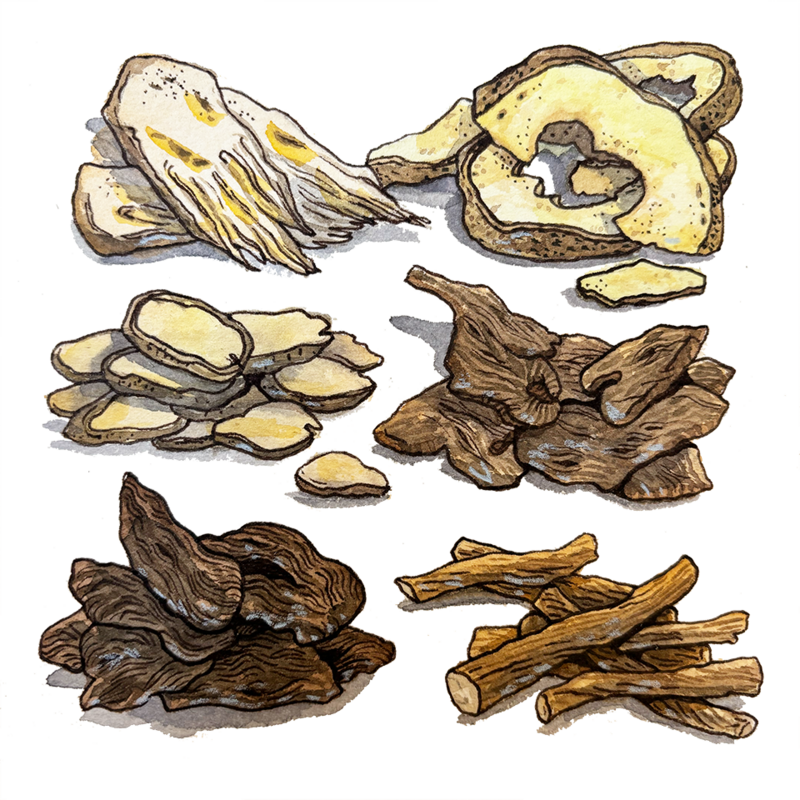
Ji Chuan Jian (JCJ) is a traditional Chinese medicine formula. It’s made up of six different herbs.
What are the potential uses and benefits?
Ji Chuan Jian is used to:
- Treat constipation (difficult or infrequent bowel movements)
Talk with your healthcare providers before taking herbal formulas. They can interact with some medications and affect how they work. For more information, read the “What else do I need to know?” section below.
What are the side effects?
Side effects of JCJ may include:
- Dizziness
- Dry mouth
For Healthcare Professionals
Clinical Summary
Ji Chuan Jian (JCJ) is a traditional Chinese medicine formula with a history of use as a treatment for constipation (1) (2). First mentioned in the classic text Jing Yue Quan Shu, JCJ consists of six herbs: Angelica sinensis (Danggui ), Achyranthes bidentata (Niuxi), Aurantii Fructus (Zhiqiao), Rhizoma Cimicifugae (Shengma ), Cistanche deserticola (Roucongrong), and Alisma orientalis (Zexie).
Limited data show that JCJ helps shorten the colonic transit time and alleviate symptoms of constipation along with improving quality of life in patients with slow transit constipation (STC) (1) (3). It also helped alleviate global symptoms in those with functional constipation (4).
Larger studies with methodological rigor are needed to expand the evidence base.
Purported Uses and Benefits
- Constipation
Mechanism of Action
Mechanisms underlying the physiological effects of Ji Chuan Jian in STC murine models include promoting intestinal motility, elevating acetylcholine levels, reducing intestinal inflammation (5), and inhibiting the cAMP/PKA/AQPs signaling pathway along with maintaining inflammatory/intestinal flora homeostasis (6).
Adverse Reactions
Dizziness and dry mouth were reported in a study (3).
Herb-Drug Interactions
None known.
References
- Dai L, Zhong LL, Ji G. Irritable bowel syndrome and functional constipation management with integrative medicine: A systematic review. World J Clin Cases. 2019 Nov 6;7(21):3486-3504.
- Wang K, Qiu H, Chen F, Cai P, Qi F. Considering traditional Chinese medicine as adjunct therapy in the management of chronic constipation by regulating intestinal flora. Biosci Trends. 2024 Jun 6;18(2):127-140.
- Zhang SX, Zhang XA, An YK. Effect of Jichuanjian on Gastrointestinal Function,Serum Intestinal Neurotransmitters andIntestinal Flora in Elderly with Chronic Functional Constipation. Chin J ETMF. 2018;24:169–174.
- Lyu Z, Fan Y, Bai Y, Liu T, Zhong LL, Liang HF. Outcome of the efficacy of Chinese herbal medicine for functional constipation: A systematic review and meta-analysis. World J Clin Cases. 2022 May 26;10(15):4856-4877.
- Wang XM, Lv LX, Qin YS, et al. Ji-Chuan decoction ameliorates slow transit constipation via regulation of intestinal glial cell apoptosis. World J Gastroenterol. 2022 Sep 14;28(34):5007-5022.
- Lin L, Jiang Y, Lin P, et al. Classical famous prescription of Jichuan decoction improved loperamide-induced slow transit constipation in rats through the cAMP/PKA/AQPs signaling pathway and maintained inflammatory/intestinal flora homeostasis. Heliyon. 2023 Nov 29;10(1):e21870.
- Cai XL. Observation on the therapeutic effect of Jichuan Decoction (Jiangsuan Jian) on functional constipation in middle-aged and elderly patients. Shi yong Zhong xi yi jie he lin chuang. 2020;20(11):17-18.