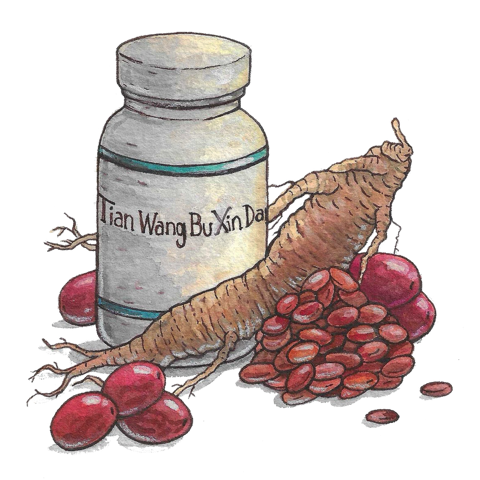
Tian Wang Bu Xin Dan
Purported Benefits, Side Effects, and More
Common Names
- Tian Wang Bu Xin Wan
- Tian Wang Bu Xin Pian
- Emperor’s Teapills
- HeartVigor
- Cheonwangbosimdan
For Patients & Caregivers
Tell your healthcare providers about any dietary supplements you’re taking, such as herbs, vitamins, minerals, and natural or home remedies. This will help them manage your care and keep you safe.
What is it?
Tian Wang Bu Xin Dan (TWBXD) is a traditional Chinese medicine (TCM) formula. It’s made up of 16 different herbs.
What are the potential uses and benefits?
Tian Wang Bu Xin Dan(TWBXD) is used to treat:
- Insomnia (trouble falling asleep, staying asleep, or waking up too early)
- Palpitations (feeling of the heart beating too hard or fast)
- Memory loss
- Constipation (difficult or infrequent bowel movements)
- Mouth ulcers
Talk with your healthcare providers before taking herbal formulas. They can interact with some medications and affect how they work. For more information, read the “What else do I need to know?” section below.
What are the side effects?
Side effects have not been reported.
For Healthcare Professionals
Clinical Summary
Tian Wang Bu Xin Dan(TWBXD) is a traditional Chinese medicine (TCM) formula historically used to treat insomnia and palpitations. Documented in the TCM treatise Ren Zhai Zhi Zhi Fang Lun (1), it consists of 15 herbs and a mineral: Salvia miltiorrhiza, Angelica sinensis, Acorus tatarinowii, Codonopsis pilosula, Poria cocos, Schisandra chinensis, Ophiopogon japonicus, Asparagus fern, Rehmannia glutinosa, Scrophularia scrophularia, processed Polygala tenuifolia, stir-fried Jujube seed, Cyperus seed, Platycodon grandiflorum, licorice, and cinnabar. Because cinnabar contains mercury, it is replaced by other herbs in commercially available formulations.
TWBXD is among the commonly prescribed formulas for neurological and mental disorders as well as cardiovascular disease (2). Small studies suggest its potential in treating insomnia (18) (20) (23); diabetic cardiomyopathy (3); palpitations (24) (25) (26); skin conditions such as chloasma (5), acne (6), and neurodermatitis (7); habitual constipation (8) (9); and recurrent mouth ulcers (10) (11).
In cancer settings, preliminary findings show TWBXD to be comparable to CBT-I in alleviating insomnia (12); and to improve sleep quality (15) along with reducing anxiety and perimenopause-like syndrome in breast cancer patients (17). Additionally, a population-based study found TWBXD to be positively associated with 5-year survival in breast cancer patients (39).
However, majority of the studies are poorly designed with high risk of bias, small sample sizes, and significant heterogeneity. Larger, methodologically-robust trials are needed to strengthen the evidence.
Purported Uses and Benefits
- Insomnia
- Palpitations
- Amnesia
- Constipation
- Recurrent mouth ulcers
Mechanism of Action
TWBXD exerts sedative and tranquilizing effects through its actions on neurotransmitters, regulating the level of inflammatory factors, and improving oxidative stress (28) (29) (30) (31). It has also been shown to improve circadian rhythm abnormality, oxidative stress, glycolipid metabolism disorders, and inflammation response caused by sleep deprivation in rats(33) (34). Other suggested mechanisms include regulation of monoamine metabolism in the frontal cortex through intestinal flora (35), and up-regulation of Clock and Bmal1 in the hypothalamus of rats along with reductions in levels of Per1 and Cry2 (36).
The constipation-relieving effects of TWBXD are thought to be through regulating inflammatory response, neoangiogenesis, relaxing intestinal smooth muscle, and protecting intestinal barrier (37).
TWBXD also showed antidepressant effects in a murine model with chronic unpredictable stress depression likely by inhibiting HPA axis activity, up-regulating hippocampal GSK3β phosphorylation, and BDNF expression (38).
Adverse Reactions
Side effects have not been reported.
Herb-Drug Interactions
None known.
References
- Tian T, Xiao XR. Investigation on the origin of Tianwang Buxin Dan. Jilin J Chin Med. 2010;30(3):250-252. doi:10.13463/j.cnki.jlzyy.2010.03.035.
- Zhang T, Yang N, Kang L, et al. Research progress on clinical and pharmacological effects of Tianwang Buxin Dan. Chin J Integr Med Cardio-Cerebrovasc Dis. 2018;16(18):2765-2769.
- Yang L. Clinical efficacy of modified Tianwang Buxin Dan in treating 42 cases of diabetic cardiomyopathy. Diabetes New World. 2016;(12):9-10. doi:10.16658/j.cnki.1672-4062.2016.12.009.
- Huang HH. Clinical observation of modified Tianwang Buxin Dan in treating hyperthyroidism with yin deficiency and fire excess syndrome [master’s thesis]. Nanjing University of Chinese Medicine; 2017.
- Rui Q. Clinical observation of modified Tianwang Buxin Dan in treating chloasma. Shanxi J Tradit Chin Med. 2017;33(5):18-19.
- Ye L, Xu YM. Clinical observation of Tianwang Buxin Dan in treating 38 cases of adolescent female acne. J Sichuan Tradit Chin Med. 2015;33(2):96.
- Shen YQ, Wu YH, Jiang SM. Clinical observation of Tianwang Buxin Tang combined with fire needle in treating 40 cases of neurodermatitis with blood deficiency and wind-dryness syndrome. Hunan J Tradit Chin Med. 2017;33(7):67-69. doi:10.16808/j.cnki.issn1003-7705.2017.07.030.
- Yuan JS. Tianwang Buxin Dan in treating habitual constipation. Henan Tradit Chin Med. 2014;34(2):347-348. doi:10.16367/j.issn.1003-5028.2014.02.058.
- Xiao YY. Clinical observation of modified Tianwang Buxin Dan in treating habitual constipation with insomnia. Clin J Chin Med. 2016;8(12):5-6.
- Feng LL, Deng XM. Clinical observation of Tianwang Buxin Tang in treating recurrent oral ulcer. Guangxi J Tradit Chin Med. 2016;39(4):20-22.
- Luo Q. Clinical observation of Tianwang Buxin Tang combined with Wuwei Xiaodu Yin in treating oral lichen planus. New Chin Med. 2016;48(8):205-207. doi:10.13457/j.cnki.jncm.2016.08.089.
- Moon SY, Jerng UM, Kwon OJ, et al. Comparative Effectiveness of Cheonwangbosimdan (Tian Wang Bu Xin Dan) Versus Cognitive-Behavioral Therapy for Insomnia in Cancer Patients: A Randomized, Controlled, Open-Label, Parallel-Group, Pilot Trial. Integr Cancer Ther. 2020 Jan-Dec;19:1534735420935643.
- Chi WC, Wang BB, Yang F, et al. Clinical effect of acupuncture combined with medication on cancer-related insomnia in non-small cell lung cancer patients after chemotherapy. Chin Med Herald. 2019;16(23):114-117.
- Zhe N. Clinical study of Ganmai Dazao Tang combined with Tianwang Buxin Dan in treating breast cancer-related perimenopausal syndrome [master’s thesis]. Zhejiang Chinese Medical University; 2013.
- Wei HX, Deng SM, Tang CJ. Clinical study of modified Tianwang Buxin Dan in treating breast cancer patients with insomnia due to yin-blood deficiency. Chin Pract Rural Doct. 2020;27(8):54-57.
- Zhang ZM. Experience of Tianwang Buxin Tang in treating insomnia in 63 cancer patients. Inner Mongolia J Tradit Chin Med. 2009;28(23):11. doi:10.16040/j.cnki.cn15-1101.2009.23.030.
- Xu J, Zang DJ, Bai J. Clinical observation of nourishing yin and clearing fire method in treating breast cancer patients with postoperative anxiety. World J Integr Tradit West Med. 2012;7(9):794-796. doi:10.13935/j.cnki.sjzx.2012.09.033.
- Kim MJ, Bose S, Shin NR, et al. The Herbal Formula CWBSD Improves Sleep Quality Dependent on Oral Microbial Type and Tongue Diagnostic Features in Insomnia. J Pers Med. 2021 Apr 21;11(5):325.
- Zheng SF. Clinical observation of modified Tianwang Buxin Dan in treating 50 cases of insomnia with heart-yin deficiency. Chin Folk Ther. 2018;26(1):23. doi:10.19621/j.cnki.11-3555/r.2018.0116.
- Dai Y, Xiang WB, Xiang YD. Clinical effect of acupuncture combined with Tianwang Buxin Dan in treating perimenopausal insomnia with heart-kidney disharmony syndrome. Syst Med. 2025;10(2):187-190. doi:10.19368/j.cnki.2096-1782.2025.02.187.
- Lin YQ. Clinical observation of modified Tianwang Buxin Dan in treating 25 cases of perimenopausal insomnia with heart-kidney disharmony syndrome. Clin J Chin Med. 2018;10(10):91-94.
- Liu SJ, Zhang MB, Wen C, et al. Clinical observation of Tianwang Buxin tablets in treating insomnia with yin deficiency and fire excess syndrome. J Liaoning Univ Tradit Chin Med. 2017;19(9):21-24. doi:10.13194/j.issn.1673-842x.2017.09.006.
- Yang XQ, Liu L, Ming SP, Fang J, Wu DN. Tian Wang Bu Xin Dan for Insomnia: A Systematic Review of Efficacy and Safety. Evid Based Complement Alternat Med. 2019 Mar 24;2019:4260801.
- Zhang HS, Li R, Zhang L. Protective effect of modified Tianwang Buxin Dan combined with Jinlingzi San on myocardial ischemia in coronary heart disease with arrhythmia. J Sichuan Tradit Chin Med. 2018;36(9):74-77.
- Wang GY, Teng MZ, Zhu J. Clinical observation of modified Tianwang Buxin Dan in treating atrial fibrillation with coronary heart disease and yin deficiency-fire excess syndrome. Chin J Exp Tradit Med Form. 2018;24(17):189-194. doi:10.13422/j.cnki.syfjx.20181735.
- Ma YH. Modified Buxin Dan in treating 40 cases of perimenopausal palpitations in women. Pharmacol Clin Chin Mater Med. 2014;30(6):50.
- Zhou X. Tianwang Buxin Dan in treating 46 cases of ventricular premature beats (yin deficiency-fire excess type). Chin Med Mod Distance Educ China. 2015;13(12):50-51.
- Xie GJ, Liu YC, Hu H, et al. Intervention effect of Tianwang Buxin Fang on insomnia model rats based on Trx system-mediated oxidative stress. Lishizhen Med Mater Med Res. 2018;29(4):805-808.
- Xie GJ, Bo WJ, Huang PP, et al. Effect of Tianwang Buxin Dan on VIP and AVP expression in myocardium and hypothalamic suprachiasmatic nucleus of chronic sleep deprivation model rats. Chin Arch Tradit Chin Med. 2018;36(2):323-326. doi:10.13193/j.issn.1673-7717.2018.02.016.
- Liu S, Jing XP, Xie AW, et al. Therapeutic effect and mechanism of Tianwang Buxin Dan on insomnia model mice. World Chin Med. 2018;13(5):775-778.
- Huang XY, Xie GJ, Li H, et al. Effect of modified Tianwang Buxin Dan on learning-memory and inflammatory factors in sleep-deprived rats. Chin J Exp Tradit Med Form. 2020;26(23):56-62. doi:10.13422/j.cnki.syfjx.20202338.
- Zhu BK, Huang XY, Xie GJ, et al. Mechanism of active components of modified Tianwang Buxin Dan regulating energy metabolism in sleep-deprived rats via AMPK/PPAR/PGC-1α pathway. World Sci Technol-Mod Tradit Chin Med. 2020;22(8):2681-2687.
- Huang XY, Xie GJ, Li H, et al. Intervention effect of modified Tianwang Buxin Dan on glucose-lipid metabolism in chronic sleep-deprived mice via orexin A/OX1R. Chin J Exp Tradit Med Form. 2020;26(1):121-127. doi:10.13422/j.cnki.syfjx.20202242.
- Zhao Q, Li JC, Wang LX, et al. Mechanism of modified Tianwang Buxin Dan in improving sleep deprivation-induced injury in rats. Chin Tradit Herb Drugs. 2023;54(8):1025-1033. doi:10.19378/j.issn.1003-9783.2023.08.001.
- Yang WY, Li YH, Tang FY, et al. Study on the mechanism of Tianwang Buxin Dan in treating insomnia by regulating monoamine metabolism via gut microbiota. China J Tradit Chin Med Pharm. 2023;38(3):1392-1396.
- Ma XH, Gao YD, Yang JY, et al. Mechanism of Tianwang Buxin Dan in treating insomnia by regulating circadian feedback loop. J Tradit Chin Med. 2025;47(2):30-36. doi:10.19664/j.cnki.1002-2392.250027.
- Xu HB, Qian HW, Wang YL, et al. Network pharmacology and molecular docking study on the mechanism of Tianwang Buxin Dan in treating slow transit constipation. Chin J Libr Inf Sci Tradit Chin Med. 2023;47(4):10-16.
- Wang YL, Wang YY, Jia R, et al. Effect of Tianwang Buxin Wan on behavior, HPA axis, hippocampal GSK3β phosphorylation, and BDNF expression in chronic unpredictable stress-induced depression model mice. Chin J Exp Tradit Med Form. 2020;26(21):55-61. doi:10.13422/j.cnki.syfjx.20201864.
- Chan PW, Yu H, Hsu CH, Liu CY. Characteristics of early short-term traditional Chinese medicine in breast cancer patients: A population-based cohort study. J Chin Med Assoc. 2024 Jan 1;87(1):70-78.