In 2008, approximately 184,450 new cases of breast cancer will be diagnosed in the US, with approximately 41,000 individuals dying from the disease. The average American woman has a one in seven chance of developing breast cancer during her lifetime.
Studies have shown that regular screening of women with no symptoms has decreased the number of women who die from breast cancer by approximately 45 percent.
In the past, recommendations for breast cancer screening have been the same for women from different cancer-risk groups. However, due to the results of recent studies, Memorial Sloan-Kettering investigators have developed separate breast cancer screening guidelines for women at average risk and for those at increased risk because of familial and genetic predisposition.
In the sections below, we include a discussion of different screening tests and our doctors' breast cancer screening guidelines, separated into four distinct risk categories.
Breast cancer screening can involve a number of different types of examinations, which include breast self examination (BSE), clinical breast examination (CBE), mammography, magnetic resonance imaging (MRI), and ultrasound.
During a breast self-examination (BSE), a women checks her own breasts for any irregularities, which may include lumps, changes in breast size or shape, nipple discharge, or irregular tissue thickening. Despite attempts by investigators to demonstrate the impact of BSE on reducing breast cancer deaths, no study has been able to show a statistically significant reduction. As a result, our doctors and a number of national organizations no longer aggressively encourage women to perform BSE. However, because BSE is easy and free, and may detect some cancers, women are not discouraged from performing regular BSE.
A clinical breast examination (CBE) is a physical examination of the breast performed by a health professional. In clinical studies where CBE was performed along with mammography, the reduction in deaths from breast cancer was similar to the reduction in those women who had received mammography alone. This suggests that CBE adds little to mammography in reducing breast cancer deaths.
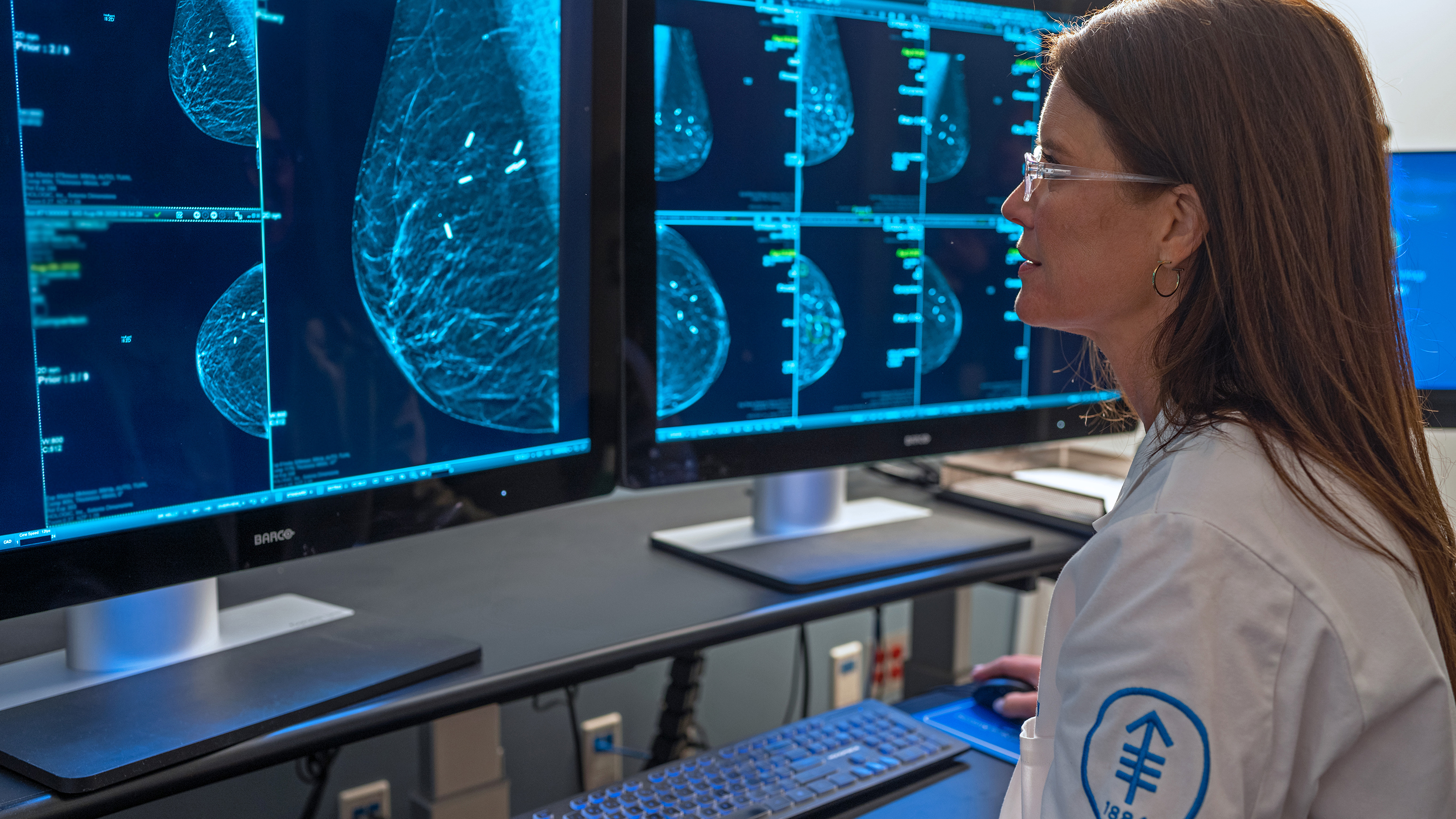
Mammography is the diagnostic examination of the breast using low-dose x-rays. Annual mammogram screenings have been shown to reduce significantly the number of women dying from breast cancer in the age group 40 years and older. Until fairly recently, all mammograms used the conventional film-based technique, which utilizes x-rays to produce an image of the breast on film. Introduced in the US in 2001, digital mammography also uses x-rays but captures the image on a computer, where it can be viewed and manipulated for contrast. While finding no significant difference between the two techniques when applied to the general population and for most women over 50, studies have shown that digital mammograms detected more tumors in three specific groups: women under 50, women with dense breasts, and women not yet in menopause.
Ultrasound, also known as ultrasonography, is an imaging method in which high-frequency sound waves are used to create images of blood vessels, tissues, and organs including the breast. Breast ultrasound is often used to evaluate breast abnormalities that are found during mammography or a clinical breast exam. The accuracy of breast ultrasound is highly dependent on the skill level and training of the ultrasound technician. This creates an increased risk of false positives, requiring follow-up exams and biopsy — which can be expensive and lead to unnecessary anxiety for the patient.
Magnetic resonance imaging (MRI) is a diagnostic procedure that uses a magnetic field to provide three-dimensional images of internal body structures, including the breast. MRI is expensive and requires the injection of intravenous contrast dyes. Recent studies of women with an inherited risk of breast cancer have shown that MRI has a higher sensitivity in detecting breast cancers than other screening methods. However, there are no study data showing that MRI screening reduces the number of breast cancer deaths.
Our doctors recommend different breast cancer screening guidelines based on four distinct risk categories: women of average risk; women with at least one first-degree relative (i.e. parent or sibling) affected by breast cancer; women who have received a diagnosis of atypical hyperplasia (a form of benign breast disease) or lobular carcinoma in situ (cancers that are confined to the milk duct or lobule); and women with a history of mantle radiation (radiation received during treatment for Hodgkin disease).