Researchers at Memorial Sloan Kettering Cancer Center (MSK) and their colleagues have discovered that a type of rogue DNA found in aggressive cancers has a hidden structural weakness — and that blocking a single repair protein can cause it to fall apart, suggesting a new therapeutic opportunity.
This rogue DNA is called extrachromosomal DNA, or ecDNA, and it is found in roughly 1 in 6 human cancers. ecDNA are circular pieces of DNA that sit outside normal chromosomes and drive the amplification of cancer-causing genes.
The presence of ecDNA has been linked to faster tumor growth, resistance to treatment, and poorer survival — but scientists haven’t been clear on how cancer cells manage to keep this unstable DNA intact.
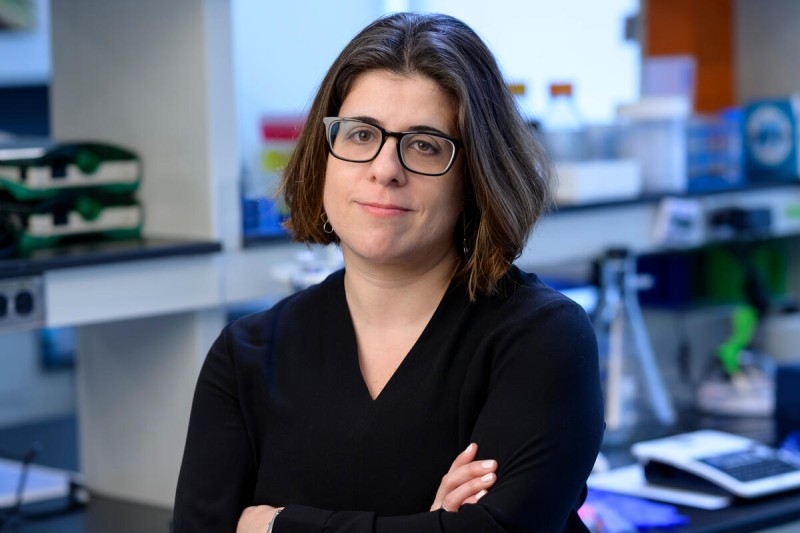
Now the lab of Agnel Sfeir, PhD, at MSK’s Sloan Kettering Institute and collaborators have uncovered a two-part protection system that cancer cells use to prevent and repair breaks in ecDNA. Further, they show that ecDNA carries a structural vulnerability that could potentially be targeted therapeutically. Their findings were published September 23 in Nature.
Finding ecDNA’s structural weakness
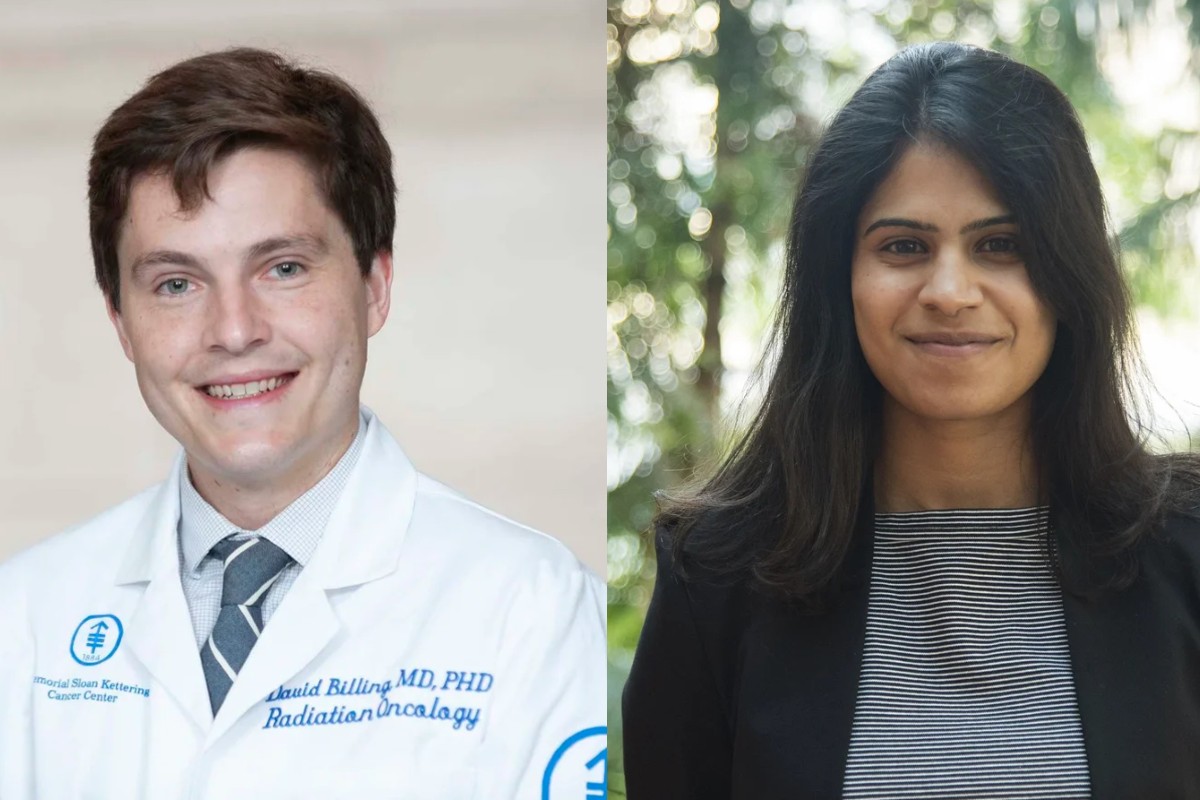
The team — co-led by radiation oncologist David Billing, MD, PhD, and graduate student Monica Selvaraj — found that repetitive sequences in ecDNA are structural weak points where it is prone to breaking.
Specifically, the team identified stretches of alternating T and A letters in the DNA code — called TA repeats — that tend to fold into unusual, cross-shaped structures. These structures are particularly fragile, leading to breaks that the cancer cell must repair quickly.
“We were surprised to find that ecDNA has a built-in fragility,” Dr. Sfeir says. “The circular shape that allow genes to rapidly amplify and that give cancer cells a growth advantage are also inherently prone to breaking. That means cancer cells depend on repair to keep them intact, and that dependency is something we may be able to exploit.”
Uncovering ecDNA’s two-pronged repair system
Cancer cells depend on a key repair protein — polymerase theta, or Polθ — to patch these breaks and keep ecDNA stable, the researchers found. They also identified a second protein called FANCM that serves as a first line of defense by preventing breaks from forming in the first place.
Together, the two proteins act as a two-pronged protection system: FANCM smooths out the problematic DNA structures before they break, while Polθ fixes breaks after they happen.
When the researchers blocked Polθ with an experimental inhibitor, ecDNA became unstable, accumulated damage, and was progressively lost from cancer cells — while cells without ecDNA were largely unaffected. The team saw this effect across several cancer cell lines, including prostate, gastric, and colorectal cancers.
And the findings appear to hold true beyond the lab, too. An analysis of large human tumor sequencing datasets showed that the same TA repeat regions where breaks cluster are also common sites for DNA rearrangements in patient tumors across multiple cancer types.
Toward clinical applications
Together, the findings suggest that Polθ inhibitors — several of which are already in clinical development — could offer a targeted strategy to destabilize ecDNA and potentially help overcome therapy resistance in some of the hardest-to-treat cancers.
And combining a Polθ inhibitor with depletion of FANCM had an even stronger effect, the researchers note, additionally pointing toward possible combination therapy strategies.
“This gives us a new way to think about targeting ecDNA,” says Dr. Sfeir, who holds the PaineWebber Chair in Cancer Genetics at MSK. “There’s still much to learn, but we’re excited to see where the discovery of this vulnerability can take us.”
Additional authors, funding, and disclosures
Additional authors on the paper include: Megan E. Kelley, Benton Bailey, Alessandra Brambati, Oluchi Ezekwenna, Ashley Nichols, Yi-Zhen Jiang, Lucia Wang, Shih-Chun Wang, Davide Pradella, Andrea Ventura, John Maciejowski, Andrew McPherson, and Sohrab P. Shah, of MSK.
Gabriel Matos-Rodrigues, Gang Zhen, Elsa Callen, and Andre Nussenzweig, of the Laboratory of Genome Integrity at the National Cancer Institute.
Finnja Becker, Elias Rodriguez-Fos, and Anton George Henssen, of the Experimental and Clinical Research Center at the Max Delbrück Center and Charité Berlin in Berlin.
And Marie-Claude Mathieu, Hugo Poirier, Stephen J. Morris, Michal Zimmermann, and Michael Zinda, of Repare Therapeutics.
This work was supported by grants from the National Cancer Institute (R01CA229161, U01CA231019, F32CA298730-01, R37CA261183, R01CA270102, RM1HG011014, R01CA281928-01, U24CA264028, P30CA08748); the MSK’s Halvorsen Center for Computational Oncology; a Cancer Grand Challenges partnership funded by Cancer Research (CGCATF-2021/100017) and the National Cancer Institute (OT2CA278644); the Deutsche Krebshilfe Mildred Scheel Professorship program (70114107); the European Research Council under the European Union’s Horizon 2020 research and innovation program (949172); and the Deutsche Forschungsgemeinschaft (377984878).
The work utilized MSK’s Integrated Genomics Operation and Flow Cytometry Core.
The Polθ inhibitor used in the study, RP-2119, was developed by Repare Therapeutics. Dr. Sfeir was a co-founder, consultant, and shareholder of Repare. Marie-Claude Mathieu, Hugo Poirier, Stephen J. Morris, Michal Zimmermann, and Michael Zinda are former employees of Repare. Dr. Henssen is a founder, consultant, and shareholder of Econic Biosciences.
Read the study: “MMEJ repair of breaks at TA repeats maintains ecDNA and cancer fitness,” Nature. DOI: 10.1038/s41586-026-11048-8